
San Fermín 1980: Eight Mornings, Two Deaths, and a New Spain
July 6 to 14, 1980. Eight mornings of encierros including the deadliest single run in a generation on July 13, when one bull killed two men before the peñas had finished their morning wine.
Looking Back at 1980
Looking back at 1980, the San Fermín festival sits at a particular crossroads in modern Spanish history. Spain’s 1978 constitution had only just been ratified, and Pamplona was still learning what it meant to celebrate freely after four decades under Franco. The fiesta carried a charged energy that year, something beyond the usual mix of fear and exhilaration on Estafeta Street. People were testing the edges of their new freedoms, and the encierro was one arena where that energy had nowhere to hide.
Looking back at July 13, 1980, the record is stark. A single bull, Antioquío, number 17 from the Guardiola Fantoni herd, killed two men in the same run. That had not happened in a single encierro since 1977. The two men, José Antonio Sánchez Navascués from Cintruénigo and Vicente Eladio Risco Sierra from Badajoz, were 26 and 29 years old. The run did not stop. The fiesta continued. That is what the encierro has always done, and understanding that fact is the beginning of understanding San Fermín.
Dennis Clancey, Founder, Encierro
The Encierro in a Transitional Spain
By 1980, Spain had moved through its transition from dictatorship with remarkable speed but uneven results. Francisco Franco died in November 1975. The 1978 constitution established a parliamentary monarchy. But in Navarra and the Basque Country, the transition was shadowed by ETA’s ongoing campaign of bombings and assassinations. In 1980 alone, ETA killed more than 90 people across Spain, making it the deadliest year of the organization’s history. Pamplona was not outside this reality. Navarra’s political status remained contested, and the fiesta unfolded against a backdrop that mixed genuine democratic euphoria with real anxiety about political violence.
The international crowd at San Fermín in 1980 was growing, partly thanks to the long shadow of Hemingway but also because Spain itself had become newly accessible. Tourism was climbing. The red and white crowds on the streets of the old city included more foreign runners than in any previous generation, many of them with little knowledge of the ganaderías whose bulls they were about to chase. This combination – loosening Spanish identity, international curiosity, political tension, and the ancient ritual of the run – made 1980’s festival a compressed version of everything that San Fermín has always been.
“The encierro does not distinguish between a democracy and a dictatorship. The bulls run. The street narrows. What happens next is entirely yours.”
Every 1980 Encierro, Day by Day
Each run with its ganadería, approximate time, and horn injuries. The route runs approximately 849 meters from Santo Domingo to the ring. No video recordings of the 1980 encierros are available online.
Conde de la Corte
Gored: see year total
Conde de la Corte bulls from Badajoz have a reputation for running in a cohesive pack, moving with purpose rather than erratic aggression. The first run of any fiesta carries its own nervous electricity, and the 1980 opening was no different: a crowd testing the route again after a year away, and bulls that gave them a relatively clean passage through to the ring.
César Moreno
Gored: see year total
César Moreno bulls are compact and quick through the narrow sections of the route. The second run drew a crowd beginning to settle into the week’s rhythm, with experienced runners starting to identify their preferred positions along the route.
Fermín Bohórquez
Gored: see year total
The Bohórquez herd carries Portuguese bloodline influence, and the bulls tend to show a particular alertness through the turns. The third run often separates the serious runners from those treating the encierro as pure spectacle, and Bohórquez bulls have a way of clarifying that distinction quickly.
Miura
Gored: see year total
The most feared name in bullfighting history, Miura bulls are tall, athletic, and long-horned, bred at a historic ranch in Lora del Río on the Guadalquivir. Placing Miura fourth rather than in the traditional final slot was unusual, and it forced runners who had planned for the closing-day intensity to recalibrate their expectations mid-week. The bulls did not disappoint those expectations of difficulty.
Dolores Aguirre
Gored: see year total
Dolores Aguirre is one of the celebrated female ganaderas in the corrida tradition, and her bulls carry a size and strength that commands respect on the course. The fifth run came after Miura’s fourth-day appearance, and experienced runners spent the day recalibrating after the mid-week challenge the Miura herd had presented.
Marqués de Domecq
Gored: see year total
Domecq bulls from Jerez are known for running in an orderly pack, moving through the streets with a collective momentum that experienced runners can read and position around. The sixth run carries the weight of accumulated fatigue from the week, and Domecq’s relatively legible behavior offered a window of clarity before the final days.
Guardiola Fantoni
Gored: 2 fatal + additional injuries
On the morning of July 13, a Guardiola Fantoni bull designated number 17, named Antioquío, became separated from the main pack before the Plaza del Ayuntamiento. A separated bull is the most dangerous condition in an encierro. Antioquío gored José Antonio Sánchez Navascués, 26, from Cintruénigo, near the Plaza del Ayuntamiento. Vicente Eladio Risco Sierra, 29, from Badajoz, was gored inside the bullring itself. Both men died from their wounds. It was the only double fatality in a single encierro since 1977.
Albaserrada
Gored: see year total
Albaserrada bulls from Salamanca are medium-sized and known for speed through the straights. The closing run carries the weight of everything that came before it, and in 1980 that weight was heavier than most years. Pamplona said goodbye to the fiesta and to two men it had lost three days earlier.
What the Record Remembers
San Fermín 1980 Official Poster
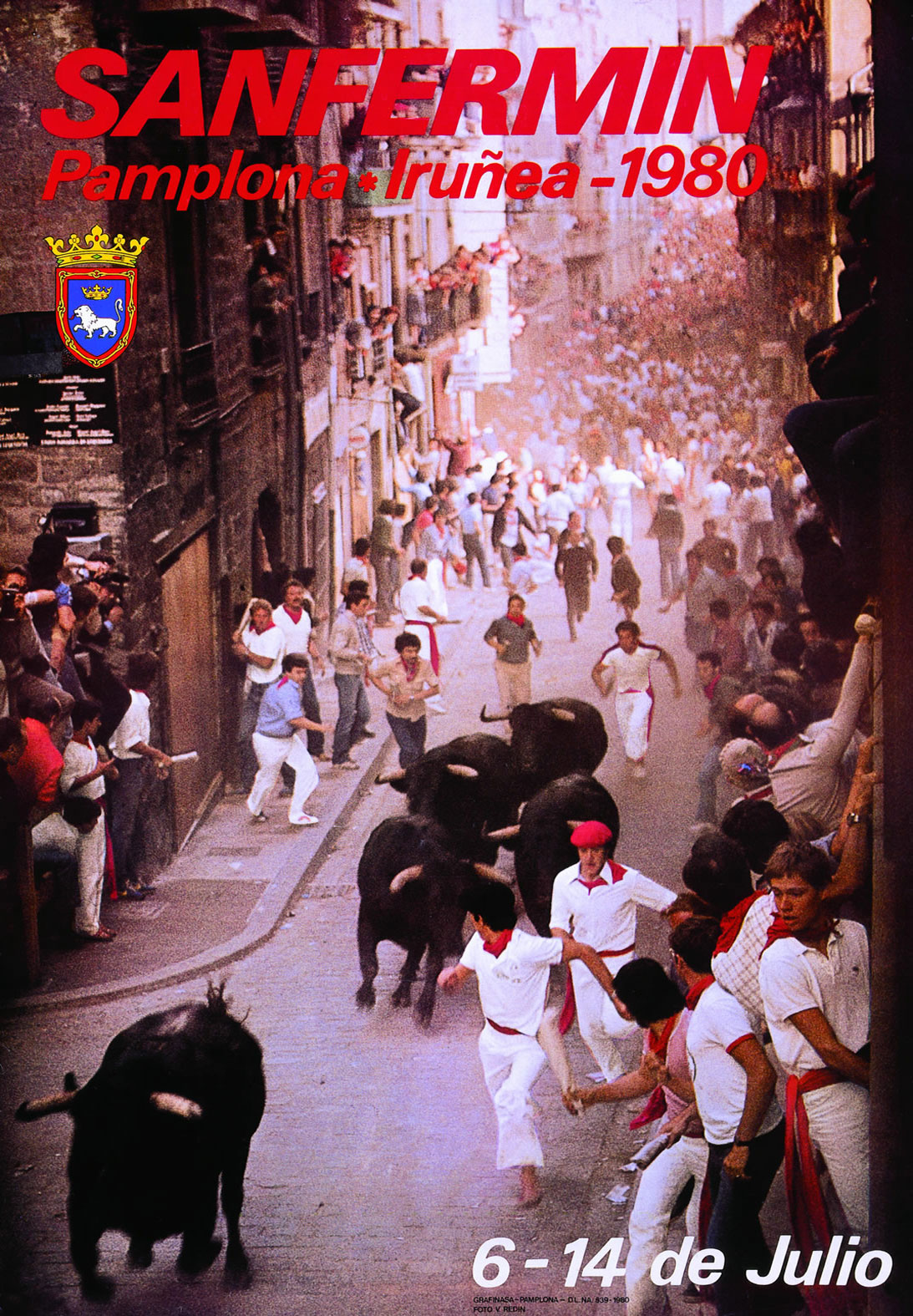
Cartel 1980 by Valentín Redin.
Valentín Redin’s 1980 cartel for San Fermín follows the visual language that defined Navarran festival posters of the era: bold primary colors anchored in red and white, the traditional figure of the runner or the bull rendered with strong graphic lines rather than photographic detail. The lettering carries the confident typography of late-1970s Spanish design, a moment when the country was developing its own post-Franco visual identity while still reaching back to older regional traditions. The overall effect is declarative – this is the fiesta, this is the year, here are the colors of Navarra, come and see.
Source: Ayuntamiento de Pamplona, cartel archive
Selected as the official poster of Sanfermines 1980 through Pamplona’s annual concurso de carteles.
The City in 1980
Pamplona in July 1980 was a city wearing two faces simultaneously. Five years after Franco’s death, the freedoms encoded in the 1978 constitution were still being discovered in practice rather than theory: the right to assemble, to demonstrate, to celebrate without the regime’s hand on the dial. The fiesta expanded into that space with something between relief and ferocity. But Navarra’s proximity to the Basque conflict, and ETA’s record-breaking violence that year, meant that the crowds in the streets were also crowds living inside a serious political moment.
The red-and-white frenzy of the peñas carried genuine joy, and underneath it carried genuine uncertainty about what Spain was becoming. The encierro itself, unchanged for centuries, offered the strange comfort of a ritual older than all of it. The chupinazo opened the fiesta at noon on Saturday, July 6, 1980, from the balcony of the Pamplona town hall. The Pobre de Mí at midnight on July 14 brought the 1980 fiesta to its close, three days after its darkest morning.
How 1980 Came Together
Key facts in the 1980 fiesta, kept on the record.
Chupinazo: the rocket fires from the balcony of City Hall, opening the fiesta and releasing the crowd into the old city.
Miura runs fourth, departing from tradition and forcing experienced runners to recalibrate their week. The most feared name in the encierro placed mid-week rather than in the closing slot.
Guardiola Fantoni’s bull Antioquío kills two men in a single run – the only double fatality in a single encierro since 1977. José Antonio Sánchez Navascués, 26, from Cintruénigo, and Vicente Eladio Risco Sierra, 29, from Badajoz, both die from their wounds.
Albaserrada closes the 1980 fiesta. Pamplona returns to ordinary time three days after its darkest morning. The Pobre de Mí ceremony at midnight marks the end of the festival.
San Fermín 1980, Answered
Which bull caused the 1980 deaths?
A bull named Antioquío, number 17 from the Guardiola Fantoni herd, separated from the pack during the July 13 run. A separated bull is the most dangerous scenario in the encierro, and Antioquío killed two men: one on the route near the Plaza del Ayuntamiento and one inside the bullring itself.
Who were the two men killed in 1980?
José Antonio Sánchez Navascués, 26 years old, from Cintruénigo in Navarra, and Vicente Eladio Risco Sierra, 29, from Badajoz in Extremadura. Both died from wounds inflicted by the same bull during the seventh run of the festival.
Why did Miura run fourth rather than last in 1980?
Scheduling decisions at San Fermín are made by the festival’s organizers in coordination with the ganaderías, and the specific reasoning for placing Miura in the fourth slot in 1980 is not publicly documented. It was a departure from tradition that affected how experienced runners planned their week, since Miura is typically held for the closing run.
How did the 1980 tragedy affect the rest of that year’s fiesta?
The fiesta continued after July 13, as it always does. The encierro on July 14 went ahead with Albaserrada bulls, and the peñas and street celebrations continued through the closing ceremony. San Fermín’s protocol does not include suspension for deaths during the run. What the tragedy altered was the atmosphere: participants and observers reported a solemnity in the final day that the preceding days had not carried.
Planning your own run?
The 1978 San Fermín offers a window into the fiesta’s first years after Franco’s death, when the political energy in Pamplona was at its most charged. The 1981 festival brought its own moment of Spanish history crashing into the encierro’s orbit, just months after the February coup attempt that nearly ended Spain’s democratic transition. Both years are documented at encierro.com.