
San Fermín 1981: Eight Clean Runs and a City Determined to Prove Something
July 6 to 14, 1981. Eight clean runs, no deaths, and a city determined to prove that the tragedy of 1980 had not broken the oldest continuous street-running tradition in Spain.
Looking Back at 1981
Looking back at 1981, what strikes me most is how much weight the city was carrying before a single bull left the corral. The 1980 festival had ended with deaths on the course, and in a city where memory is long and the encierro is treated as something sacred, that kind of loss does not simply reset when the calendar turns. The question going into July 1981 was not whether the fiesta would happen – it always does – but whether it could feel like itself again. By all accounts, it did.
Looking back at 1981 also means looking at Spain itself. The country had survived a military coup attempt in February, the Tejerazo, and was still working out what democracy looked like in practice. The festival arrived in summer as something more than a party. It was a statement that ordinary life could continue, that Pamplona belonged to its people and to the runners from around the world who came to test themselves on the cobblestones of Calle Estafeta. Eight runs, eight ganaderías, and when Marqués de Domecq’s bulls came through on July 14, the city exhaled.
Dennis Clancey, Founder, Encierro
A Coup Attempt, a Grief Still Fresh, and Eight Days of Running
Spain in the spring of 1981 had been shaken to its foundations. On February 23, Lieutenant Colonel Antonio Tejero led armed Civil Guards into the Congreso de los Diputados and held the entire Spanish parliament at gunpoint for eighteen hours. King Juan Carlos I addressed the nation on television late that night, backing the constitutional government. By morning the coup had collapsed, but the memory of those hours – the footage of deputies diving under their benches – did not fade quickly. When summer arrived and the country turned toward its festivals, there was something deliberate about the celebration.
The emotional context of the 1980 deaths added another layer. Two runners had died in 1980, and in the tight community of serious encierro participants, those losses meant something personal. Organizers, local runners, and the Peñas that animate the street celebrations had spent months processing both the grief and the scrutiny that followed. The 1981 festival was, in that sense, an act of return rather than simple repetition. Everyone involved understood what it meant to get through eight encierros cleanly.
“The encierro is not a spectacle designed for comfort. It is a negotiation between a runner and an animal that outweighs him by six hundred kilograms, conducted at full speed on a street built for neither of them.”
Every 1981 Encierro, Day by Day
Each run with its ganadería, approximate time, and horn injuries. The route runs approximately 849 meters from Santo Domingo to the ring. Only the July 14 closing run has surviving video footage.
Pablo Romero
Gored: see year total
Pablo Romero bulls carry centuries of breeding toward size and power, and the first run of 1981 set the festival’s tone accordingly. These are large, traditional animals from Seville with deep bloodlines that predate most of the modern ganadería families, and their presence on the opening morning announced that the 1981 fiesta was not planning to be timid.
Julio Aguirre
Gored: see year total
Julio Aguirre brought a more unpredictable profile to the second morning. The second run of any festival tends to draw runners who missed July 7 or who are settling into their approach for the week, and the Aguirre bulls rewarded attention and punished hesitation.
Fermín Bohórquez
Gored: see year total
Bohórquez is a name associated with Portuguese bloodline influence through the Cádiz corridor, and that heritage shows in the movement of these bulls: athletic, reactive, and capable of sudden direction changes that challenge runners who rely on straight-line speed rather than lateral awareness. The third run in any festival week often belongs to runners who have found their rhythm.
Conde de la Corte
Gored: see year total
The Conde de la Corte bulls from Extremadura have a reputation for running in relatively orderly formation, which sounds like a small mercy until you remember that orderly still means six animals each weighing over half a metric ton moving at roughly twenty-five kilometers per hour through a street barely wide enough for two cars. The July 10 run was, by the standards of the week, considered well-managed.
Miura
Gored: see year total
Miura bulls are the most discussed animals in encierro history – tall, athletic, long-horned, bred by the Miura family in Lora del Río since the nineteenth century and associated with more deaths in the bullring than any other ganadería in Spain. In 1981, Miura ran fifth rather than closing the festival. The July 11 run drew the largest concentration of serious participants of the week’s early runs.
Albaserrada
Gored: see year total
Albaserrada comes from Salamanca, the breeding heartland of central Spain – medium-sized bulls known for speed rather than mass. The Salamanca profile means animals that accelerate quickly through the narrow sections of the course and move with a compactness that catches runners accustomed to tracking the larger Andalusian breeds. The sixth run fell on a Sunday in 1981, historically drawing large crowds to the barricades.
Conde de la Maza
Gored: see year total
July 13 in 1981 carried specific weight. It was the anniversary of the deaths that had marked the 1980 festival on the same date, and the encierro community was acutely aware of it. The Conde de la Maza bulls ran cleanly, and that clean run meant something beyond the usual measure of a day on the course. There is a kind of collective memory on the Pamplona street that does not appear in official records, and it was present on this morning.

Marqués de Domecq
Gored: see year total
Marqués de Domecq bulls from Jerez are associated with orderly pack running – animals that stay grouped through the course, rewarding runners who position themselves within or alongside the herd. The July 14 run closed the 1981 festival without incident, and after everything the city had carried into that week, the absence of incident was itself the story.
What the Record Remembers
Official Poster of San Fermín 1981
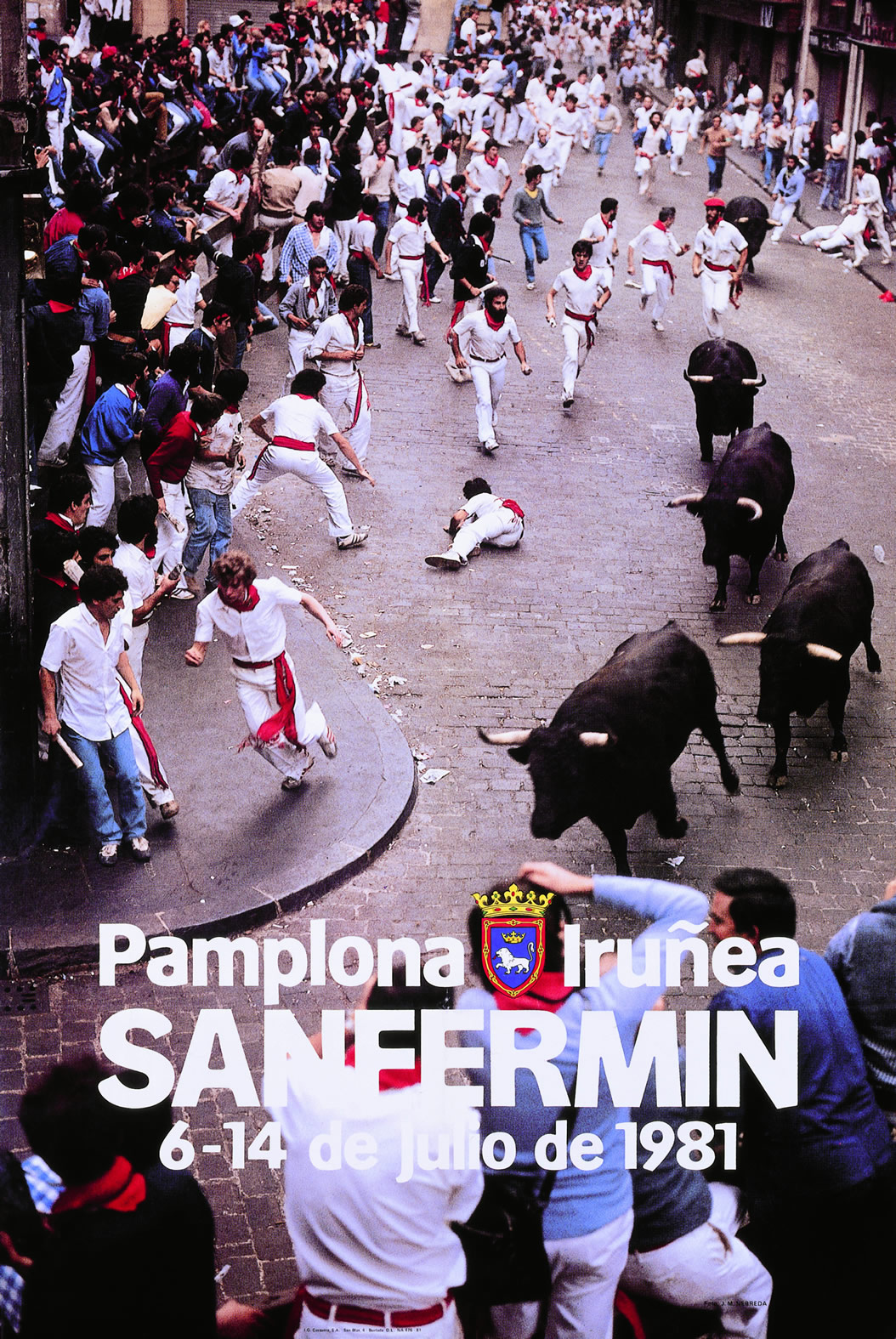
Cartel 1981 by José Mª Nebreda.
The 1981 official poster by José Mª Nebreda follows the graphic conventions of early-1980s Navarran festival art: flat planes of color, a dominant figure rendered in strong outline, and a palette drawn from the red and white of San Fermín itself. Nebreda’s work in this period leaned toward bold compositional choices over decorative detail, consistent with the poster design language that Pamplona had developed since the 1960s. The typography places the festival name and dates in the heavy block lettering characteristic of the era, readable from across a plaza. The overall effect is confident rather than ornate – a poster that announces rather than invites.
Source: Ayuntamiento de Pamplona, cartel archive
The official San Fermín 1981 cartel was chosen via the city’s annual poster contest, the concurso de carteles.
The City in 1981
Pamplona in the summer of 1981 was a city reasserting itself on two fronts simultaneously. The February coup attempt had reminded every Spaniard that the democratic gains of the post-Franco years were not automatically permanent, and the collective relief of its failure had not yet fully absorbed into daily life by the time July arrived. Layered over that was the memory of the 1980 festival deaths, which had reopened arguments about whether the encierro could continue in its traditional form.
What the city produced in response was a festival that ran its eight encierros without a death, drew its usual million visitors, and demonstrated in the most practical terms available that Pamplona’s oldest public tradition belonged to the people who ran it. The chupinazo at noon on July 6 drew the crowds it always drew. The Pobre de Mí at midnight on July 14 closed the fiesta without incident – which in 1981 felt like something the city had earned.
How 1981 Came Together
Key facts in the 1981 fiesta, kept on the record.
Chupinazo launches the 1981 San Fermín festival at noon in the Plaza del Ayuntamiento. The rocket goes up, the crowd in red and white responds, and eight days of encierros begin.
Miura runs in the fifth position rather than the traditional closing slot. The tallest, most long-horned bulls on the circuit move through the course on a Saturday morning, drawing the week’s most serious concentration of experienced runners.
One year to the date after the deaths that marked the 1980 festival, Conde de la Maza bulls complete the seventh encierro cleanly. The anniversary weight is acknowledged by those who carry it, and the course closes without serious injury.
Marqués de Domecq bulls from Jerez complete the eighth and final encierro of the 1981 festival. The closing run ends the festival without incident – a result that, in the context of this particular year, felt like everything.
San Fermín 1981, Answered
What was different about the 1981 fiesta compared to 1980?
The most significant difference was the absence of deaths. The 1980 festival had ended with two fatalities on the course, which placed the 1981 encierros under heightened scrutiny from participants, organizers, and the press. The 1981 festival ran all eight encierros cleanly, with no deaths and approximately four gorings across the week – a result that felt significant precisely because of what 1980 had been.
Why did Miura not close the 1981 encierro?
Miura’s placement in the closing slot was a tradition rather than a fixed rule, and in 1981 the scheduling placed them fifth, on July 11. Ganadería selection and sequencing involves practical negotiations around availability and organizational preference. Marqués de Domecq from Jerez ran the closing encierro on July 14.
What political events cast a shadow over the 1981 San Fermín?
The February 23 Tejerazo, in which Lieutenant Colonel Antonio Tejero led armed Civil Guards in seizing the Spanish parliament at gunpoint, was the defining political event of that year. The coup collapsed after King Juan Carlos backed the constitutional government, but the footage of the attack had played on television for weeks and the question of Spain’s democratic stability was not settled by the time the festival arrived in July.
Which ganadería closed the 1981 fiesta?
Marqués de Domecq, from Jerez in the sherry country of Andalusia, closed the 1981 San Fermín with the eighth and final encierro on July 14. Their bulls are known for running in a cohesive pack, a characteristic that tends to produce fast, relatively orderly closing runs.
Planning your own run?
The 1981 festival cannot be understood without knowing what came before it: explore the 1980 encierro to trace the losses that made 1981’s clean week so significant, or move forward to 1982 to see how Pamplona built on the relief of a year without tragedy.