
San Fermín 1982: The Year the Encierro Went National
July 6 to 14, 1982. RTVE broadcast the San Fermín encierro live on Spanish national television for the first time, pulling the running of the bulls out of Pamplona’s streets and into living rooms across the country.
Looking Back at 1982
Looking back at 1982, it is hard to overstate what the RTVE live broadcast meant for the encierro. Until that July, the run was something you either witnessed in person or heard about secondhand. A radio description, a newspaper account, a postcard from a friend who had been to Pamplona. The television camera changed the equation entirely. For the first time, a family in Seville or Bilbao or Madrid could watch the gates open at Santo Domingo and see the bulls come around the curve at Mercaderes in something close to real time. The fiesta did not change, but its audience multiplied overnight.
Looking back at 1982, the timing also mattered in ways that went beyond the encierro itself. Spain was hosting the FIFA World Cup that summer, and the country was projecting itself to an international audience with a confidence that felt earned. Democracy was taking hold, the economic picture was brightening, and the national mood carried a forward momentum that showed up everywhere – including in a broadcast decision by RTVE to put cameras on the streets of Pamplona and let the whole country watch. That decision was a milestone in the history of the fiesta, and the 1982 festival deserves to be understood in that light.
Dennis Clancey, Founder, Encierro
The Broadcast Milestone and the World Cup Summer
The RTVE broadcast of July 1982 was not a casual scheduling choice. It reflected a deliberate effort by Spanish public television to document and share a piece of national culture that had long been the province of Navarra and the foreign aficionados who made the pilgrimage to Pamplona each July. Putting live cameras on the encierro route required coordination with the city, with the Policia Municipal, and with the organizers of the fiesta. The result was a broadcast that introduced millions of Spaniards to the specific grammar of the run: the anxious wait at the corral, the rocket that signals the bulls’ release, the compression of runners through the narrow streets, and the final sprint into the Plaza de Toros.
The summer of 1982 was already freighted with national significance before the first chupinazo went up. Spain hosted the FIFA World Cup from June 13 to July 11, with matches in Madrid, Barcelona, Seville, Valencia, and seven other cities. The national team did not advance past the second round, but the hosting itself was a statement of arrival on the world stage. When San Fermín began on July 6, just days after the World Cup final in Madrid, the national mood was one of open celebration.
“The encierro had always belonged to those who could get to Pamplona. After 1982, it belonged to Spain.”
Every 1982 Encierro, Day by Day
Each run with its ganadería, approximate time, and horn injuries. The route runs approximately 849 meters from Santo Domingo to the ring. The 1982 fiesta was the first year broadcast live on Spanish national television – several runs have surviving footage on YouTube.

Conde de la Corte
Gored: see year total
The Conde de la Corte bulls from Badajoz opened the 1982 fiesta in orderly fashion, described by observers as well-behaved and consistent through the route. This opening run is historically significant as the first encierro captured by RTVE’s live cameras. Footage from this day survives on YouTube, offering a direct visual record of what television audiences across Spain watched that morning.

Albaserrada
Gored: see year total
The Albaserrada bulls from Salamanca brought a fast, medium-sized herd through the course on the second morning. Fast bulls from Salamanca tend to compress the action, reducing the time runners have to position themselves, and Albaserrada’s reputation for speed was consistent with their performance that week.

Samuel Flores
Gored: see year total
Samuel Flores bulls ran the third morning of the 1982 fiesta. This ganadería has long been associated with strong, evenly matched animals, and their appearance in the middle of the festival schedule gave runners a mid-week test of a consistent, well-known herd.
Hernández Barrera
Gored: see year total
Hernández Barrera provided the bulls for the fourth morning. The mid-festival runs in this era often drew large crowds of runners emboldened by days of experience, and the fourth day typically sees the encierro at its most densely packed, with both veterans and newcomers sharing the route through Estafeta.

Pablo Romero
Gored: see year total
Pablo Romero from Seville sent large, powerful bulls through Pamplona on the fifth morning – the day that also marked the close of the 1982 FIFA World Cup final in Madrid. Pablo Romero animals are consistently among the largest and most physically imposing to run the course, and their presence on the fifth day guaranteed a serious test for anyone in the street that morning.

Ortega Sánchez
Gored: see year total
Ortega Sánchez provided the sixth morning’s bulls. By the sixth day of the fiesta, the encierro draws runners who have found their rhythm and crowds who have settled into the week’s routines, and the Ortega Sánchez run unfolded within that established pattern of a festival moving toward its close.

Marqués de Domecq
Gored: see year total
The Marqués de Domecq bulls from Jerez ran the penultimate morning in orderly fashion, with observers noting a coherent pack that moved well through the course. Domecq animals from Jerez carry a reputation for running together rather than fragmenting, which generally produces a cleaner, more readable encierro for runners who know how to position themselves.

Miura
Gored: see year total
Miura closed the 1982 San Fermín fiesta, as they had done and would continue to do in the years that followed. What makes the 1982 closing run additionally significant is what did not happen: this was the start of a remarkable clean streak for Miura at Pamplona. From 1982 through 2000, Miura would complete their encierro appearances without goring anyone – an extraordinary run of safety from the bulls most expected to inflict damage.
What the Record Remembers
San Fermín 1982: Official Cartel
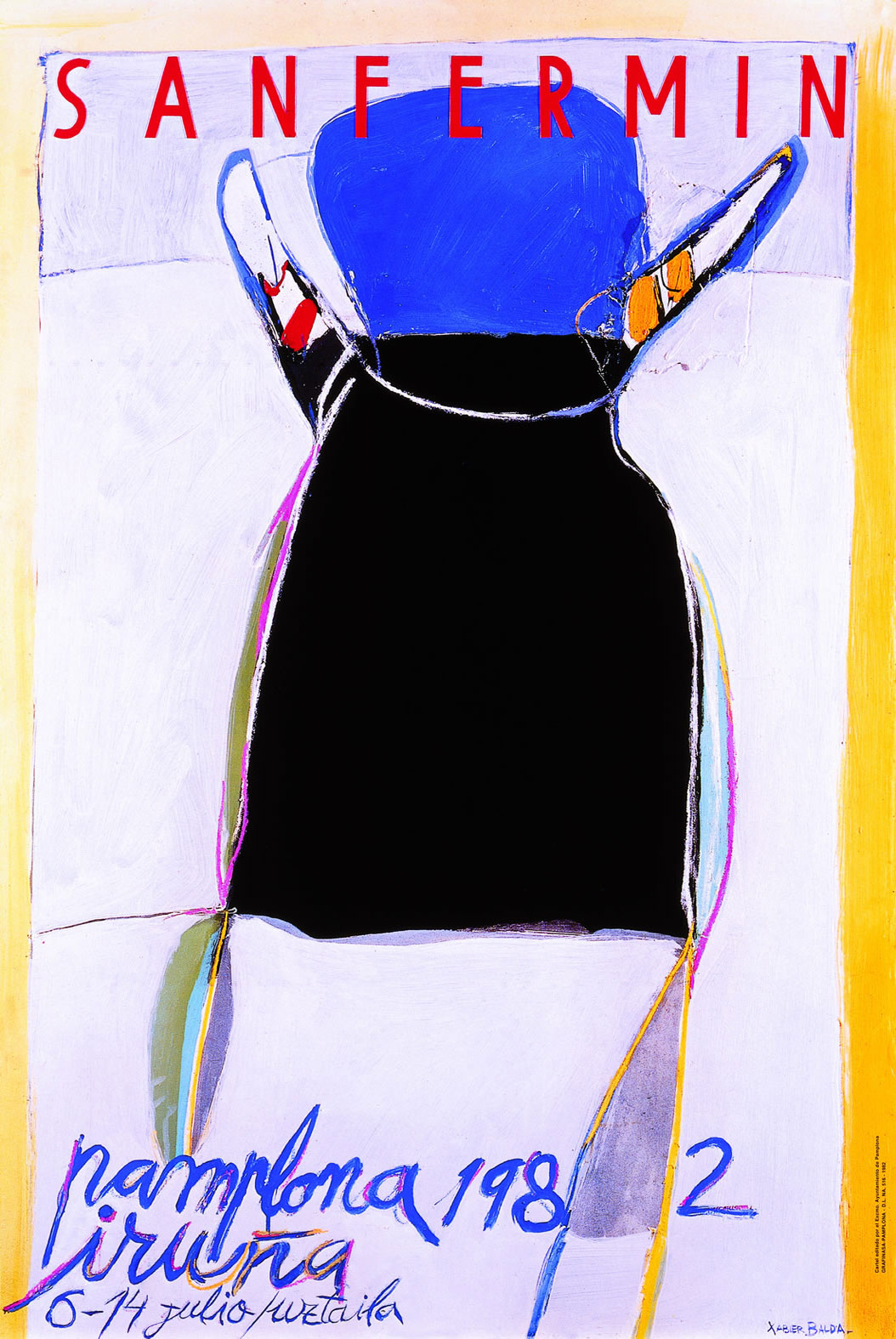
Cartel 1982 by Javier Balda Berastegui.
The 1982 San Fermín poster by Javier Balda Berastegui follows the conventions of Navarran festival graphic art in this era: bold primary colors anchored by red and white with stylized figures that suggest movement and celebration rather than document specific action. Balda Berastegui’s work reflects the influence of Spanish commercial illustration of the late Franco and early democratic period, where poster art for public festivals served both as civic announcement and as visual identity for the event itself. The 1982 cartel would have been reproduced at scale throughout Pamplona and distributed to tourist offices, hotels, and cultural centers across Navarra in the weeks before the festival opened.
Source: Ayuntamiento de Pamplona, cartel archive
Pamplona’s annual concurso de carteles selected this as the official Sanfermines poster for 1982.
The City in 1982
Pamplona in the summer of 1982 was a city with more eyes on it than usual. The World Cup had given Spain a sustained period of international visibility throughout June and into early July, and when San Fermín opened on July 6, the city absorbed a crowd estimated at around one million over the course of the week. The RTVE broadcast added a new layer to that attention, placing Pamplona on the national television schedule for the first time in the context of the encierro and introducing the fiesta to Spanish viewers who had no prior frame of reference for the streets, the bulls, or the runners.
Spain’s democratic consolidation was entering its second decade, the transition from the Franco years now far enough in the past to feel settled, and the 1982 festival carried the energy of a country that had moved through uncertainty and arrived at something more confident. The encierro, broadcast live on public television, was part of how Spain was telling itself its own story that summer. The chupinazo opened the fiesta on July 6, and the Pobre de Mí closed it at midnight on July 14.
How 1982 Came Together
Key facts in the 1982 fiesta, kept on the record.
Chupinazo fires at noon, opening the 1982 San Fermín festival from the balcony of the Pamplona town hall.
First run: Conde de la Corte bulls from Badajoz. RTVE broadcasts the encierro live on Spanish national television for the first time. Video footage of this run survives on YouTube (ID: A-m77fenpfg, Xabi1958 channel).
RTVE milestone: the entire encierro week broadcast live on Spanish national television, a first in the festival’s modern history.
Miura closes the 1982 fiesta. The start of an 18-year run in which Miura completes the San Fermín encierro without goring anyone, a streak lasting through 2000. The Pobre de Mí closes the festival at midnight.
San Fermín 1982, Answered
When did RTVE first broadcast the encierro live on Spanish national television?
RTVE broadcast the San Fermín encierro live for the first time in 1982, beginning with the opening run on July 7. The broadcast brought the running of the bulls to a national audience for the first time in the festival’s modern history and permanently changed the encierro’s place in Spanish popular culture.
What was significant about Miura closing the 1982 fiesta?
The 1982 Miura closing run on July 14 marked the beginning of an 18-year streak in which Miura completed the San Fermín encierro without goring anyone, lasting from 1982 through 2000. This is notable because Miura is historically the most feared ganadería in Pamplona, and their appearance at the end of the festival schedule is specifically intended to present the most challenging animals to the most experienced crowd.
What major sporting event was happening in Spain during the 1982 San Fermín?
Spain hosted the 1982 FIFA World Cup, which ran from June 13 to July 11. The tournament used venues across seventeen cities and represented Spain’s largest international sporting event since the country’s democratic transition. The World Cup final was played in Madrid on July 11, three days before San Fermín closed, meaning the two biggest events in Spain’s summer of 1982 overlapped during the festival week.
What is the earliest video footage available of the 1982 encierro?
The earliest known surviving video footage of the 1982 San Fermín encierro is from the July 7 opening run, featuring the Conde de la Corte bulls from Badajoz. The footage is available on YouTube under the video ID A-m77fenpfg, uploaded by the channel Xabi1958. This is also the run that RTVE broadcast live, making July 7, 1982 the first encierro in history to be watched on national television.
Planning your own run?
The 1982 festival sits between two years worth knowing: the 1981 edition that preceded RTVE’s broadcast milestone, and the 1983 fiesta that ran for the first time with the encierro already established as national television. Explore those years to follow the thread of how the run changed in the years around 1982.