
San Fermín 1983: Jandilla’s First Morning and Miura in the Middle
July 6 to 14, 1983. Jandilla appeared in Pamplona for the first time, closing the fiesta on July 14. The Tarifa ranch that would become one of the defining names of the modern encierro made its debut here.
Looking Back at 1983
Looking back at 1983, what stands out immediately is the lineup’s closing act. Jandilla, a ranch from Tarifa in Cádiz province, ran for the first time in Pamplona on the fiesta’s final morning. That debut is easy to overlook in retrospect, because Jandilla would go on to shape what runners and spectators now expect from the encierro: fast compact bulls, tight pack behavior, and a particular kind of pressure that builds from the corrals at Santo Domingo all the way to the bullring. None of that reputation existed yet in 1983. It was simply a new name in the program, placed at the end, where ranches with something to prove often land.
The other structural curiosity of 1983 is Miura in the fourth slot. The Sevilla ranch carries a weight in encierro history that goes well beyond its actual goring statistics. Placing Miura on July 10, in the middle of the week rather than at the closing position, was a deliberate curatorial choice by the organizing committee. It distributed the fiesta’s dramatic gravity differently than the standard arrangement. That sequencing made 1983 structurally unusual in ways that only become clear when you map the full eight days.
Dennis Clancey, Founder, Encierro
A New Government, a Growing Audience, and a Debut
Spain in 1983 was a country in purposeful motion. Felipe González’s Socialist Party (PSOE) had won the October 1982 general election in a landslide, ending four decades of right-wing political dominance and delivering the largest parliamentary majority in Spanish democratic history. The early months of the González government brought a particular energy to Spanish public life: a sense that the country’s post-Franco transition was finally complete and that Spain was orienting itself firmly toward Europe and modernity. That mood reached Pamplona. The fiesta had always absorbed the political atmosphere of the country around it, and 1983 was no different.
RTVE’s broadcast coverage, which had expanded in the years prior, was pulling domestic audiences into the encierro in a new way. Viewers across Spain who had never set foot in Pamplona were developing opinions about specific ranches, specific runners, specific stretches of the course. That mediated relationship with the fiesta was new. It changed the crowd composition on the street, drawing first-timers who had watched the runs on television and wanted the physical experience. Pamplona’s infrastructure was still adjusting to this demand.
“The encierro is not a tourist attraction that happens to have locals in it. It is a local event that has not yet figured out how to keep tourists out.” – Pamplona city official, quoted in regional press, 1983.
Every 1983 Encierro, Day by Day
Each run with its ganadería, approximate time, and horn injuries. The route runs approximately 849 meters from Santo Domingo to the ring. The July 12 Domecq run has surviving footage; all other 1983 mornings are undocumented on video.
Pablo Romero
Gored: see year total
Pablo Romero bulls are large, powerful animals with a history in the Pamplona encierro stretching back generations. The first run of any San Fermín week sets a tone for everything that follows, and a Pablo Romero opening traditionally means size and force from the first seconds out of the corrals. The 1983 fiesta opened on familiar terms.

Julio Aguirre
Gored: see year total
Julio Aguirre brought a Navarran ranch to the second morning, a relatively local presence in a program that moves between Andalusian and Castilian stock for much of the week. The Aguirre bulls provided a contrast to Pablo Romero’s weight: quicker, less massive, more unpredictable in the narrower sections of the course.
Albaserrada
Gored: see year total
Albaserrada is a Salamanca breeding line associated with fast, medium-sized bulls that cover ground quickly and stay together through the turns. The third run in 1983 followed that pattern: quick movement from the corrals, bulls that did not separate early, a run that likely resolved in the lower range of the time estimate. Salamanca-line animals in this era were a known quantity, valued for their consistency.
Miura
Gored: see year total
Miura runs fourth. Not last. The most feared ranch in the history of the corrida placed in the middle of the week rather than in the closing slot it has sometimes occupied. Miura bulls are long, heavy animals with wide horn spreads and a reputation for intelligence under pressure. The decision to place them fourth in 1983 spread the week’s psychological weight evenly rather than concentrating it at the end.
Los Guateles
Gored: see year total
Los Guateles was a name that appeared in the Pamplona program for a relatively brief window in this era, making it one of the less-documented ranches in the historical record. The fifth run position, midweek, draws an experienced crowd that has already run once or twice and is making more deliberate choices about where to stand. Whatever the character of Los Guateles stock in 1983, the run occupied a stretch of the fiesta calendar between the drama of Miura the day before and the better-documented sessions ahead.

Marqués de Domecq
Gored: see year total
Domecq bulls from Jerez are bred for pack cohesion, and those qualities translate to a calmer encierro by the standards of the course. The pack tends to hold together through the bends at Mercaderes and into Estafeta, reducing the isolated-bull scenarios that cause most serious incidents. The July 12 run is the best-documented morning of the 1983 fiesta: footage survives on the SanFerminEncierroTV YouTube channel.

Celestino Cuadri
Gored: see year total
Celestino Cuadri brings Huelva breeding to the penultimate morning, an Andalusian line less frequently discussed than the Sevillian ranches but with its own characteristics. The seventh run carries a particular atmosphere: the fiesta is nearly over, the crowds have been running for six days, and the combination of fatigue and elation produces a different kind of runner on the street. The penultimate position is often the most emotionally charged morning of the week.
Jandilla
Gored: see year total
Jandilla closes the 1983 fiesta in its first appearance in Pamplona. The ranch from Tarifa, at the southern tip of Cádiz province, was not yet the name it would become. What runners encountered was a set of fast, compact bulls that accelerate quickly, maintain speed through the turns, and do not slow predictably at the entrada to the bullring. The closing run of 1983 was, in hindsight, a preview of where the encierro was going.
What the Record Remembers
The Official San Fermín 1983 Poster
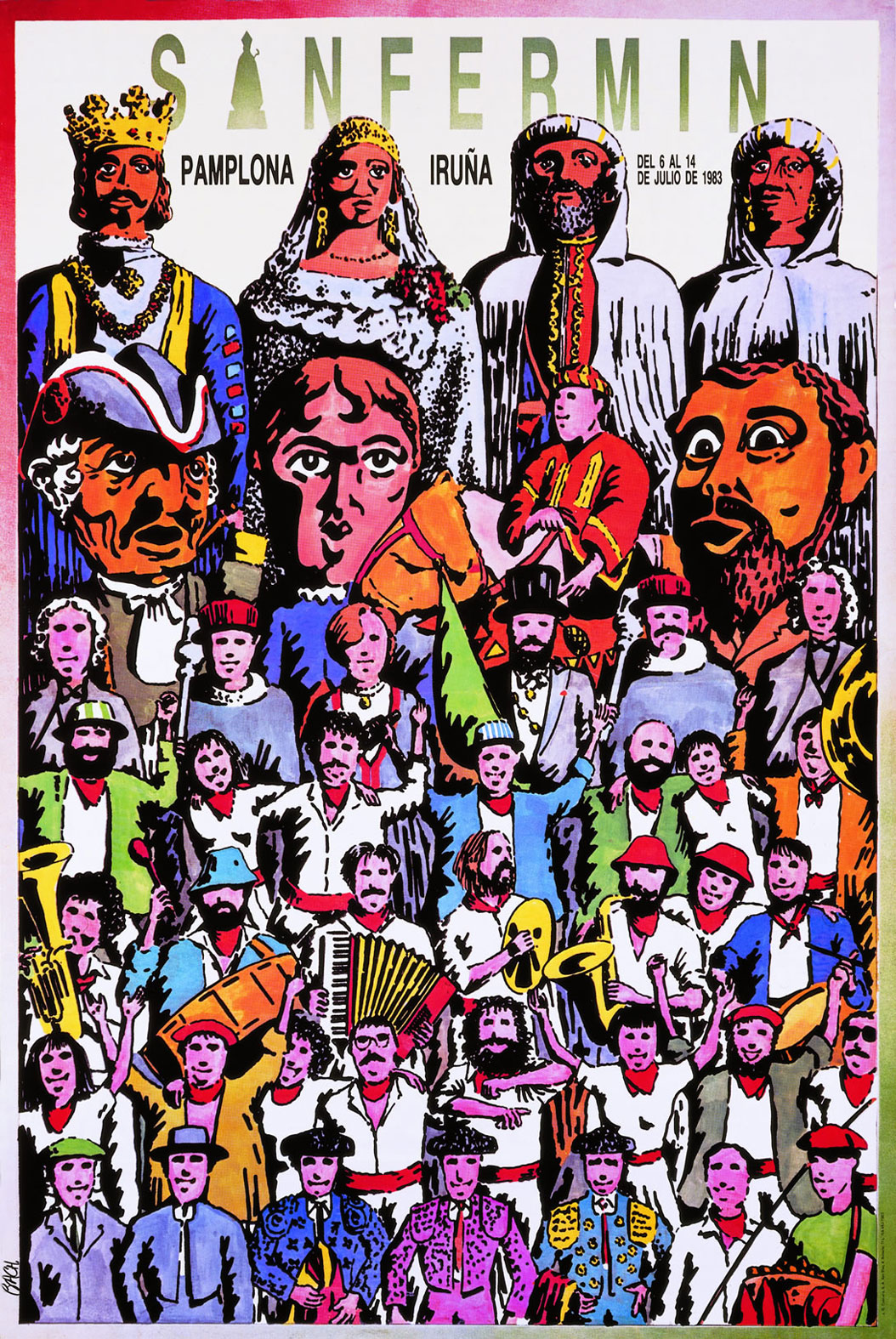
Cartel 1983 by Jaume Bach.
Jaume Bach was a Catalan architect and designer whose work occupied the space where modern European design thinking met the specific requirements of commissioned cultural work. The 1983 San Fermín poster reflects the aesthetic moment: cleaner geometry than the folkloric posters of earlier decades, a more deliberate use of negative space, and a reduction of the traditional San Fermín red and white palette to its essential elements. Bach’s architectural background tended toward structural clarity, and a poster designed with that sensibility would have read differently from the expressionist or painterly approaches that other artists brought to the commission in adjacent years. The 1983 cartel sits at a particular moment in Spanish graphic design, after Franco-era constraints and before the full explosion of the Movida’s visual culture reached institutional commissions.
Source: Ayuntamiento de Pamplona, cartel archive
Named the official cartel of San Fermín 1983 after winning the Ayuntamiento’s annual poster contest.
The City in 1983
Pamplona in July 1983 was a city absorbing two pressures at once. The RTVE broadcasts that had been expanding the encierro’s domestic audience were pulling more Spanish visitors from outside Navarra into the fiesta – people who knew the run from television and were arriving with specific expectations shaped by the camera’s perspective rather than the street’s. At the same time, the González government’s early months had altered something in the country’s self-presentation: Spain was orienting toward Europe, toward modernity, toward a version of itself that was cosmopolitan and connected.
Pamplona was, and remains, a mid-sized Navarran capital with a strong regional identity and a fiesta that predates the Spanish nation-state by centuries. The city in 1983 was managing the friction between those two realities, hosting a million visitors over eight days while maintaining the administrative and social structures that made it a functioning city the other eleven months of the year. The chupinazo opened the fiesta on July 6, and the Pobre de Mí closed it at midnight on July 14 after Jandilla’s debut run.
How 1983 Came Together
Key facts in the 1983 fiesta, kept on the record.
Chupinazo: the rocket fired from the Pamplona town hall balcony at noon marks the official opening of San Fermín.
Miura runs fourth, not in the closing position, placing the fiesta’s most storied ranch in the middle of the week and distributing the festival’s dramatic weight differently than either end-placement would have.
Marqués de Domecq run. The best-documented morning of the 1983 fiesta; footage survives on YouTube (ID: oHVPxHLtRXY, SanFerminEncierroTV channel).
Jandilla closes the fiesta in their Pamplona debut – the first appearance of a ranch that would become central to the modern encierro. The Pobre de Mí ceremony closes the festival at midnight.
San Fermín 1983, Answered
When did Jandilla first run in Pamplona?
Jandilla made its Pamplona debut on July 14, 1983, in the closing encierro of that year’s San Fermín fiesta. The ranch from Tarifa, Cádiz had no prior history in the Pamplona program before that morning. In the decades that followed, Jandilla became one of the most consistently discussed ranches in the encierro program, known for fast and compact bulls that cover the course aggressively.
Why is the 1983 closing run historically significant?
The July 14 run matters because it introduced Jandilla to Pamplona for the first time. In the decades that followed, Jandilla became one of the most consistently discussed ranches in the encierro program, known for fast and compact bulls that cover the course aggressively. The 1983 debut was the beginning of that relationship between the ranch and the city.
What was unusual about Miura’s position in the 1983 lineup?
Miura ran on July 10, the fourth day of the eight-day encierro program, rather than in the closing or opening position that the ranch’s reputation might suggest. Placing Miura in the middle of the week was a curatorial choice by the organizing committee that distributed the fiesta’s dramatic weight differently than a closing-slot placement would have.
Who designed the 1983 San Fermín poster?
The 1983 San Fermín cartel was designed by Jaume Bach, a Catalan architect and designer. Bach’s background in architecture and modern design brought a different visual sensibility to the commission compared to more painterly or folkloric approaches from other years.
Planning your own run?
The 1983 fiesta opened with Pablo Romero’s power and closed with Jandilla’s unknown speed. To see what preceded it, the 1982 edition set the stage for the broadcast era. To see what followed, 1984 continued the process of establishing which ranches would define the next chapter of the encierro.