
San Fermín 1984: Pamplona’s Quietest Storm
July 6 to 14, 1984. The 1984 San Fermín festival delivered one of the safest encierros in fifty years, with approximately 2-3 gorings across all eight mornings, zero deaths, and a Miura closing run that left veteran observers searching for explanations where there were none to find.
Looking Back at 1984
Looking back at 1984, what strikes me most is not any single moment but the accumulation of eight mornings that simply did not produce the catastrophe the encierro is capable of delivering at any time. The numbers are almost implausible: eight runs, one of the most dangerous annual events in the world, and somewhere between two and three gorings total. No deaths. No near-deaths that rewrote the week. For a student of this fiesta, a year like 1984 is as instructive as any disaster, because it reminds you how many variables have to align, or fail to align, for the worst outcomes to occur.
Looking back at 1984, I also think about what the runners did not know they were walking into. Nobody boards a plane to Pamplona expecting a safe encierro. The dread is part of the contract. And yet the bulls that year, across eight different ganaderías with eight different temperaments and eight different track records, produced a collective outcome that defied every actuarial expectation. That is the encierro’s central paradox: you cannot predict it, you cannot engineer safety into it, and occasionally it simply decides to spare everyone. 1984 was one of those years.
Dennis Clancey, Founder, Encierro
Spain on the Edge of Europe, and an Encierro That Stayed Quiet
Spain in July 1984 was a country still metabolizing its own transformation. Nine years had passed since the end of the Franco dictatorship, and the country was in active negotiations to join the European Economic Community, a membership that would formally arrive in January 1986. The mood in Pamplona that summer carried something of that forward momentum. Tourism infrastructure was expanding, international press coverage of the fiesta was growing, and RTVE’s annual encierro broadcasts had been establishing the event, for several years running, as something more than a regional curiosity.
The runner population in 1984 reflected that shift. Participants from the United States, Britain, Germany, Australia, and across Latin America were running the course alongside the Navarran locals who had done it for generations. The dynamic between those two populations – the experienced and the tourist – was already a subject of ongoing debate among fiesta regulars. Injuries, when they came, tended to disproportionately involve runners who had not studied the course, did not know the bull behavior, and sometimes ran in the wrong shoes. That 1984 saw so few injuries across eight runs speaks less to good judgment and more to statistical fortune.
“The encierro does not reward preparation. It rewards the morning when the bulls run straight.” – common observation among veteran runners
Every 1984 Encierro, Day by Day
Each run with its ganadería, approximate time, and horn injuries. The route runs approximately 849 meters from Santo Domingo to the ring. All eight 1984 runs have surviving footage on YouTube.

Alonso Moreno
Gored: see year total
The Alonso Moreno bulls came from Salamanca, the heartland of the fighting bull breeding tradition in Spain. Opening runs set the tone for the fiesta and this one delivered a clean, fast passage through the course with no major incidents. The bulls moved as a compact unit, which – counterintuitively – is exactly when the encierro is least dangerous.

Pablo Romero
Gored: see year total
Pablo Romero is a Sevillian ranch known for producing large, powerful animals with notable horn spread. On paper, this is the kind of ganadería that should produce a difficult morning. The 1984 run passed without major incident, a result that added quietly to the growing sense that this fiesta would be different.

Guardiola Fantoni
Gored: see year total
Guardiola Fantoni returned to Pamplona four years after the 1980 encierro, when two runners died on a single morning from this ranch’s bulls. That history followed the ganadería back onto the course in 1984. The run concluded without fatality, a fact that registered differently for those who remembered 1980.

Osborne
Gored: see year total
Osborne is best known outside Spain as a sherry producer and the family behind the black bull silhouettes that once lined Spanish highways. Their livestock operation is the less-discussed side of the name. The 1984 run with Osborne bulls moved through the course at pace with no serious incidents on record.

Fermín Bohórquez
Gored: see year total
The Fermín Bohórquez ranch carries Portuguese-influenced bloodlines and operates out of Cádiz in the far south of Spain. This is the one morning from 1984 for which video footage is most widely accessible, preserved and posted by SanFerminEncierroTV. The footage gives researchers and enthusiasts a direct window into what the course and the running looked like at the midpoint of the fiesta.

Marqués de Domecq
Gored: see year total
The Marqués de Domecq bulls in 1984 reportedly ran as an orderly pack through the streets, keeping together rather than scattering, which minimizes the isolated-bull scenario that produces most serious injuries. A clean morning on the sixth day of the week.

Martínez Uranga
Gored: see year total
The Martínez Uranga ranch carries Basque Country connections, making it one of the more geographically proximate ganaderías to Pamplona in the 1984 lineup. The penultimate morning passed without drama. With one run remaining and the injury count extraordinarily low, attention turned to the closing day and what the Miura bulls would bring.

Miura
Gored: see year total
For the second consecutive year, Miura closed the San Fermín encierro. No ranch carries more historical weight in this context – their history in the formal corrida includes an extraordinary number of matador fatalities. The 1984 Miura closing run held. No deaths. The clean streak that had begun building in 1982 was still intact.
What the Record Remembers
Official Sanfermines Poster, 1984
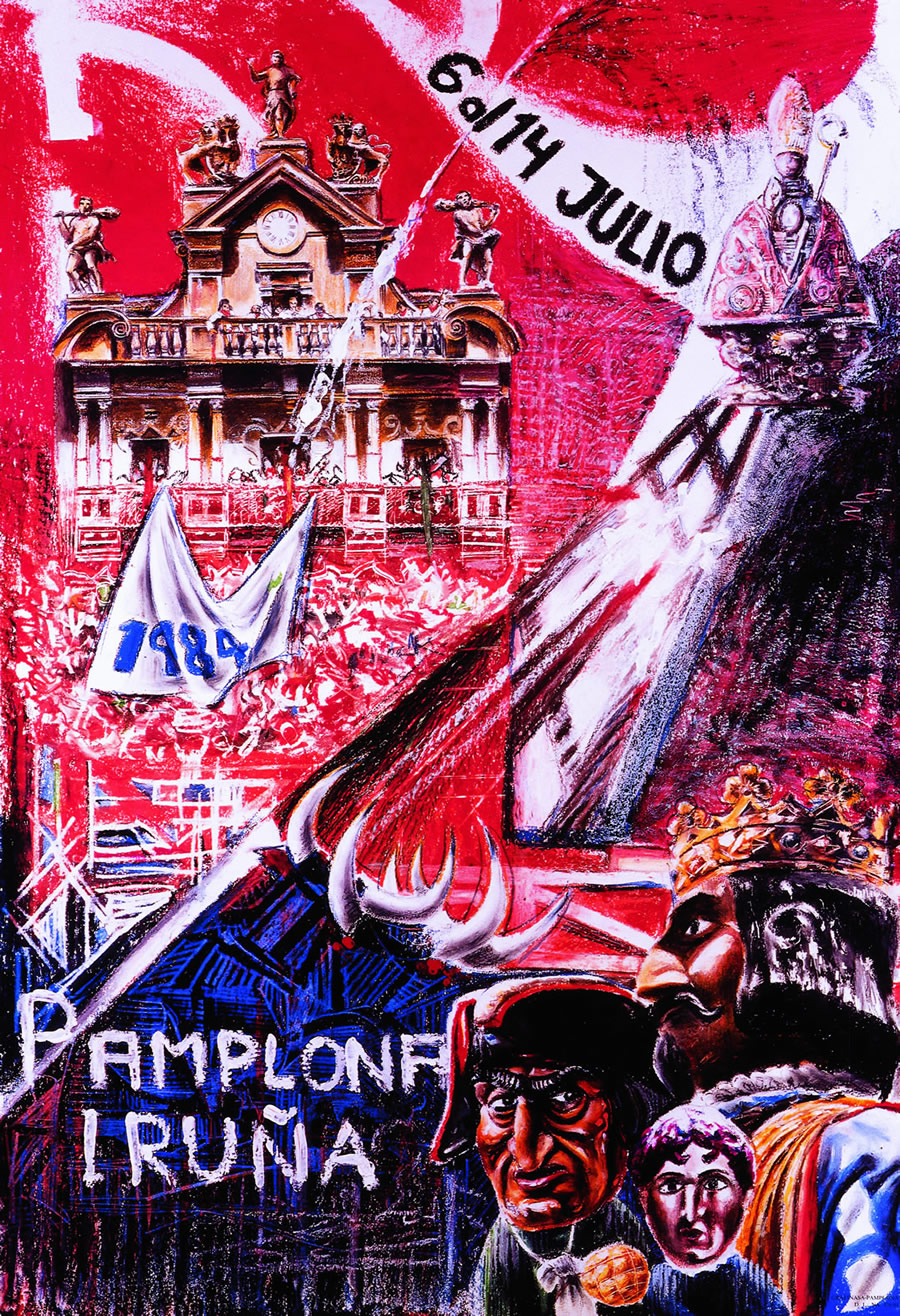
Cartel 1984 by Francisco Bastida Marchiñena.
The 1984 official poster by Francisco Bastida Marchiñena follows the conventions of Navarran festival graphic tradition while drawing on the bold color fields and clean compositional approach that characterized Spanish festival design in the early 1980s. Deep reds and golds dominate the palette, with the figure of a runner in traditional white and red clothing occupying the central frame. The typography is set in a serif face consistent with the era, placing the year and the festival name in a formal register. Bastida Marchiñena’s treatment avoids the more illustrative, painterly approach of earlier decades in favor of something closer to graphic design proper. The result is a poster that reads clearly at distance, which was the practical requirement for images reproduced and displayed across Navarra in the weeks before the fiesta.
Source: Ayuntamiento de Pamplona, cartel archive
The 1984 San Fermín official poster, selected through the annual concurso de carteles held by Pamplona each year.
The City in 1984
Pamplona in July 1984 was a city navigating the practical realities of becoming international while remaining distinctly Navarran. Spain was in the final stages of EEC accession negotiations, a process that would conclude with formal membership arriving January 1, 1986, and the economic and cultural implications of that transition were present in daily conversation. The encierro was attracting runners from dozens of countries, and RTVE’s annual broadcast of the runs had, by 1984, established itself as a fixed point in the Spanish sporting calendar.
Bringing the course into living rooms across the country and, through syndication and recording, reaching audiences far beyond Spain, the infrastructure around the fiesta was expanding to meet a demand that showed no sign of leveling off. The chupinazo opened the fiesta at noon on July 6, and the Pobre de Mí at midnight on July 14 closed eight of the safest mornings in memory.
How 1984 Came Together
Key facts in the 1984 fiesta, kept on the record.
Chupinazo: the noon rocket launch from the Pamplona town hall opens the fiesta, crowds pack the Plaza Consistorial.
Guardiola Fantoni runs the course, four years after the same ranch’s bulls killed two runners in 1980. The third encierro of the 1984 fiesta concludes without fatality.
Fermín Bohórquez run – one of the most accessible mornings from 1984 with surviving video footage (YouTube: 4ijRPoAnP0s, SanFerminEncierroTV channel).
Miura closes the encierro for the second consecutive year. The clean streak since 1982 holds. Total gorings for the 1984 fiesta: approximately 2-3 across all eight runs. The Pobre de Mí closes the festival at midnight.
San Fermín 1984, Answered
Why was 1984 considered one of the safest encierros in decades?
The 1984 fiesta produced approximately 2-3 gorings across eight runs with no deaths, a total that sits well below historical averages for the encierro. No single condition explains it. Bull temperament, weather, crowd behavior on the course, and the specific lineup of ganaderías all contribute to outcomes, and in 1984 those variables combined in an unusually benign way across the full eight mornings.
What was significant about Guardiola Fantoni running in 1984?
Guardiola Fantoni bulls had killed two runners in the 1980 encierro, one of the worst single-morning outcomes in the modern history of the fiesta. When the ranch returned four years later in 1984, the July 9 run concluded without fatality. The result does not rehabilitate or condemn the ranch’s reputation; it simply adds another data point to the record.
Did Miura gore anyone in the 1984 encierro?
No deaths were recorded in the 1984 Miura closing run on July 14. The specific goring count for that morning is not individually recorded in available sources, but the closing run was part of a broader year in which total gorings across all eight runs came to approximately 2-3. Miura had also closed 1983 without a fatality, and the clean streak begun in 1982 held through 1984.
What was Spain’s international situation during the 1984 fiesta?
Spain was in active negotiations to join the European Economic Community in July 1984, with formal accession arriving in January 1986. The country was nine years out of the Franco dictatorship, and the transition toward European integration was shaping economic policy, cultural exchange, and the general atmosphere of a country repositioning itself on the continent. Pamplona’s growing international runner population during this period was one small reflection of that broader opening.
Planning your own run?
The 1983 fiesta set up the clean-year run that 1984 delivered, and the 1985 encierro would test whether the quiet stretch could hold through a third consecutive year. Explore both adjacent years for the full picture of what the early-to-mid 1980s encierro looked like as a sustained stretch of running history.