
San Fermín 1985: The Year a Legend First Ran
July 6 to 14, 1985. The first appearance of Cebada Gago at Pamplona, Miura extending its clean streak, and eight encierros through streets charged with a Spain six months from joining Europe.
Looking Back at 1985
Looking back at 1985, you see a fiesta at an interesting crossroads. The ganaderiía lineup that year reads as a mix of the familiar and the quietly new. Pablo Romero and Miura anchored the week with centuries of prestige, while Cebada Gago made its first appearance at Pamplona with no fanfare and no warning of what that ranch would eventually come to mean in the encierro record books. The run times were unremarkable, the death toll was zero, and the week closed without catastrophe. By any measure, a successful San Fermín.
What is striking in retrospect is how little anyone would have flagged the Cebada Gago run as significant. The Gavira family’s cattle from Bornos were compact and fast, but in 1985 that was simply noted and moved on from. It took years, and a growing body of goring statistics, before the pattern became undeniable. That first appearance in 1985 is the kind of historical footnote that only acquires meaning later. The encierro rewards patience. The full story of any given year often takes decades to read correctly.
Dennis Clancey, Founder, Encierro
A Country Six Months from Europe
Spain in the summer of 1985 was a country in motion. Less than a decade had passed since Francisco Franco’s death in November 1975, and the constitutional democracy ratified in 1978 was still finding its footing. The Socialist government of Felipe González, elected in 1982, had been negotiating Spain’s entry into the European Economic Community, and the accession date was now locked in: January 1, 1986, six months away. The country was shedding a long isolation. For many Spaniards, San Fermín that year carried a particular charge, a sense that the world was opening up, that Spain was rejoining Europe on its own terms.
In the Basque Country and Navarre, that sense of possibility coexisted with tension. ETA attacks had not stopped, and the political negotiations of the following years were still in the future. Pamplona sat at the edge of all of this, a Navarran city with its own identity, drawing runners and spectators from across Europe and beyond. By 1985, the fiesta’s international profile was well established, partly due to Ernest Hemingway’s long shadow and partly because the encierro had become a reference point in global sports culture. The runners who packed the Calle Estafeta that week were arriving into a city that was old and traditional in the streets but very much part of a new European story.
“The bulls don’t know it’s a fiesta. That’s the point.”
Every 1985 Encierro, Day by Day
Each run with its ganaderiía, approximate time, and horn injuries. The route runs approximately 849 meters from Santo Domingo to the ring. All eight runs from 1985 have video records available via the SanFerminEncierroTV archive on YouTube.

Pablo Romero
Gored: see year total
Pablo Romero cattle are among the most traditional in the corrida, large and powerful animals bred in Seville with bloodlines that predate most modern ranches. The opening run set a physical tone for the week: heavy bulls, serious weight on the course.

Guardiola Fantoni
Gored: see year total
The Huelva ranch was a consistent Pamplona presence through the late 1980s, appearing every year from 1985 to 1989. Their bulls had a reputation for unpredictability, which tends to produce the kind of encierro where runners cannot get comfortable.

Osborne
Gored: see year total
The Osborne family, famous for their sherry and brandy empire, also maintained a serious fighting bull ranch. Their cattle were well-bred and generally ran with a certain evenness that can make for a fast, clean course. The July 9 run sat in the middle of the week without drawing exceptional attention.

Fermín Bohórquez
Gored: see year total
Bohórquez cattle carry Portuguese-influenced breeding, which tends to produce animals with a distinct physical profile and movement pattern on the course. This run added some variety to the week’s genetics.

Marqués de Domecq
Gored: see year total
The Domecq line has produced some of the most reliably orderly encierros in Pamplona’s modern history. Their Jerez cattle tend to run compact, staying together well and giving experienced runners a cleaner passage through the course.

Cebada Gago
Gored: see year total
First appearance of Cebada Gago at Pamplona’s encierro in the modern era. The Gavira family’s cattle from Bornos were smaller and faster than the week’s earlier ganaderiías, with a tendency to scatter. Nobody watching on July 12, 1985 could have known they were seeing the debut of the ranch that would one day lead all others in encierro gorings.

Hernández Barrera
Gored: see year total
The Seville-area ranch brought the penultimate run of the week. The July 13 slot carries a particular intensity: runners know Miura closes the following morning, so the second-to-last encierro draws those who want one more run before the finale.

Miura
Gored: 0
Miura closes the fiesta every year, as they have for generations. The 1985 run continued what would become a remarkable streak: from 1982 to 2000, Miura ran at Pamplona without goring a single runner. The most feared name on the course produced eighteen years of clean encierros, and the July 14 run sent the 1985 fiesta out without incident.
What the Record Remembers
Official Poster: San Fermín 1985
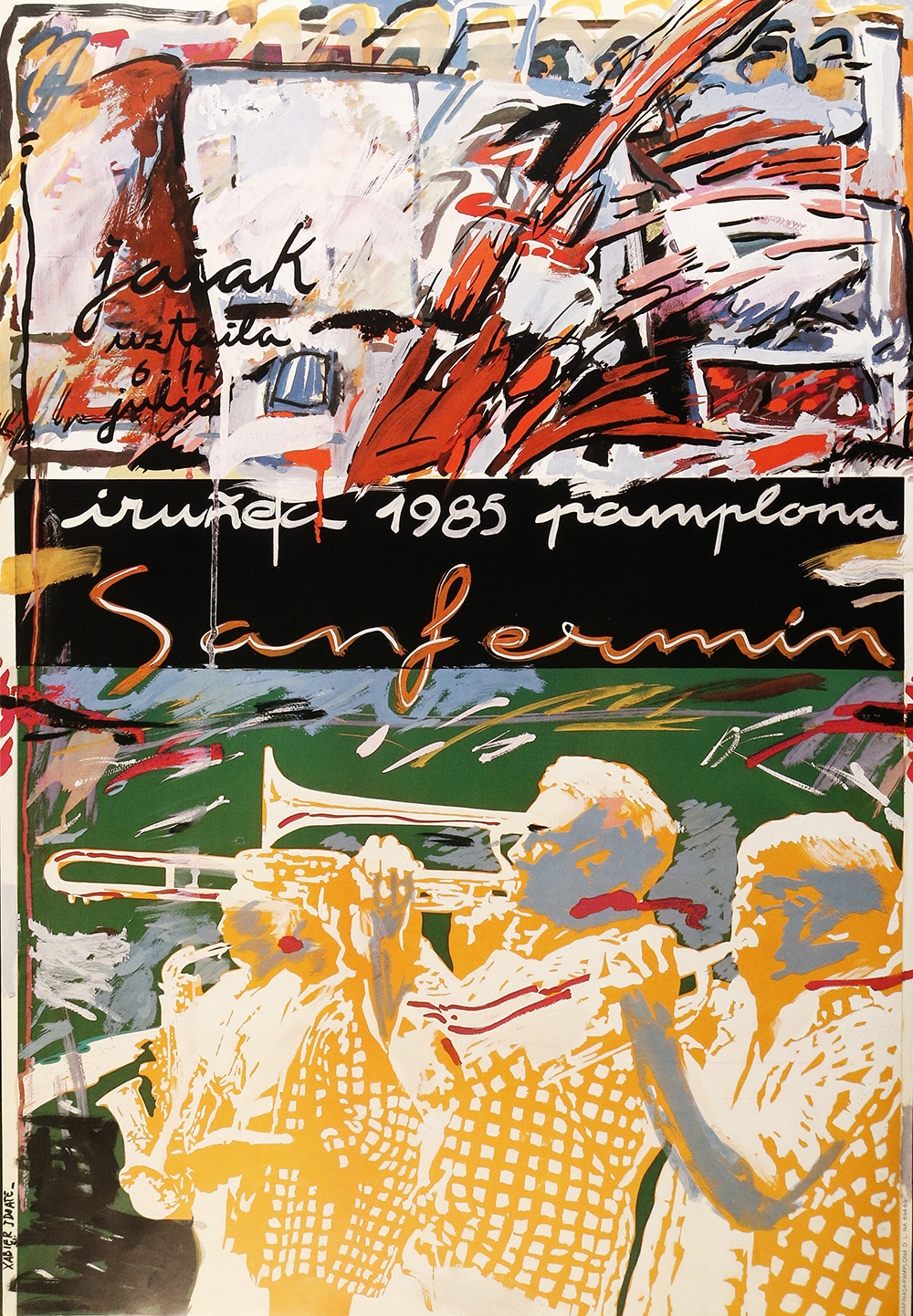
Cartel 1985 by Xabier Idoate Iribarren.
Xabier Idoate Iribarren’s 1985 cartel follows the visual language that Navarran and Basque poster artists brought to the fiesta through the 1970s and 1980s: strong graphic lines, bold use of the red and white of San Fermín, and a composition that tends to place the bull or the runner in dynamic tension against a simplified background. The period’s poster tradition leaned toward a modernist flatness, influenced by European graphic design movements while staying rooted in Navarran subject matter. The 1985 cartel likely foregrounds the encierro itself rather than the religious processions, reflecting a decade when the running of the bulls had become the event’s internationally recognized signature.
Source: Ayuntamiento de Pamplona, cartel archive
Winner of the annual cartel contest and the official San Fermín 1985 poster for Sanfermines.
The City in 1985
Pamplona in July 1985 was a city in white and red, as it always is during San Fermín, but the Spain surrounding it was in a specific historical moment that gave the fiesta a particular texture. EEC membership was six months away. The constitutional monarchy was holding. Felipe González had won a second general election the previous October with a strong majority, giving the Socialist government a stability it had not had in its first term. ETA had not stopped operating, and the security presence in Navarre and the Basque Country remained significant.
Into this came a million visitors, the rocket from the town hall steps, the running of bulls through streets laid out centuries before any of this existed. The fiesta does not stop for politics. It has never needed to. But the people who filled Pamplona that week were living in a Spain that was moving fast, and some of them knew it.
Planning your own run?
The 1984 fiesta brought a different lineup and its own stories worth tracing. The 1986 edition ran for the first time with Spain inside the EEC, a country changed by more than one winter. Both years are covered in full at encierro.com.