
San Fermín 1986: Eight Runs Into a New Europe
July 6 to 14, 1986. The first San Fermín under full EEC membership, a Murteira cross-border appearance, and Miura adding another clean year to its remarkable Pamplona streak.
Looking Back at 1986
Looking back at 1986, the fiesta arrived at an unusual intersection of Spanish history. Six months earlier, on January 1, Spain had formally entered the European Economic Community, ending decades of economic and political isolation that stretched back through Franco’s long rule. That context matters because San Fermín had always served as a kind of annual pressure gauge for the country. By July 1986, the gauge showed something different: a nation with new trade partners, new institutional ties, and a governing socialist party under Felipe González that was steering a careful path between modernization and tradition.
Looking back at 1986 through the encierro’s lens, the ganaderiía lineup was strong and regionally varied. Bulls from Seville, Huelva, Cádiz, and even Portugal’s Lusophone taurine circuit all made the run down Calle Estafeta. Miura closed the fiesta on July 14, as they always did, and added another year to a remarkable Pamplona streak: not a single goring during their appearances from 1982 onward. The 1986 fiesta was, by most accounts, a solid and serious edition, neither record-breaking nor tragic, which in Pamplona counts as a good year.
Dennis Clancey, Founder, Encierro
The First Fiesta in Europe
Spain’s accession to the European Economic Community on January 1, 1986 was the political event of the year, and its effects were already being felt six months later when Pamplona exploded into fiesta. For Spaniards of that generation, EEC membership was not simply an economic arrangement. It was a declaration that the country had rejoined the democratic world from which Francoism had excluded it for nearly four decades. The González government had campaigned hard for entry, framing it as the final institutional seal on Spain’s transition to democracy. By July, optimism was cautious but real. Trade barriers were coming down. Young Spaniards were beginning to think about a continent, not just a country.
The Basque Country and Navarre, however, carried a more complicated mood into the summer of 1986. ETA’s campaign of political violence had not ended with democracy, and Pamplona, sitting at the edge of the Basque cultural sphere, absorbed that tension. The city’s identity, Navarran but culturally Basque in many quarters, kept the political atmosphere layered in ways that the tourist brochures never quite captured. The encierro itself was a rare space where those tensions dissolved, at least for a few minutes each morning, into something shared.
“In Pamplona, the bulls do not care which party is in power. The street is the only constituency that matters.”
Every 1986 Encierro, Day by Day
Each run with its ganaderiía, approximate time, and horn injuries. The route runs approximately 849 meters from Santo Domingo to the ring. Video records exist for several 1986 runs via the SanFerminEncierroTV archive on YouTube.
Domínguez Camacho
Gored: see year total
The fiesta opened with bulls from a Seville-area ranch, a traditional southern Spanish operation. Domínguez Camacho cattle were well-known in the corrida circuit, and their appearance on the first morning set a serious tone for the week. Runners who came early for the opening run found bulls that moved with purpose through the stone streets.

Guardiola Fantoni
Gored: see year total
Guardiola Fantoni was a consistent Pamplona presence throughout the late 1980s, appearing every year from 1985 through 1989. The Huelva ranch produced bulls with a reputation for aggression and unpredictability, the combination that makes veteran runners most alert. Their second consecutive year at Pamplona confirmed the city’s trust in what the ranch delivered.

Osborne
Gored: see year total
The Osborne name is woven into Andalusian commercial history through brandy and sherry, but the family’s taurine operation produced well-bred fighting cattle that commanded respect in the ring and on the street. The July 9 run featured animals from one of Spain’s most recognizable family brands, crossing the cobblestones with the athleticism their bloodlines promised.

Cebada Gago
Gored: see year total
Only their second year at Pamplona, and Cebada Gago were still building the reputation that would eventually make them the most goring-prone ganaderiía in encierro history. Their Cádiz-bred bulls are fast, compact, and aggressive, traits that only become more apparent on a narrow city street at 8 in the morning.

Fermín Bohórquez
Gored: see year total
Fermín Bohórquez brought Portuguese-influenced breeding to the Pamplona streets, a bloodline tradition rooted in the border-crossing taurine culture of the Iberian Peninsula. The Cádiz-area ranch produced animals with distinctive movement and temperament, giving experienced participants a chance to read cattle with a somewhat different profile than the Andalusian mainstream.

Marqués de Domecq
Gored: see year total
The Jerez ganaderiía of the Marqués de Domecq had a reputation for producing bulls that ran with relative order. Footage from this run survives on YouTube, offering a rare visual record of a mid-1980s encierro in motion. One of the bulls selected for the corrida that afternoon, “Vidriero” (number 24, black, 589 kilos), was fought by José Antonio Campuzano.

Murteira
Gored: see year total
Portuguese ranches are less common at Pamplona than their Spanish counterparts, making Murteira’s appearance something of a cross-border event within the Iberian taurine world. Their runs tended toward the measured side; the bull “Bilbaino” (number 29, black, 522 kilos) was fought in third place that afternoon by Roberto Bermejo.

Miura
Gored: 0
The most feared name in the encierro closed the fiesta, as it always does on July 14. Miura cattle are tall, long-horned, and athletic. At Pamplona during 1986, they extended what would become a remarkable historical footnote: from 1982 onward, Miura ran the Pamplona streets without recording a goring, a streak that held through 2000.
What the Record Remembers
The 1986 Sanfermines Official Cartel
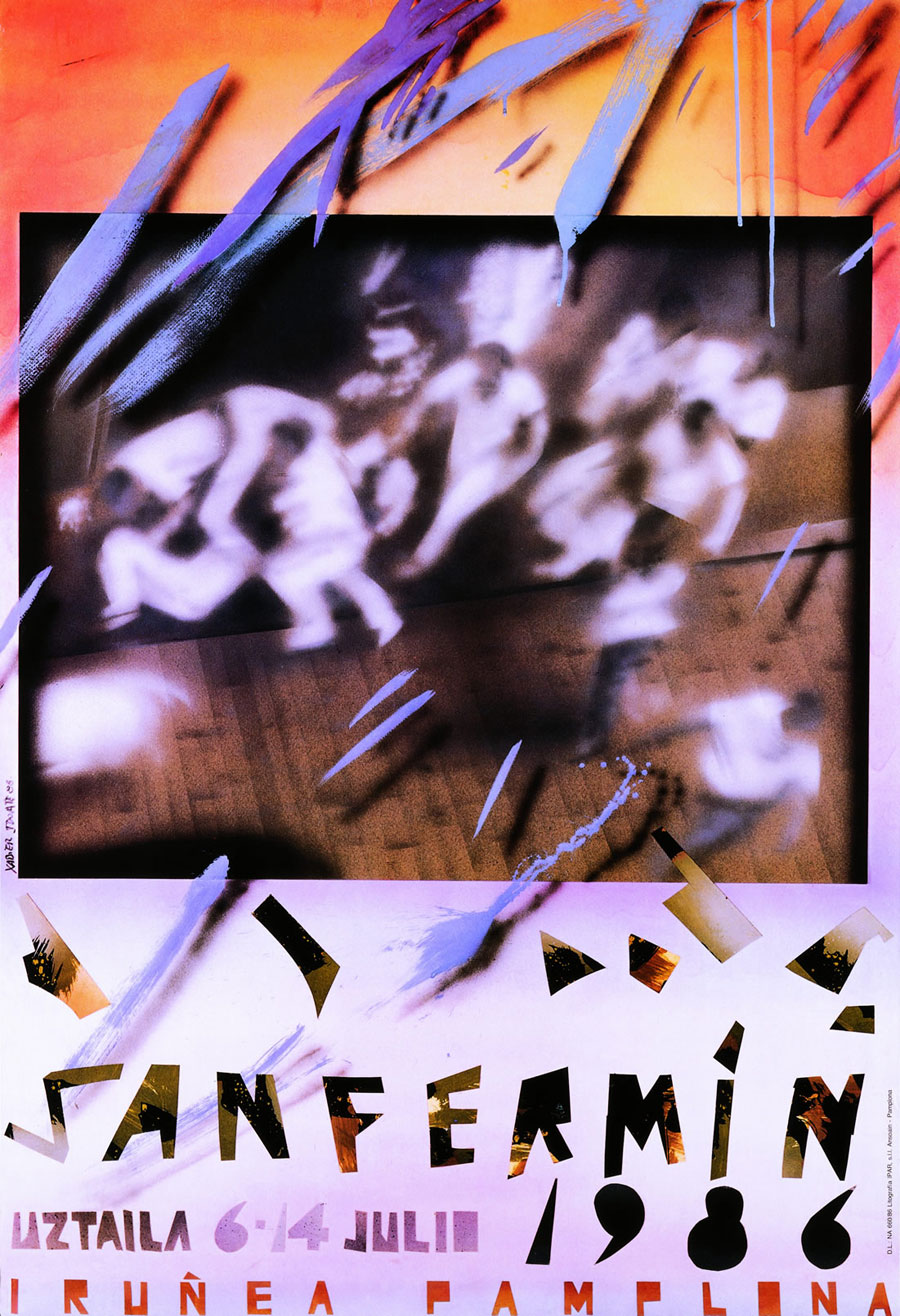
Cartel 1986 by Xabier Idoate Iribarren.
Xabier Idoate Iribarren, a Pamplona-born artist and faculty member at the University of the Basque Country, designed the 1986 cartel, repeating the assignment he had held the previous year. His work in this period drew on urban imagery and figurative tradition, and the San Fermín poster format encouraged a direct engagement with the festival’s visual iconography: runners in white and red, the narrow street, the momentum of the herd. Artists working in the Basque and Navarran cultural sphere in the mid-1980s often navigated between local identity and the broader Spanish visual culture, a tension that gave poster art from this era a particular density.
Source: Ayuntamiento de Pamplona, cartel archive
Selected as the official poster of Sanfermines 1986 through Pamplona’s annual concurso de carteles.
The City in 1986
Pamplona in July 1986 was a city in a country that had just changed its address. EEC membership, signed into effect on January 1, was not yet shaping daily economic life in obvious ways, but it had altered the political atmosphere. González’s PSOE government, now several years into office, was managing the contradictions of a modernizing welfare state with significant regional tensions on multiple fronts.
Navarre’s complex relationship with the Basque Country, straddling cultural affinity and administrative separateness, made Pamplona an unusual place to hold one of Europe’s largest public festivals: a city deeply Navarran in its institutions, deeply Basque in much of its street culture, and deeply internationalized by the encierro’s global reputation. ETA’s campaign had not ended with democracy; security considerations remained real throughout the decade. Against that background, the fiesta continued as it always had, drawing a million people into a space where the rules of ordinary Spanish politics temporarily gave way to something older and louder.
How 1986 Came Together
Key facts in the 1986 fiesta, kept on the record.
The chupinazo rocket launches from the Pamplona city hall balcony at noon, officially opening the nine-day fiesta of San Fermín. Crowds packed the Plaza Consistorial hours before the signal.
Run 1 gets underway with Domínguez Camacho bulls, setting the week’s opening pace through Calle Santo Domingo, Calle Estafeta, and into the Plaza de Toros. The encierro season is officially open.
The Marqués de Domecq run, preserved on video, gives a visual record of what a mid-1980s encierro looked like in motion. Footage (YouTube: UAKwheuvmH0) shows the compressed energy of the Estafeta straightaway.
Miura bulls close the fiesta in their traditional final-day role. Their run adds another year to what would become an 18-year Pamplona streak without a goring, contradicting every expectation the ranch’s reputation generates.
San Fermín 1986, Answered
How many gorings occurred during the 1986 San Fermín encierros?
Approximately 6 gorings were recorded across the eight runs of the 1986 fiesta, though precise per-run breakdowns are not fully documented in public records. No deaths occurred.
Why is Spain’s EEC accession relevant to the 1986 San Fermín fiesta?
Spain joined the European Economic Community on January 1, 1986, making the July fiesta the first Sanfermin held under full EEC membership. It marked a symbolic moment in the country’s post-Franco democratic consolidation, and the political mood of optimism and openness shaped the atmosphere of that summer.
Which ganaderiía had the fewest Pamplona appearances in the 1986 lineup?
Cebada Gago was in only their second year at Pamplona in 1986, a relative newcomer that would go on to become the most goring-prone ranch in the encierro’s history. Murteira, the Portuguese ranch, was also an infrequent presence at Pamplona compared to the Andalusian operations that dominated the lineup.
Did Miura bulls gore anyone during the 1986 encierro?
No. The 1986 Miura run on July 14 passed without a goring, continuing a streak that ran from 1982 through 2000 during which Miura appeared at Pamplona without recording an injury to runners. It remains one of the more counterintuitive statistical facts associated with the most feared name in the encierro.
Planning your own run?
The 1985 fiesta set the stage for everything that followed, with many of the same ganaderiías building their Pamplona records across consecutive years. The 1987 edition picked up where 1986 left off, carrying Spain’s new European identity further into the decade.