
San Fermín 1987: Eight Runs, Zero Deaths, and Cebada Gago Showing Its Teeth
July 6 to 14, 1987. Cebada Gago’s third year at Pamplona, Arauz de Robles opening, and Miura adding another year to its clean-run streak in a fiesta that ran inside a Spain still settling into Europe.
Looking Back at 1987
Looking back at 1987, the fiesta arrived at a moment of real transition for Spain, and that energy filtered into Pamplona every July regardless of what was happening in Madrid or Brussels. The ganaderiía lineup that year tells a story of its own: a classic rotation of Andalusian, Extremaduran, and Portuguese ranches, anchored at the end by Miura, as always. What stands out from the historical record is how the week unfolded without a fatality, even with Cebada Gago making their third appearance and already earning a reputation for sharp, compact animals that ran fast and cornered unpredictably.
The 1987 fiesta is also notable for what it represents chronologically. Cebada Gago was still in the early chapter of what would become the dominant encierro story of the coming decades. Runners in 1987 who paid attention to the Bornos bulls were watching something develop in real time. The rest of the lineup, Arauz de Robles opening, Miura closing, Pablo Romero’s powerful Sevillian cattle in the middle of the week, reads like a textbook Pamplona rotation from the era. No single run defined the year. Instead, 1987 holds up as a solid, well-constructed fiesta in a country that was remaking itself.
Dennis Clancey, Founder, Encierro
Spain’s Second Year in Europe
Spain had joined the European Economic Community on January 1, 1986, and by July 1987 the country was deep into its second year of membership. Felipe González and the PSOE were governing from Madrid with a reformist mandate, pushing economic liberalization and integration into European institutions. The peseta was under pressure, industrial restructuring was cutting into traditional employment, and Spain was simultaneously exhilarated and unsettled by what full European membership meant. In the Basque Country, ETA remained active. The organization had carried out bombings and assassinations into the mid-1980s, and the political shadow of that violence hung over northern Spain, including Navarra.
Into this context arrived the Sanfermines of 1987. The encierro lineup featured Cebada Gago in their third year at Pamplona. The Gavira family’s ranch in Bornos, Cádiz had not yet become the byword for danger it would later be, but runners who had watched the bulls in 1985 and 1986 already knew to pay attention. Fast, compact animals bred for aggression, they were starting to develop a word-of-mouth reputation in the callejon before the wider world caught on.
“The bulls from Bornos don’t waste time. They come out of the corral like they already know where they’re going.”
Every 1987 Encierro, Day by Day
Each run with its ganaderiía, approximate time, and horn injuries. The route runs approximately 849 meters from Santo Domingo to the ring. Video records exist for several 1987 runs via the SanFerminEncierroTV archive on YouTube.

Arauz de Robles
Gored: see year total
Opening day at San Fermín draws the largest and most adrenaline-charged crowds of the fiesta. The Arauz de Robles bulls from the Madrid region handled the opening slot on a morning that set the tone for the week ahead, with the close-packed field of runners making for a physically demanding run through the curves.
Guardiola Fantoni
Gored: see year total
The Huelva-based Guardiola Fantoni ganaderiía was a fixture at Pamplona throughout the late 1980s, appearing every year from 1985 to 1989. Their bulls carried a reputation for unpredictability and aggression, which made them a reliable source of tension in the encierro.

Cebada Gago
Gored: see year total
Third year at Pamplona for the Gavira family’s Bornos operation, and the bulls were already developing a following among the runners who tracked the ganaderiías year to year. Compact and fast with a sharp, aggressive style that made them difficult to read at pace, Cebada Gago in 1987 was still building what would eventually become the most storied encierro record of any ganaderiía.

Osborne
Gored: see year total
The Osborne family, famous across Spain for brandy and sherry, also maintained a well-regarded ranch producing animals bred to high standards. Their encierro runs tended to feature well-formed bulls that moved together cohesively through the course, giving the fiesta a moment of relative order before the heavier Pablo Romero cattle followed the next morning.

Pablo Romero
Gored: see year total
The Seville ranch of Pablo Romero is one of the oldest and most traditional lines in Spanish bullfighting, known for producing large, powerful animals with classical breeding. In the encierro, size matters differently than it does in the ring: big animals are harder to dodge, hit harder on contact, and can pin a runner against the barricade with little warning.

Murteira
Gored: see year total
The Portuguese Murteira ranch brought a different lineage to Pamplona. Less common at the fiesta than the major Andalusian and Castilian ganaderiías, the Lusophone taurine tradition produces animals with their own character. For runners, a Portuguese ganaderiía in the lineup was a point of curiosity, a chance to read animals shaped by a slightly different breeding tradition on the same narrow streets.

Marqués de Domecq
Gored: see year total
The Jerez-based Domecq operation typically produced encierro runs described by veterans as cleaner than average: animals that stayed together and moved in a predictable group through the course. That relative orderliness made the second-to-last run of the fiesta a different kind of challenge, one where the temptation to run close to the horns was easier to act on.

Miura
Gored: 0
Miura always closes the fiesta. The tall, athletic, long-horned cattle from Lora del Río in Sevilla carry the most fearsome name in the encierro. From 1982 through 2000, Miura ran the encierro without goring a single person, a streak that contradicted everything the name implied. The 1987 run was part of that quiet chapter, bulls that lived up to their physical reputation in the ring but moved through the streets without drawing blood.
What the Record Remembers
San Fermín 1987 Official Poster
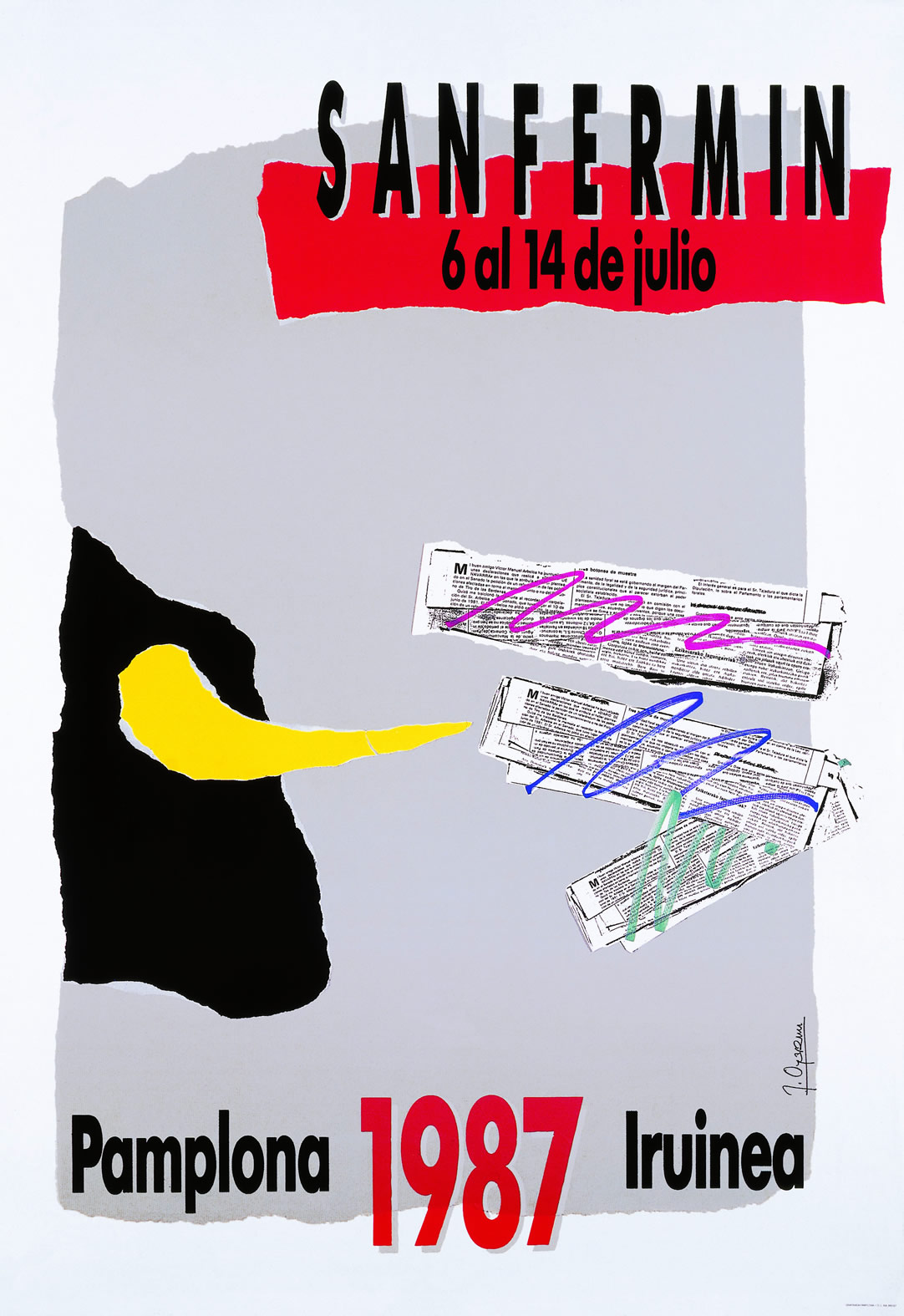
Cartel 1987 by J. Oyarzun Echandi.
Oyarzun Echandi’s 1987 poster represented a change from the artists who had held the commission in 1985 and 1986. Navarra has a strong tradition of poster art rooted in the region’s graphic culture, and 1987’s cartel reflects the visual language of the era: bold color, figurative imagery drawing on the religious and civic symbolism of the fiesta, and the kind of direct composition that reads well on walls and in windows across Pamplona each July. Posters from this period often featured the procession of San Fermín, the encierro itself, or formal street scenes from the casco antiguo, rendered in a style that balanced popular accessibility with regional artistic identity.
Source: Ayuntamiento de Pamplona, cartel archive
The official San Fermín 1987 cartel was chosen via the city’s annual poster contest, the concurso de carteles.
The City in 1987
Pamplona in July 1987 was a city hosting one of the world’s most watched festivals while navigating the specific tensions of Navarran political identity. The region’s relationship with the Basque Country, with Madrid, and with its own foral traditions made local politics a layered and sometimes volatile subject. ETA’s continued activity kept security visible and political conversation tense in a way that outsiders arriving for the fiesta rarely registered.
At the same time, Spain’s second year in the EEC was bringing the first tangible effects of European integration: changing market conditions, new regulatory frameworks, and a cultural opening that had been building since the transition to democracy. The Movida, the explosion of post-Franco creative energy centered on Madrid, was winding down by 1987, its energy absorbed into mainstream Spanish culture. What remained was a country that felt more European than it had a decade earlier, more confident in some ways, more uncertain in others. The fiesta arrived into all of that, as it always does, indifferent to the headlines.
How 1987 Came Together
Key facts in the 1987 fiesta, kept on the record.
The opening ceremony, the Chupinazo, fires from the Pamplona town hall balcony at noon, officially beginning the 1987 Sanfermines. Crowds fill the Plaza Consistorial.
Cebada Gago runs the encierro for their third consecutive year at Pamplona. The Bornos bulls complete the course without incident, but their speed through the course draws attention from veteran runners.
The Portuguese Murteira ganaderiía takes the course in one of the rarer international appearances in the fiesta’s lineup, providing a different kind of morning for the runners and spectators lining Estafeta.
Miura closes the 1987 fiesta. The long-horned Sevilla cattle run the course without goring anyone, continuing what would eventually be recognized as an 18-year streak without a goring at Pamplona, running through 2000.
San Fermín 1987, Answered
Which ganaderiía ran on July 9, 1987?
Cebada Gago, the Gavira family’s ranch from Bornos in Cádiz, ran the third encierro of the 1987 fiesta. It was their third consecutive appearance at Pamplona, and the beginning of a long association between those bulls and the encierro’s most dangerous moments in the years that followed.
Did anyone die in the 1987 San Fermín encierro?
No. The eight runs of 1987 produced no fatalities. The fiesta recorded approximately seven gorings across the week, none of them fatal.
What made the 1987 Miura run significant?
Miura ran the final encierro of the 1987 fiesta, as they traditionally do on July 14. During the period from 1982 through 2000, Miura completed every encierro at Pamplona without goring a single runner, a streak that ran counter to their fearsome reputation. The 1987 run was part of that quiet chapter.
Where can I watch footage from the 1987 encierros?
Archival footage from several 1987 runs is available via the SanFerminEncierroTV channel on YouTube. The July 7 Arauz de Robles opening run (ID: 7xPC5N_OElQ), the July 9 Cebada Gago run (ID: 4Tk4rU_-czI), and the July 14 Miura close (ID: NTUwT-uPwiM) are among the preserved recordings from that year.
Planning your own run?
The 1986 fiesta brought its own cast of ganaderiías through the streets of Pamplona in Spain’s first year as an EEC member, and 1988 continued the pattern with Cebada Gago’s fourth appearance accelerating their growing reputation.