
San Fermín 1989: Eight Runs, Clean, Into the Last Year Before the World Changed
July 6 to 14, 1989. A fiesta that ran clean and fast and quietly into history, delivering eight encierros without a single death in a year that Spain would remember for reasons well beyond Pamplona.
Looking Back at 1989
Looking back at 1989, it is striking how unremarkable the fiesta was by statistical measure, and how much that unremarkability is itself the story. Six gorings across eight runs, no deaths, no catastrophic pile-ups in Callejon or at the entrance to the bullring. By the standards of any year bracketing it, the 1989 fiesta was composed. The ganaderiías brought capable animals, the streets filled as they always do, and Pamplona absorbed another July without a major incident to mark it.
Looking back at 1989 through the lens of the decade that produced it, you also have to place the fiesta inside a Spain that was moving fast. The country had joined the European Community in 1986, the economy was expanding, and the horizon was pointed squarely at 1992 and its twin symbols of national ambition: the Barcelona Olympics and the Seville World Expo. The encierro ran in July, months before the Berlin Wall came down in November and changed the map of the world. That temporal distance is worth sitting with. The runners in the streets of Pamplona that summer had no idea what the rest of the year held.
Dennis Clancey, Founder, Encierro
A Working Fiesta in a Confident Spain
Spain in July 1989 was a country confident in its trajectory. The Socialist government of Felipe González was midway through its second consecutive term, the economy was producing growth rates that outpaced most of Western Europe, and the construction and planning work for the 1992 mega-events was generating jobs and national pride in equal measure. Against that backdrop, Pamplona filled with its annual million visitors, the chupinazo fired on July 6, and the encierros began.
The Basque Country, an hour’s drive north, remained a zone of political tension. ETA had not demobilized, and the violence that punctuated Spanish political life through the 1980s had not disappeared. It was a reminder that Spain’s modernization was uneven, and that the fiesta’s spirit of abandon existed alongside a harder, ongoing reality. The encierro itself in 1989 was what veterans of the run would call a working fiesta. No single run dominated the conversation afterward. Approximately six gorings were recorded across the week, down from the roughly nine reported in 1988, and no runner died.
“The encierro doesn’t care about history. It only cares about the next corner.”
Every 1989 Encierro, Day by Day
Each run with its ganaderiía, approximate time, and horn injuries. The route runs approximately 849 meters from Santo Domingo to the ring. Video records exist for three 1989 runs: July 11, 12, and 14 via the SanFerminEncierroTV archive on YouTube.
Celestino Cuadri
Gored: see year total
The Huelva ranch opened the 1989 fiesta with bulls that set a measured early tone. Celestino Cuadri animals are known for a certain directness, and the opening run delivered the adrenaline of a first morning without the chaos that can define an early-week crowd still finding its footing.
Murteira
Gored: see year total
Murteira brought the Lusophone taurine tradition to Pamplona, a Portuguese ranch that appeared less frequently on the encierro calendar than its Spanish counterparts. Their runs tended toward the measured rather than the explosive, a product of breeding lines that diverged from the dominant Andalusian ranches.
Pablo Romero
Gored: see year total
Pablo Romero bulls are large, powerful, and traditionally bred, a Seville ranch with a lineage that connects to some of the oldest cattle in the corrida. Size matters in the encierro; a bigger bull is harder to predict and harder to avoid in close quarters. The July 9 run put that power on the streets of Pamplona.
Guardiola Fantoni
Gored: see year total
Guardiola Fantoni bulls have a reputation for aggression and unpredictability, qualities that keep runners honest. This was their fifth consecutive year at Pamplona, having appeared every year from 1985 through 1989. Five straight Julys at the encierro is a mark of trust from the organization and a signal to experienced runners that these are animals worth respecting.

Marqués de Domecq
Gored: see year total
The Jerez ganaderiía brought animals that tended to run in relative order, producing what encierro regulars sometimes call a clean run: bulls that move together, stay on course, and give runners a chance to work alongside the herd rather than scatter from it. A clean run is not a boring run.

Cebada Gago
Gored: see year total
Cebada Gago’s fifth appearance at Pamplona landed on July 12, and it was recorded on video by SanFerminTV, the footage now preserved on YouTube. The Gavira family’s ranch from Bornos was cementing a reputation in 1989 that would only grow in the decades ahead. The July 12 recording is a primary document of what the encierro looked like in the late 1980s.
Baltasar Ibán
Gored: see year total
The León-region ranch brought animals known for quality, a penultimate-day run that gave the week a strong second-to-last chapter before the traditional Miura close. By July 13 the fiesta is running on its own momentum, the crowds dense and the energy pitched high.

Miura
Gored: 0
Miura closes the fiesta. That is not tradition so much as gravitational law. Tall, athletic, long-horned cattle from Lora del Río, bred for generations into animals that experienced runners regard with a particular kind of attention. From 1982 through 2000, Miura ran Pamplona without goring anyone. The July 14 close in 1989 held to that pattern.
What the Record Remembers
San Fermín 1989: Official Cartel
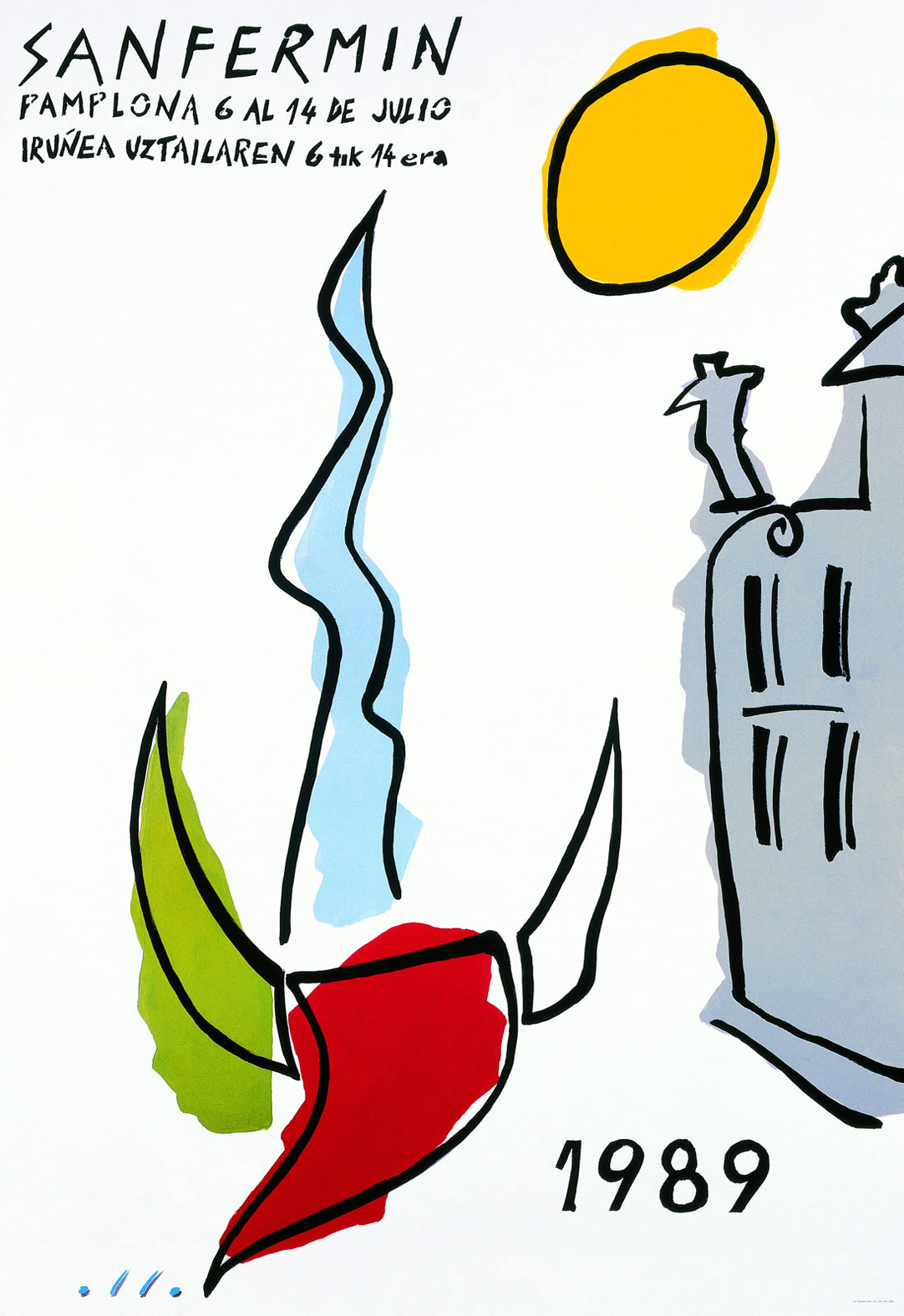
Cartel 1989 by J. Luis y Alberto Ollo Casas.
The 1989 cartel was a collaborative work by J. Luis y Alberto Ollo Casas, a pairing that placed it within the Navarran artistic tradition of treating the fiesta as a subject worthy of serious visual craft. Posters of this era typically drew on the bold color contrasts that made fiesta imagery legible from a distance, reds and whites against darker grounds, with the rocket burst of the chupinazo or the motion of the encierro itself as compositional anchors. A collaborative cartel carries a specific energy: two perspectives negotiated into a single image, which is not unlike the fiesta itself, a million people sharing one week’s worth of common ground.
Source: Ayuntamiento de Pamplona, cartel archive
Named the official cartel of San Fermín 1989 after winning the Ayuntamiento’s annual poster contest.
The City in 1989
Pamplona in July 1989 was a city inside a country that had not yet stopped accelerating. Spain’s GDP had been growing at rates that made it one of the faster-expanding economies in the European Community, which it had joined three years earlier. Felipe González’s PSOE government was governing from a position of strength, with planning for the 1992 Barcelona Olympics and the Seville Expo generating investment and a sense of national purpose that had been absent for much of the previous decade.
ETA’s campaign of violence continued as a permanent backdrop to Basque and Navarran life, a reminder that the optimism of Spain’s modernization was not universal and not uncontested. The fiesta absorbed all of it, as it always does: the politics, the economics, the tension, the joy. By November the Berlin Wall would fall and 1989 would become one of the fixed points of modern history. In July, Pamplona was simply running.
How 1989 Came Together
Key facts in the 1989 fiesta, kept on the record.
The chupinazo fires at noon in the Plaza Consistorial, officially opening the 1989 San Fermín fiesta. The city shifts into its annual nine-day mode.
Run 1 gets underway with Celestino Cuadri bulls from Huelva. Eight mornings of encierros begin at 8:00 a.m.
Cebada Gago’s fifth Pamplona appearance is captured on video by SanFerminTV, preserving one of the only surviving footage records from the 1989 encierros.
Miura closes the fiesta on the final morning, completing an encierro week that recorded approximately six gorings and no deaths across all eight runs.
San Fermín 1989, Answered
Which ganaderiía had the most notable run in 1989?
Cebada Gago’s July 12 run stands out because it was recorded on video, making it the best-documented encierro of the 1989 fiesta. The footage, available via SanFerminTV (wx5ZJbblVKU), captures the Bornos ranch’s fast, aggressive bulls at a point when their Pamplona reputation was still being built.
How did 1989 compare to 1988 in terms of gorings?
The 1988 fiesta recorded approximately nine gorings, making it a notably high-incident year. The 1989 fiesta came in at approximately six gorings across eight runs, with no deaths. By the standards of a late-1980s encierro, 1989 was the quieter of the two years.
Did Miura gore anyone in 1989?
No. The 1989 Miura run was part of a broader streak that holds through the record: from 1982 to 2000, Miura ran Pamplona without recording a goring. Given the ganaderiía’s reputation as the most feared name in the encierro, that streak was and remains one of the more surprising statistical facts about the modern run.
What was Guardiola Fantoni’s significance in 1989?
The Huelva ranch’s July 10 appearance was their fifth consecutive year at Pamplona, having run every year from 1985 through 1989. Five straight appearances reflected a sustained relationship with the encierro organization and made Guardiola Fantoni one of the defining ganaderiías of the late-1980s fiesta.
Planning your own run?
The 1988 fiesta brought approximately nine gorings and a dramatic Cebada Gago run that RTVE covered in depth: see the 1988 year-in-review for the full account. And if 1989’s composed week left you wanting to see what came next, the 1990 encierro is one page away.