
The Encierro Archive
San Fermín 1990: The First Eight O’Clock Run
The year the encierro moved to 8am, bringing Pamplona’s most famous street race into full daylight for the first time in its modern history.
From the Founder
Looking Back at 1990
Dennis Clancey · Founder, Encierro
Looking back at 1990, it is striking how much a single administrative decision reshaped an event that had run roughly the same way for generations. Moving the encierro from 6:00am to 8:00am sounds bureaucratic on paper, but it was a genuine turning point. Until that July, runners had been launching into near-darkness, reading the route by instinct and the first thin light of a summer dawn. The 1990 change put the run in full daylight, which changed how runners saw the bulls, how spectators watched from the balconies, and how television cameras captured every meter from Santo Domingo to the arena.
The early 1990s were a period of growing confidence in Spain generally, and that confidence was visible in Pamplona. The city was deepening its reputation as one of the great summer destinations in Europe, not just for the fiesta, but for the encierro specifically. International runners were arriving in larger numbers each year, and the new start time gave the event a cleaner broadcast window for audiences in the Americas and across Europe. What had been a ritual of the dark hours became, in 1990, a morning event in every sense.
Dennis Clancey, Founder
1990 in context
Pamplona and Spain in 1990
For most of its modern history, the San Fermín encierro ran at 6:00am. That meant the route down Calle Estafeta was, in the early July mornings, still grey and shadowed when the rocket fired. Runners knew the turns by memory. The bulls came fast and the light was poor. In 1990, the Ayuntamiento de Pamplona moved the start to 8:00am, a change that aligned the event with full daylight for the entire route. The practical effect was immediate: runners could see farther ahead, spectators on balconies had better sightlines, and cameras could film without fighting the pre-dawn murk.
Spain in 1990 was in the middle of a sustained economic expansion. The country had joined the European Community in 1986 and was two years away from hosting both the Barcelona Olympics and the Sevilla World Exposition simultaneously. Pamplona was part of this upward momentum, drawing more international visitors, more press coverage, and a broadening community of runners who traveled from abroad specifically for the encierro. The 8am change was, in that sense, part of a larger opening of the event to the world.
Moving to eight in the morning changed everything about how the encierro looked and felt. It was the same bulls, the same streets, the same two minutes of controlled chaos. But suddenly the whole world could see it clearly.” (Encierro commentator, recalling the 1990 change)
Morning by morning
Every 1990 Encierro, Day by Day
Eight mornings, eight ganaderías. The full encierro record for San Fermín 1990.
July 7, 1990 / First Run
First Run
Time: approx. 2:30 to 4:00
Marqués de Domecq from Jerez opened the first encierro of the new 8am era, their cattle known for traveling in relatively compact packs and maintaining pace through the curves of Estafeta. The new start time meant the July 7 crowd had a different feel on the streets, daylight already strong by rocket time.
July 8, 1990 / Second Run
Second Run
Time: approx. 2:30 to 4:00
Celestino Cuadri, a solid mid-era ganadería from Huelva, provided the second morning of the 1990 fiesta. Their cattle ran with consistent aggression through the straights, which kept the crowd on the balconies leaning forward from start to finish.
July 9, 1990 / Third Run
Third Run
Time: approx. 2:30 to 4:00
Guardiola Fantoni brought their Huelva cattle to the streets mid-week, a ganadería known for unpredictable behavior through the course. Runners who had found their confidence over the first two mornings were reminded that each ganadería brings its own logic.
July 10, 1990 / Fourth Run
Fourth Run
Time: approx. 2:30 to 4:00
Cebada Gago’s compact, fast cattle from Bornos ran the fourth encierro of 1990, already building the reputation that would make them the most statistically dangerous ganadería at Pamplona over the following decade. Their bulls accelerate hard off the start and take the curves of Estafeta without slowing, leaving little margin for error.
July 11, 1990 / Fifth Run
Fifth Run
Time: approx. 2:30 to 4:00
Atanasio Fernández brought the Salamanca tradition to the fifth morning, cattle that tend toward a measured but forceful pace through the course. Friday of fiesta week draws a dense crowd on the route, and the Fernández bulls moved through it without major incident.
July 12, 1990 / Sixth Run
Sixth Run
Time: approx. 2:30 to 4:00
Miura ran sixth in 1990, not in the closing position they occupy in many years, but midway through the week. Their tall, long-horned, intelligent cattle from Sevilla are the most feared name in the encierro, though in the 1982-2000 period they completed their Pamplona runs without goring anyone, making them uniquely dangerous by reputation and measured by record. Saturday’s crowd knew what was coming when the name Miura appeared on the program.
July 13, 1990 / Seventh Run
Seventh Run
Time: approx. 2:30 to 4:00
Sepúlveda, from the Salamanca area, ran the seventh encierro with cattle that were a regular feature of the early 1990s lineups. The penultimate morning of the fiesta, with the closing day approaching, brought experienced runners back for one more pass through the route.
July 14, 1990 / Eighth Run
Eighth Run
Time: approx. 2:30 to 4:00
Conde de la Corte from Badajoz closed the 1990 fiesta on the final Monday, their Extremadura cattle generally well-regarded among runners for their behavior through the course. It was the last encierro of a year that had permanently changed when the event happens.
The stories of 1990
What the Record Remembers
The Official Cartel
The Official San Fermín 1990 Poster
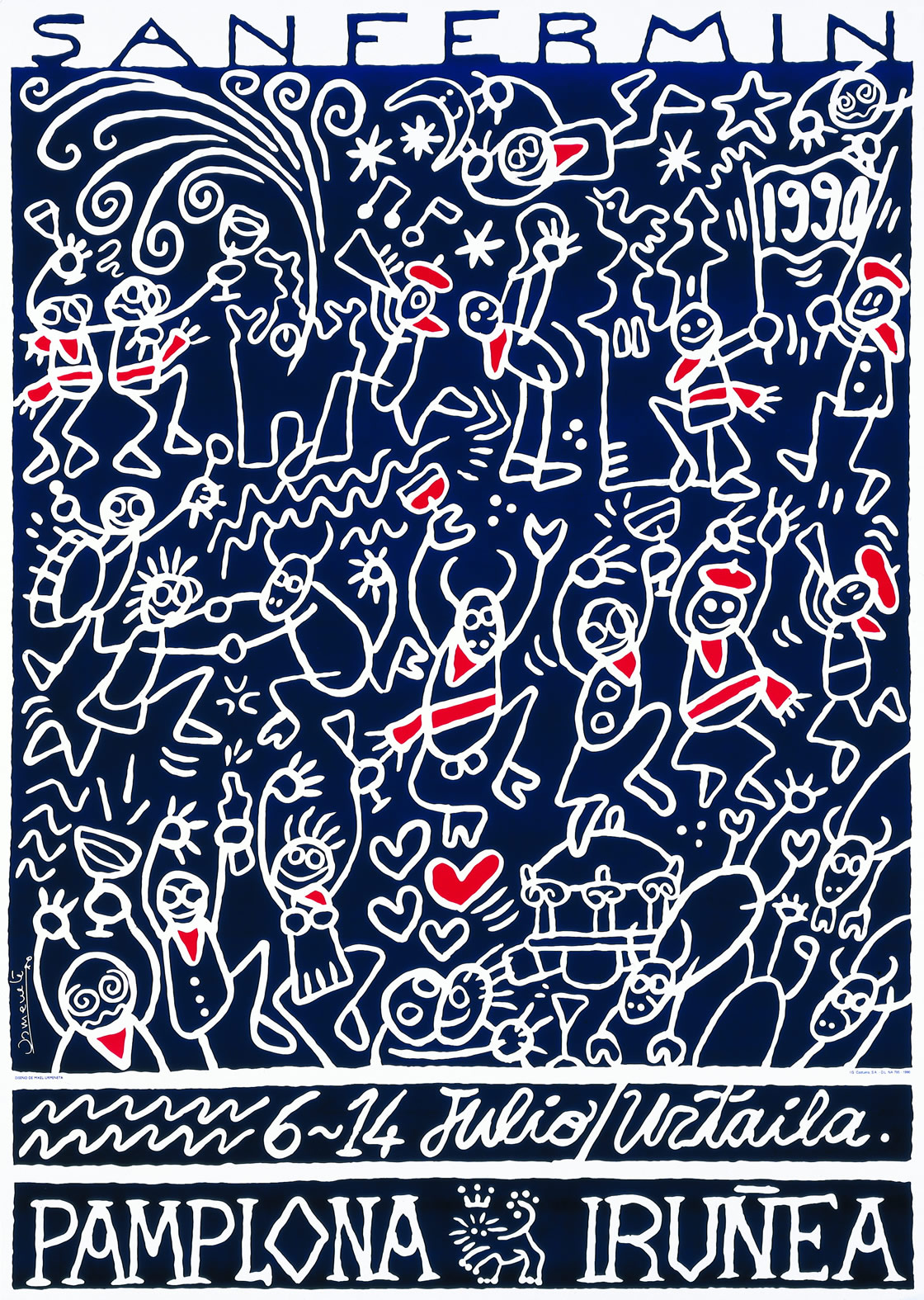
Cartel 1990.
Mikel Urmeneta’s 1990 poster brought a bold graphic sensibility to the fiesta’s visual tradition. San Fermín cartel art of this era typically centered on the tension between runner and bull, using strong blocks of color, often the red of the pañuelo against the white of the traditional outfit, to convey motion and urgency. Urmeneta worked within that tradition while bringing a contemporary design approach that suited the moment: 1990 was the year the encierro stepped into the daylight, and the poster reflects that clarity of line and color.
Source: Ayuntamiento de Pamplona, cartel archive
The 1990 San Fermín official poster, selected through the annual concurso de carteles held by Pamplona each year.
Beyond the run
The City in 1990
Pamplona in July 1990 was a city accelerating into something larger than itself. Spain’s economic confidence was building toward the extraordinary 1992 year, and Pamplona was attracting a steadily more international crowd, drawn not just by the fiesta’s reputation but by improved travel infrastructure and the encierro’s growing presence on television. Calle Estafeta in the first week of July was a compressed world: Basques and Navarrans who had attended every year of their lives alongside first-timers from Australia, the United States, and across Europe, all sharing the narrow street in the hours before the rocket fired. The 8am start meant the mornings felt different in 1990. The city was awake earlier, the cafes were open, the newspapers were on the stands before the bulls finished their run. A clock had shifted, and Pamplona adjusted.
The record
How 1990 Came Together
Key facts in the 1990 fiesta, kept on the record.
Questions and answers
San Fermín 1990, Answered
Why did the San Fermín encierro change from 6am to 8am, and when did it happen?
The Ayuntamiento de Pamplona moved the encierro start time from 6:00am to 8:00am beginning with the 1990 fiesta, starting with the July 7 run. The reasons were partly practical: 8:00am put the run in full daylight, improved conditions for television broadcast, and made the event more accessible to international visitors who found a 6am start extremely difficult to manage. The time change has remained in place from 1990 to the present day.
Which ganadería closed the 1990 fiesta?
Conde de la Corte, from Badajoz in Extremadura, ran the eighth and final encierro on July 14, closing the 1990 fiesta. They are a generally well-regarded ganadería whose cattle tend to run in a controlled manner through the course.
Did Miura close the 1990 encierro?
No. In 1990, Miura ran sixth on July 12, not in the closing position. The final encierro of 1990 was run by Conde de la Corte. Miura’s position in the lineup varies across years, and 1990 placed them mid-week rather than at the end of the fiesta.
How many gorings were there in 1990 and were there any deaths?
The approximate goring total for 1990 was 5. There were no deaths in 1990, nor in any of the years from 1990 to 1994. The 1990 figure was on the lower end for the era, which may partly reflect the adjustment period as runners and bulls alike adapted to the new morning light on the route.
The archive grows
Explore the full encierro record
If you want to understand how the 1990 encierro fits into the broader history of the run, the [Year-by-Year Archive](/archive) covers every fiesta from the mid-20th century forward. For a deeper look at the ganaderías that ran in 1990 and what makes each one distinct, see the [Ganadería Guide](/ganaderias).