
San Fermín 1991: Miura returned to close the fiesta, and Pamplona marked the second year of the 8am era with a run that kept the tension high into the final morning
July 6 to 14, 1991. Eight encierros in the second year of the new start time, a week that built toward Miura’s closing run as Spain prepared for the most ambitious year in its modern history.
Looking Back at 1991
Looking back at 1991, the fiesta settled into the new rhythm established the year before. The 8am start was no longer a novelty; it was simply how the encierro worked. What made 1991 notable was the return of Miura to the closing slot, restoring the traditional finale that many runners and watchers considered the natural endpoint of the week. With approximately 6 gorings across the eight runs, 1991 was a moderate year by the standards of the early decade, but “moderate” at Pamplona still means eight mornings of concentrated risk on a cobbled street with animals that weigh half a ton.
The year also came with a growing sense of anticipation for what 1992 would bring to Spain as a whole. Barcelona had been awarded the Olympic Games, and Sevilla was preparing to host the World Exposition. Spain was projecting itself outward in a way that made international attention on every Spanish event, including San Fermín, more intense. In 1991, Pamplona was already filling with visitors who planned to pair the encierro with the broader Spanish summer that the following year would amplify enormously.
Dennis Clancey, Founder, Encierro
The Second Year of the 8am Era
The 1991 fiesta was the second under the 8am start, and the change had already become unremarkable to regular attendees. What drew more discussion was the lineup: Miura in the closing slot on July 14 was a return to a form that felt right to the Pamplona community. When the most feared ganaderiía runs last, there is a narrative logic to the week’s eight mornings. The other seven runs build toward the finale, and experienced runners plan their week accordingly, sometimes holding back their best efforts for the day that carries the most weight.
Spain in 1991 was a country in a confident moment. The economy had been growing through the late 1980s, European integration was delivering visible results, and the combination of the 1992 Olympics in Barcelona and the Expo 92 in Sevilla was approaching like a major event on the national calendar. Pamplona was part of this broader energy: the encierro was receiving more television attention across Europe and the Americas, and the profile of the runners coming from abroad was broadening.
“When Miura closes on the fourteenth, the whole week points somewhere. Every other morning is buildup. The last run is what people remember.”
Every 1991 Encierro, Day by Day
Each run with its ganaderiía and approximate time. The route runs approximately 849 meters from Santo Domingo to the ring. Gorings for 1991 are not individually recorded by run; the year total was approximately 6.

Conde de la Corte
Gored: see year total
Conde de la Corte from Badajoz opened the 1991 fiesta on the first Monday, their Extremadura cattle providing a controlled but forceful passage through the course from Santo Domingo to the arena. Opening a fiesta sets the tone for the week, and Conde de la Corte are generally considered a reliable opener.

Guardiola Fantoni
Gored: see year total
Guardiola Fantoni brought their Huelva cattle for the second morning, a ganaderiía known for producing animals that behave unpredictably through the turns of the course. Their appearance early in 1991 gave the opening days of the fiesta an elevated edge.

Cebada Gago
Gored: see year total
Cebada Gago’s fast, compact bulls from Bornos ran the third encierro, appearing mid-week as they would in most years of this era. By 1991, the ranch was already accumulating a reputation as the most statistically dangerous ganaderiía at Pamplona, their animals prone to separating from the pack and creating isolated-bull situations.

Albaserrada
Gored: see year total
Albaserrada, from the Salamanca breeding tradition, provided the fourth morning of the fiesta with medium-sized, fast cattle that moved through the course at pace. The Salamanca ranches tend to produce animals with consistent temperament, which makes them somewhat more predictable than the Cádiz or Huelva ganaderías.

Osborne
Gored: see year total
Osborne, the famous Jerez family’s ranch, brought well-bred animals to the fifth encierro. Their cattle are considered among the better-behaved in the lineup in terms of keeping the pack together, which generally means a cleaner run with less risk of isolation. A Friday morning at Pamplona draws experienced runners who have been building through the week.

Sepúlveda
Gored: see year total
Sepúlveda provided the sixth encierro from their Salamanca-area ranch, their cattle a regular feature of early 1990s lineups. Saturday morning in fiesta week is one of the busiest on the route, with crowds deep on both sides of Estafeta and the pressure on runners to find and hold their lane at its peak.

Marqués de Domecq
Gored: see year total
Marqués de Domecq from Jerez ran the penultimate encierro of 1991, their cattle known for moving through the course in relatively orderly packs. The Sunday morning of fiesta week, with Miura waiting for the following day, draws runners who want one final preparation before the closing run.

Miura
Gored: see year total
Miura closed the 1991 fiesta on the final Monday, returning to the position that carries the most weight in the week’s schedule. Their tall, long-horned cattle from Sevilla completed the course as part of the 1982-2000 clean streak at Pamplona, meaning no gorings attributed to Miura during this period. The anticipation of a Miura closing run and the reality of it are two very different experiences.
What the Record Remembers
Official Sanfermines Poster, 1991
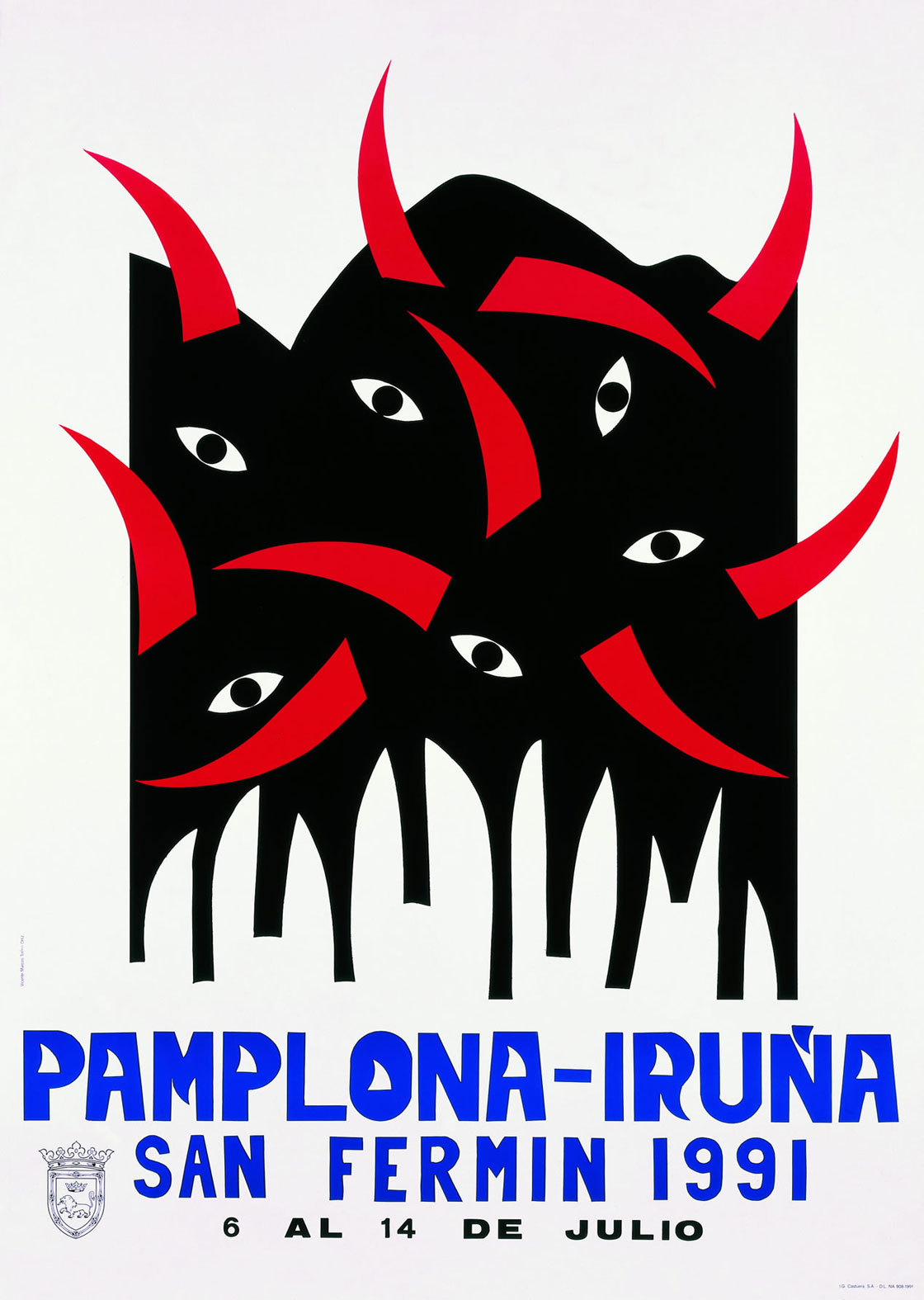
Cartel 1991 by Vicente Marcos Ortiz.
Vicente Marcos Ortiz’s 1991 poster worked within the visual language that San Fermín cartel art had developed over decades: strong color contrasts, imagery that captured the movement and danger of the run, and the festive elements of the fiesta presented as inseparable from its intensity. Cartel art of this era typically used the white and red of the encierro uniform as a starting point, with the bull’s silhouette or the arc of Estafeta’s street often providing the compositional anchor. Ortiz brought his own graphic approach to this tradition for the 1991 edition.
Source: Ayuntamiento de Pamplona, cartel archive
Winner of the annual cartel contest and the official San Fermín 1991 poster for Sanfermines.
The City in 1991
Pamplona in July 1991 was a city that had absorbed the 8am start time as fact and was now simply running on it. The adjustment period was over. The cafes around the Plaza del Castillo had reconfigured their morning hours, the television trucks had worked out their setups, and the rhythm of the fiesta week had settled into its new schedule. The international crowd was growing, and the city was accommodating it: more hotel rooms, more organized viewing spots, more non-Spanish voices in the crowd on Estafeta on the mornings when the rocket fired.
Spain’s broader confidence in 1991, a country that knew it was about to host the world the following summer, showed up in Pamplona as a kind of ease, a city that knew what it had and was glad to share it. The chupinazo opened the fiesta at noon on July 6, and the Pobre de Mí at midnight on July 14 closed it after Miura had run their eighth and final encierro of the week.
How 1991 Came Together
Key facts in the 1991 fiesta, kept on the record.
The chupinazo rocket fires from the Town Hall balcony, opening the 1991 fiesta and sending the crowd in the Plaza Consistorial into the traditional white-and-red celebration.
Conde de la Corte opens the fiesta in the first encierro, setting the tone for a week that will end with Miura.
Cebada Gago runs the third encierro, their fast compact Cádiz cattle mid-week, adding to the growing body of evidence about this ganaderiía’s distinctive danger profile at Pamplona.
Miura closes the 1991 fiesta in the eighth and final encierro. The most feared name in the lineup takes its traditional closing position, completing the week without a goring in this run, continuing the clean streak of the 1982-2000 period. The Pobre de Mí at midnight ends the fiesta.
San Fermín 1991, Answered
Which ganaderiía closed the 1991 fiesta and why does the closing slot matter?
Miura closed the 1991 fiesta on July 14, running the eighth and final encierro. The closing slot carries the most weight in the week’s program because it represents the final run, and Miura’s reputation as the most feared ganaderiía in the encierro makes their appearance in that position feel like the natural conclusion of eight days. When Miura closes, experienced runners often save something for the last morning. The anticipation runs through the entire preceding week.
Where did Cebada Gago run in 1991?
Cebada Gago ran the third encierro on Wednesday July 9. This mid-week placement was typical of their appearances in the early 1990s lineups. Their fast, compact cattle from Bornos, Cádiz were already developing a reputation as the most dangerous ganaderiía by injury statistics at Pamplona, appearing in the schedule in a position that gave runners two warm-up mornings before facing the most unpredictable herd.
What drove the approximate total of 6 gorings in 1991?
The approximately 6 goring total in 1991 reflects a moderate year for the early decade. Gorings in the encierro result from a range of factors: animals separating from the pack, runners falling in front of isolated bulls, crowd pressure narrowing the running lane, and the inherent unpredictability of cattle behavior on the course. The 1991 total was above the 1990 figure of approximately 5, though both years are relatively contained compared to heavier years in the era.
What was happening in Spain in 1991 and how did it affect Pamplona?
Spain in 1991 was in the final year of its buildup to the 1992 Olympic Games in Barcelona and the Expo 92 in Sevilla. The country was experiencing sustained economic growth, deeper European integration, and a growing international profile. Pamplona benefited from this broader attention: more international runners and journalists were attending the fiesta, and the encierro was receiving more television coverage across Europe and the Americas than it had in previous decades.
Planning your own run?
For the full picture of how 1991 fits into the early-decade sequence, see San Fermín 1992, Spain’s Olympic year, or explore the route with the runners who have studied it longest.