
San Fermín 1992: Spain’s Olympic summer placed the encierro in front of a global audience that had never paid closer attention to anything Spanish
July 6 to 14, 1992. Eight encierros in the most internationally watched Spanish summer in the modern era, three weeks before the Barcelona Olympics opened.
Looking Back at 1992
Looking back at 1992, it is impossible to separate the encierro from the extraordinary context in which it ran. Spain hosted the Barcelona Olympics and the Sevilla World Exposition in the same year, a combination that had no modern precedent and that put the country at the center of global attention for most of the summer. The encierro ran in early July, weeks before the Olympic flame was lit, but the buildup was already consuming Spain’s public conversation. Pamplona’s fiesta that year attracted an unusually international crowd, partly because anyone planning a Spanish summer in 1992 had every reason to add Pamplona to the itinerary.
There is also something worth noting about 1992 that has nothing to do with what happened on the streets. The official cartel poster from that year has disappeared from the record. The Ayuntamiento de Pamplona maintains an archive of fiesta posters going back to 1942, and 1992 is a gap in that collection. The artist is unknown. The image is unknown. What every other year in this era has, a named artist and a poster that can be reproduced, 1992 does not. It is a genuine archival mystery from what was otherwise a very well-documented moment in Spanish public life.
Dennis Clancey, Founder, Encierro
The Encierro in Spain’s Most Watched Summer
In the summer of 1992, Spain was operating at a level of national ambition and international visibility that it had not reached before in the modern era. The Barcelona Olympics opened on July 25, three weeks after the encierro closed its eight-run sequence in Pamplona. The Expo 92 in Sevilla, with its theme of the 500th anniversary of Columbus’s voyage, ran from April through October. King Juan Carlos and Prime Minister Felipe González were presiding over a country that was redefining how it appeared to the outside world.
The encierro ran against this backdrop on its own terms, as it always does. The bulls did not know about the Olympics. The route from Santo Domingo to the arena was the same 875 meters it had always been. But the crowd that watched from the balconies of Estafeta was different in 1992, larger and more international than most previous years, and the television coverage feeding to international broadcasters was more extensive. The approximately 7 gorings across the eight runs meant 1992 was above the 1990 and 1991 totals.
“Spain in 1992 felt like it was running on a different kind of fuel. Everything was bigger and louder and more watched. Pamplona was part of that, even if the encierro itself was the same as it always had been.”
Every 1992 Encierro, Day by Day
Each run with its ganaderiía and approximate time. The route runs approximately 875 meters from Santo Domingo to the ring. Gorings for 1992 are not individually recorded by run; the year total was approximately 7.

Ortega Sánchez
Gored: see year total
Ortega Sánchez opened the 1992 fiesta, a ganaderiía that appeared less frequently in Pamplona lineups than the established names of the era. Opening the encierro with a less familiar ranch created some uncertainty for runners who rely on prior knowledge of a ganaderiía’s behavior patterns to calibrate their approach to the course.

Cebada Gago
Gored: see year total
Cebada Gago appeared second in the 1992 lineup, their fast, compact cattle from Bornos running early in the week and living up to their growing reputation for producing separated animals that create danger across multiple points on the route. Running second put one of the most unpredictable herds on Estafeta before the crowd had fully settled into the week’s rhythm.

Guardiola Fantoni
Gored: see year total
Guardiola Fantoni from Huelva ran the third encierro on July 9. Their cattle are aggressive and unpredictable through the turns of Estafeta, adding to what was already shaping up as a volatile opening sequence to the Olympic-year fiesta.

Conde de la Corte
Gored: see year total
Conde de la Corte brought their Extremadura cattle to the fourth encierro on a Saturday, traditionally one of the busiest mornings on the route. Their well-regarded animals moved through the course without the unpredictable behavior associated with some of the earlier herds that week.

Osborne
Gored: see year total
Osborne’s well-bred Jerez cattle ran the fifth encierro on Sunday, the midpoint of the fiesta week. The Osborne ranch generally produces animals that keep together better than some of the more volatile ganaderías, which makes their mornings somewhat more manageable, though a well-packed herd moving at speed through Estafeta is never without risk.

Miura
Gored: see year total
Miura ran sixth in 1992, not in the closing position but in the middle of the second half of the week. Part of the 1982-2000 clean streak at Pamplona, their tall, long-horned, intelligent cattle from Sevilla completed the course without incident. In 1992, Marqués de Domecq rather than Miura closed the final morning.

Sepúlveda
Gored: see year total
Sepúlveda provided the penultimate encierro from their Salamanca-area ranch, their cattle a familiar mid-decade presence in the lineup. The seventh morning of the fiesta, with the final run approaching, tends to bring the most experienced runners back for one last pass through the course before the week concludes.

Marqués de Domecq
Gored: see year total
Marqués de Domecq from Jerez closed the 1992 fiesta on the final Wednesday, their cattle known for running in relatively ordered packs. Closing the encierro with a Jerez ranch rather than a Sevilla name like Miura gave the 1992 finale a different character from years where the closing run carries the maximum weight of fear and anticipation.
What the Record Remembers
Official Poster: San Fermín 1992
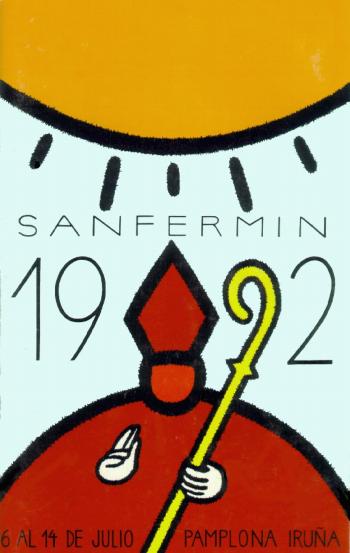
The official San Fermín 1992 poster, selected through the annual concurso de carteles held by the Ayuntamiento de Pamplona. Source: Ayuntamiento de Pamplona, cartel archive.
The City in 1992
Pamplona in the summer of 1992 carried the energy of a Spain that was, for the first time in the modern era, genuinely at the center of the world’s attention. The fiesta filled the city as it always did, but the international component of the crowd was higher than usual and the press presence was more varied. Journalists who had come to Spain to get ahead of the Olympic story were stopping in Pamplona first. The bars around the Plaza del Castillo were busier than ever in the mornings after each run.
On Estafeta itself, the multilingual crowd at the barriers, watching each morning’s bulls charge past, reflected a Spain that had opened itself to a global audience and was finding that the audience had arrived. The approximately 7 gorings across the week added a kind of news value that Olympic-era coverage was ready to amplify. The chupinazo opened the fiesta at noon on July 6; three weeks after the Pobre de Mí closed it on July 14, Barcelona lit the Olympic flame.
How 1992 Came Together
Key facts in the 1992 fiesta, kept on the record.
The chupinazo marks the opening of the 1992 fiesta in the Plaza Consistorial, with a crowd drawn in part by the extraordinary national context of Spain’s Olympic summer.
Cebada Gago runs the second encierro, their compact Cádiz cattle making an early-week appearance in one of the most internationally watched fiestas in Pamplona’s modern history.
Miura runs the sixth encierro, not in the closing slot but mid-week, continuing the 1982-2000 clean streak at Pamplona. The most feared name completes the course without incident.
Marqués de Domecq closes the final encierro of 1992. The eight runs of the Olympic year are complete. Three weeks later, on July 25, Barcelona opens the Summer Olympics. The Pobre de Mí at midnight ends the fiesta.
San Fermín 1992, Answered
Why was 1992 significant for Spain and how did it affect Pamplona?
Spain in 1992 hosted both the Barcelona Summer Olympics (opening July 25) and the Expo 92 World Exposition in Sevilla, which ran from April through October. This combination made Spain the focus of global media attention for most of the year. The San Fermín fiesta ran in early July, three weeks before the Olympic opening ceremony, and benefited from the elevated international interest: more foreign press, more international visitors, and broader television coverage than most previous years.
What happened to the 1992 San Fermín cartel poster?
The 1992 cartel is missing from the Ayuntamiento de Pamplona’s official archive, which otherwise holds posters from 1942 onward. The artist is unknown, and no verified reproduction has been publicly identified. It is the most significant archival gap in the fiesta’s modern visual record, and the reason for the absence has not been officially explained.
Did Miura close the 1992 fiesta?
No. In 1992, Miura ran sixth on July 12. The closing encierro was run by Marqués de Domecq from Jerez on July 14. Miura’s position in the lineup varies across years; in some years they close, in others they appear earlier in the week.
How many gorings were there in 1992?
The approximate goring total for 1992 was 7, above the 1990 figure of approximately 5 and the 1991 figure of approximately 6. There were no deaths in 1992. The higher total may reflect the larger and more diverse crowd that the Olympic-year context attracted, including more inexperienced runners on the course alongside the regulars.
Planning your own run?
To trace how the 1992 encierro fits into the wider arc of the early decade, see San Fermín 1993 for the year the goring count reached its early-decade peak, or explore the route with the runners who have studied it longest.