
San Fermín 1994: Miura ran third, the most feared herd in Pamplona arriving just two days into the fiesta, before most runners had found their rhythm
July 6 to 14, 1994. Eight encierros with an unprecedented scheduling decision: Cebada Gago opened for a second consecutive year, and Miura appeared in the third slot, their earliest placement in recent memory.
Looking Back at 1994
Looking back at 1994, the scheduling decision that draws the most attention is Miura running third. In most years of the 1980s and 1990s, the Sevilla giants appeared in the second half of the encierro week, often in the closing slot. Running third on July 9 meant that by the time Miura appeared on the streets, the fiesta had only held two encierros. Runners who structured their week around Miura as a finale had to recalibrate completely, and those who were only able to attend a few mornings near the start of the week faced the most feared ganaderiía in Pamplona on what would have been a relatively early morning under any other year’s schedule.
The year also continued a pattern established in 1993: Cebada Gago opening the fiesta for the second consecutive year. Two years running, the most statistically dangerous herd in Pamplona’s lineup occupied the first slot. Osborne closed on July 14, providing a well-bred Jerez finale to a week that had Miura and Cebada Gago in its first three positions. The approximately 6 gorings, lower than 1993’s approximately 8, suggest the fiesta was somewhat more contained despite the high-intensity opening sequence.
Dennis Clancey, Founder, Encierro
When the Calendar Refused to Wait
The Miura placement in 1994 was the kind of scheduling anomaly that the Pamplona encierro community takes seriously. For runners who follow the event closely, the position of the ganaderías in the lineup is not a trivial detail. Miura in the third slot on July 9 meant the most feared name in the encierro would run just 48 hours after the fiesta opened. Most runners were still shaking off the previous year’s absence from the course. The muscle memory, the reading of the crowd, the sense of pace on Estafeta, none of it had fully returned by day three.
Spain in 1994 was in a period of economic correction after the expansion of the late 1980s and the Olympic year. The political landscape was also shifting, with several corruption scandals touching the governing Socialist party, and the national mood was more complicated than the confident outward-facing tone of 1991 and 1992. Pamplona absorbed none of this directly, the fiesta ran on its own calendar with its own priorities, but the crowd that arrived in July 1994 was part of a Spain that was working through a more difficult moment. The encierro itself was, as always, indifferent to national politics. The bulls ran the same 875 meters regardless.
“Miura third was not something you planned for. You trained for Miura closing the week, a full seven mornings to build up to it. Running into them on Saturday, after only two previous encierros, was a different kind of problem.”
Every 1994 Encierro, Day by Day
Each run with its ganaderiía and approximate time. The route runs approximately 875 meters from Santo Domingo to the ring. Gorings for 1994 are not individually recorded by run; the year total was approximately 6.
Cebada Gago
Gored: see year total
Cebada Gago opened the 1994 fiesta for the second consecutive year, their fast compact bulls from Bornos providing the same volatile beginning they had in 1993. Two years in the opening slot established something close to a pattern, though Cebada Gago’s usual positioning was mid-week. A fiesta that begins with the most unpredictable herd in the lineup offers runners no introductory morning at lower intensity.

Conde de la Corte
Gored: see year total
Conde de la Corte from Badajoz provided the second encierro on Friday July 8, their Extremadura cattle generally more controlled in their passage through the course than the opening day’s Cebada Gago. The second morning gave runners a chance to find their footing, knowing that Miura was next.

Miura
Gored: see year total
Miura ran third on Saturday July 9, the earliest they had appeared in recent memory in the encierro sequence. Part of the 1982-2000 clean streak at Pamplona, their tall, long-horned, intelligent cattle from Sevilla completed the course without a goring in this run. The Saturday crowd, among the largest of the week, filled the balconies to capacity for a Miura morning that arrived unusually early in the schedule.

Pablo Romero
Gored: see year total
Pablo Romero brought their large, traditionally bred Sevilla cattle to the fourth encierro. Running the day after Miura, Pablo Romero’s substantial animals provided the Sunday morning crowd with another demanding run. The classic ranch is known for imposing bulls that carry weight and presence through the course.

Benítez Cubero
Gored: see year total
Benítez Cubero, a less commonly seen ganaderiía at Pamplona, ran the fifth encierro on Monday July 11. Their appearance in the 1994 lineup added a degree of unfamiliarity to the week’s second half, as runners had less accumulated knowledge of this ranch’s behavior patterns on the course compared to the established names that had run the first four mornings.

Torrestrella
Gored: see year total
Torrestrella from Jerez, a well-regarded ganaderiía, ran the sixth encierro on July 12. Their Jerez cattle ran with the discipline associated with the better-bred southern ranches, giving the second half of the week a more measured quality after the front half’s extraordinary opening sequence.

Marqués de Domecq
Gored: see year total
Marqués de Domecq ran the penultimate encierro on Wednesday July 13, their cattle known for running in ordered packs. The second-to-last morning of a fiesta week draws experienced runners who want one more pass through the course before the closing run. A Domecq penultimate morning means the week ends without the maximum pressure of the final day falling on the most volatile ganaderiía.

Osborne
Gored: see year total
Osborne closed the 1994 fiesta on the final Thursday, their well-bred Jerez cattle providing the last encierro of the week. The famous family’s ranch is known for animals that behave consistently on the course, and a closing run with Osborne meant the 1994 fiesta ended at a different register than years when Miura closes. With Miura already spent three days into the week, the final morning belonged to one of the more measured herds in the lineup.
What the Record Remembers
San Fermín 1994 Official Poster
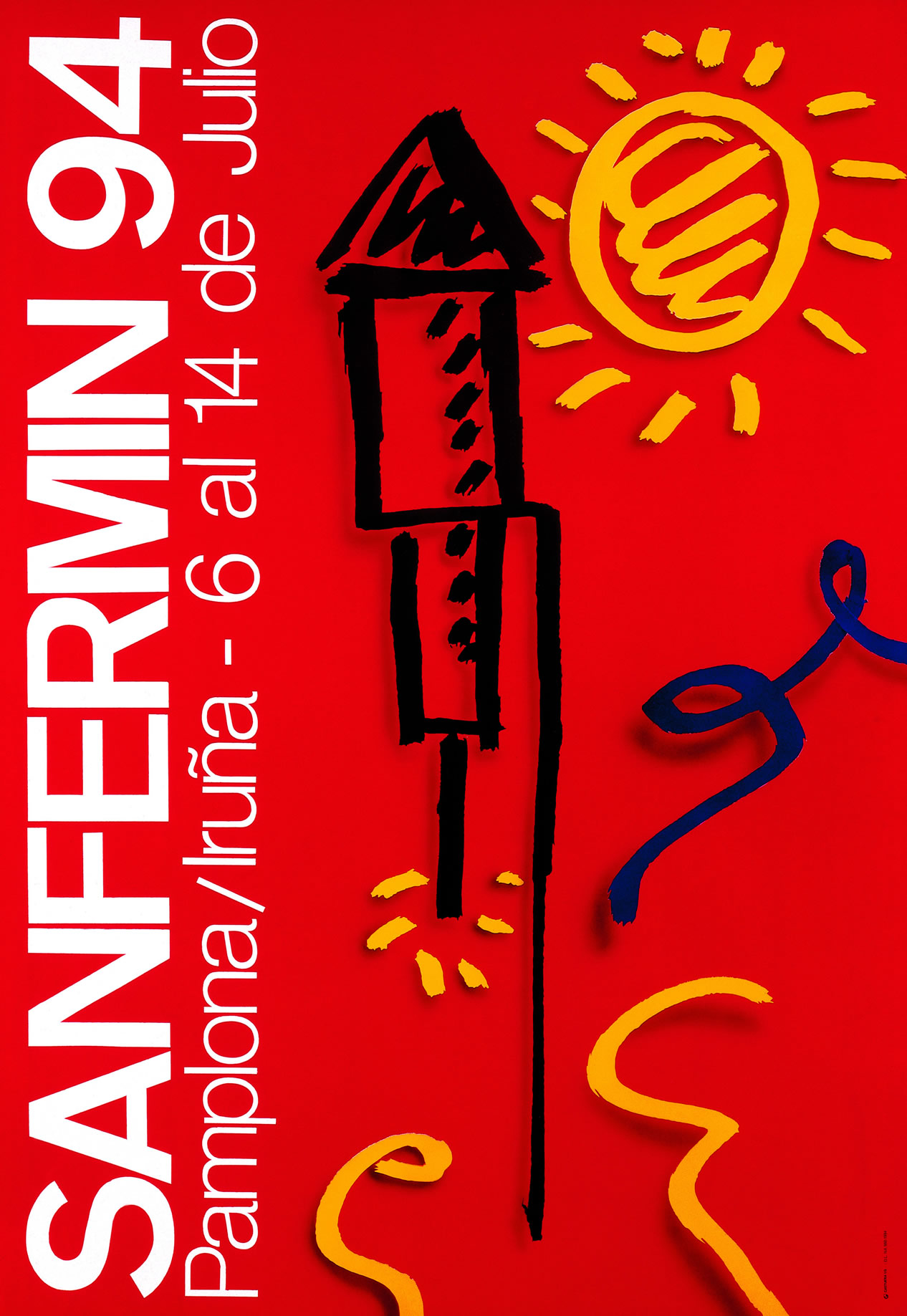
Cartel 1994 by Enrique Martín González.
Enrique Martín González’s 1994 poster worked in the graphic tradition of San Fermín cartel art, which by the mid-1990s had developed a consistent visual vocabulary: the tension between red and white, the suggestion of motion through strong compositional lines, and imagery that captured both the festive and the dangerous aspects of the encierro in a single image. Martín González brought his own approach to this framework for the 1994 edition.
Source: Ayuntamiento de Pamplona, cartel archive
Pamplona’s annual concurso de carteles selected this as the official Sanfermines poster for 1994.
The City in 1994
Pamplona in July 1994 was a city firmly embedded in the annual ritual of the fiesta, the logistics fully practiced and the international component of the crowd large enough to have changed the character of the week without displacing the local and Navarran core that has always run the encierro on its own terms. The unusual scheduling of 1994, Miura third and Cebada Gago first for a second year, gave regulars more to discuss in the bars around Plaza del Castillo than a conventional lineup would have.
Runners who had followed the encierro for years were comparing notes: how did Miura third feel versus Miura closing? What had changed about the Cebada Gago morning with two consecutive opening slots? The approximately 6 gorings, lower than 1993’s approximately 8, suggested the week ran with somewhat less incident than its front-loaded drama had threatened. The chupinazo opened the fiesta at noon on July 6; the Pobre de Mí at midnight on July 14 closed it with Osborne’s measured Jerez cattle fresh in the memory.
How 1994 Came Together
Key facts in the 1994 fiesta, kept on the record.
The chupinazo rocket fires, opening the 1994 fiesta. The lineup, with Cebada Gago opening and Miura third, is already generating discussion among runners who follow the schedule.
Cebada Gago opens the fiesta for the second consecutive year, their compact fast bulls from Bornos providing a volatile beginning with no introductory warm-up morning for runners.
Miura runs the third encierro on Saturday, their earliest appearance in recent memory. The most feared ganaderiía in the encierro completes the course as part of the 1982-2000 clean streak at Pamplona.
Osborne closes the final encierro of 1994. The eight runs of the year end with a well-bred Jerez herd, a quieter finale than the week’s opening sequence might have suggested. The Pobre de Mí at midnight ends the fiesta.
San Fermín 1994, Answered
Why was Miura running third in 1994 unusual?
In most years of the early 1990s and the broader mid-century era, Miura appeared in the second half of the encierro week, often in the closing slot on July 14. Running third on July 9 placed them just two days after the fiesta opened, before most runners had accumulated the week’s usual preparation. Experienced runners who structured their approach around Miura as a finale had to recalibrate entirely. It was the earliest appearance by Miura in the lineup for several years and is consistently cited by participants as one of the memorable scheduling decisions of the era.
Did Cebada Gago open the fiesta in back-to-back years?
Yes. Cebada Gago opened the fiesta in both 1993 and 1994, an unusual consecutive placement for a ganaderiía that typically ran mid-week. This two-year opening sequence put the most statistically dangerous herd at Pamplona in the highest-profile slot for back-to-back fiestas, ensuring that both fiestas began at maximum unpredictability.
Which ganaderiía closed the 1994 fiesta?
Osborne from Jerez de la Frontera closed the 1994 fiesta on July 14, running the eighth and final encierro. With Miura already run on July 9, the closing morning with Osborne was a well-bred Jerez finale rather than the high-intensity ending that a Miura closing would produce. Osborne’s cattle are known for consistent behavior on the course.
How does the 1994 goring total compare to the rest of the early decade, and were there any deaths?
The approximately 6 gorings in 1994 placed it below the 1993 total of approximately 8, returning to a level closer to the 1991 figure of approximately 6. The trend from 1990 to 1993 was upward (approximately 5, 6, 7, 8), and 1994 broke that trend with a reduction. There were no deaths in 1994, continuing the zero-fatality record that held throughout the 1990-1994 period.
Planning your own run?
To see how the 1994 fiesta sits within the broader arc of the mid-decade encierro, see San Fermín 1995, or explore the route with the runners who have studied it longest.