
San Fermín 1995: The year an American runner died in Pamplona, and the world finally paid attention.
July 6 to 14, 1995. Eight encierros, one fatality, and the international moment that changed how the world understood the running of the bulls.
Looking Back at 1995
Looking back at 1995, it is clear this was the year the encierro crossed a threshold in international consciousness. Matthew Peter Tassio, a 22-year-old from Barrington, Illinois, was gored and killed on July 13 by a Torrestrella bull named “Castellano” at the Plaza del Ayuntamiento. He was the first American citizen to die in the Pamplona encierro. ABC, CBS, and CNN carried the story into American homes, and suddenly a medieval Spanish tradition was front-page news across the Atlantic.
Looking back at the arc of the fiesta in that era, 1995 sits as a turning point. Hemingway had introduced the encierro to English-language readers decades earlier, and travel journalism had been building North American curiosity through the 1980s and early 1990s. But nothing spread awareness faster than a news cycle. After July 13, 1995, every American backpacker in Europe knew the name Pamplona. The Tassio family later worked with the city to develop awareness materials explaining the real dangers to first-time runners, a practical legacy from a devastating loss.
Dennis Clancey, Founder, Encierro
The Year the Encierro Entered the American Conversation
By the mid-1990s, Spain was in the middle of a sustained economic expansion. Madrid and Barcelona were modernizing rapidly, regional tourism infrastructure was improving, and Pamplona was drawing more international visitors than at any point in its history. The internet was not yet a mass medium, but it was beginning to carry encierro footage and planning information to curious runners worldwide. The fiesta of 1995 arrived at the intersection of this rising global curiosity and a genuinely deadly morning on the Estafeta.
The death of Matthew Tassio at the Plaza del Ayuntamiento on July 13 was not a freak accident in the sensational sense; the encierro had killed runners before, and the risks were well understood by anyone who studied the record. What was new was the camera coverage and the speed of the news cycle. Within hours, networks were broadcasting footage and filing dispatches from Pamplona. For a generation of American travelers who associated San Fermín vaguely with Hemingway and adventure, 1995 made the danger concrete and undeniable.
“He had stopped, and when the bull came through, he was rising. That is the worst position you can be in on the course. Everything the organizers warn about.” Source: Contemporary press account, July 1995
Every 1995 Encierro, Day by Day
Each run with its ganaderiía, approximate time, and horn injuries. The route runs approximately 849 meters from Santo Domingo to the ring. Per-run goring counts for 1995 are not individually recorded in the main reference sources.

Celestino Cuadri
Gored: see year total
The festival opened with Celestino Cuadri, a solid Huelva ranch that had been sending bulls to Pamplona through the 1990s. The first morning drew the usual mix of veteran runners and first-timers who had been waiting since the previous night’s chupinazo.
Miura
Gored: see year total
The most feared name in the encierro ran second in 1995, extending their extraordinary 1982-2000 no-goring streak at Pamplona. Miura’s tall, long-horned, intelligent bulls drew more experienced runners to the barriers and more cameras to the course than any other ganaderiía.
Dolores Aguirre
Gored: see year total
A woman-owned ranch with deep roots in Salamanca taurine culture, Dolores Aguirre brought a well-regarded string to the July 9 morning. The run completed without fatality in what was becoming a pattern of accumulating tension heading toward the festival’s second week.
Cebada Gago
Gored: see year total
By the mid-1990s, Cebada Gago was already building its reputation as one of the most dangerous ganaderiías on the course: fast, compact, and aggressive. The July 10 morning brought the characteristic Cebada energy to the Estafeta and the Dead Man’s Corner at Telefónica.
Sepúlveda
Gored: see year total
Sepúlveda, a regular Pamplona participant through the 1990s, ran the fifth morning. By the second week of the fiesta, the crowd always thins somewhat from pure exhaustion, but the commitment level among those still running tends to be high.
Núñez del Cuvillo
Gored: see year total
Núñez del Cuvillo would go on to become one of the most prominent ganaderiías of the 2000s and 2010s. In 1995 the ranch was already earning its reputation for well-built, fast bulls. The penultimate full day before the fatal July 13 morning passed without major incident.
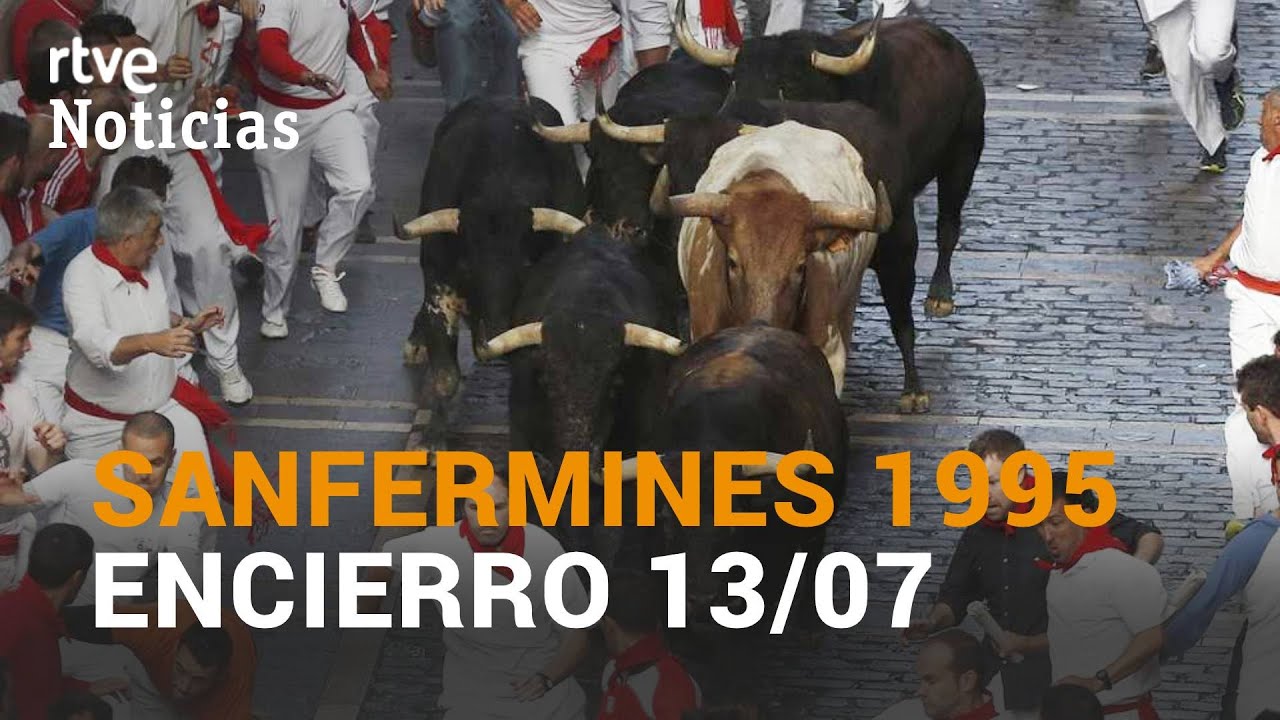
Torrestrella
Gored: 1 fatal
At the Plaza del Ayuntamiento, Torrestrella bull “Castellano” caught Matthew Peter Tassio as he was rising after a fall. The horn caught him in the neck. Tassio, 22, from Barrington, Illinois, died from his injuries. He was the first American citizen to die in the Pamplona encierro. International press coverage began within hours.
El Torreón
Gored: see year total
The festival closed with El Torreón, one of the less common names in the 1990s encierro rotation. The July 14 closing run always carries the weight of farewell; in 1995, with a death two days earlier still fresh, the final morning had a particular gravity.
What the Record Remembers
Official Poster of San Fermín 1995
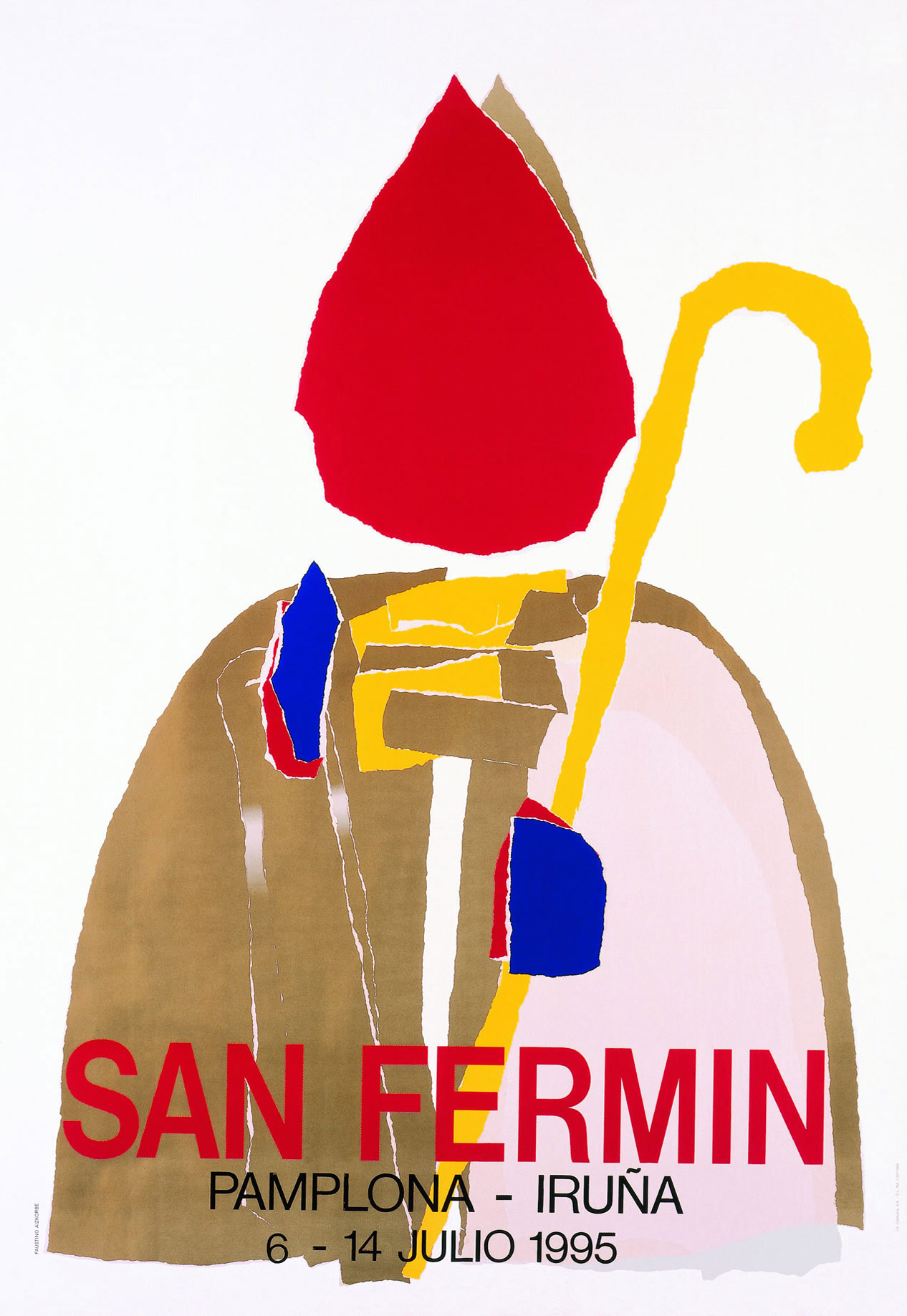
Cartel 1995 by Faustino Aizkorbe.
The 1995 official poster, by Faustino Aizkorbe, is rendered in the bold graphic style characteristic of the era’s Navarrese festival art. The image centers on the bull and the runner in a dynamic composition, drawing on the visual shorthand that had defined San Fermín cartels for decades. The palette tends toward the reds and whites of the festival colors.
Source: Ayuntamiento de Pamplona, cartel archive
Named the official cartel of San Fermín 1995 after winning the Ayuntamiento’s annual poster contest.
The City in 1995
Pamplona in 1995 was a city that had grown considerably since the Franco years, expanding outward from the old walled city into modern apartment blocks and commercial districts, but the fiesta still compressed everything back into the narrow streets of the casco antiguo. The weeks surrounding San Fermín brought the city’s population from around 180,000 to something closer to a million, with visitors from across Spain, Europe, and increasingly North America and Australia. The city had invested in festival infrastructure through the late 1980s and early 1990s, and by 1995 the logistics of managing a week-long mass event were well-rehearsed.
The shadow of July 13 fell across the final two days, but the fiesta continued, as it always does, because Pamplona understood long before 1995 that the encierro could not be stopped by grief. The chupinazo had opened the festival at noon on July 6 from the balcony of the Pamplona town hall, and the Pobre de Mí at midnight on July 14 brought it to its close as it had done every year before.
How 1995 Came Together
Key facts in the 1995 fiesta, kept on the record.
The chupinazo fires from the balcony of the Pamplona city hall at noon, officially opening the 1995 fiesta. The crowd in the Plaza del Castillo is dense from the early morning.
Miura runs the second encierro of the festival, completing the morning without goring any runner and extending their post-1982 clean record at Pamplona.
Matthew Peter Tassio, 22, of Barrington, Illinois, is fatally gored by Torrestrella bull “Castellano” at the Plaza del Ayuntamiento. He becomes the first American citizen to die in the Pamplona encierro. International media coverage begins within hours.
El Torreón runs the final encierro of the 1995 fiesta. The closing ceremonies of San Fermín take place in the Plaza del Castillo with the traditional Pobre de Mí song, ending the festival as the clock strikes midnight.
San Fermín 1995, Answered
Who was Matthew Tassio and why does his death matter historically?
Matthew Peter Tassio was a 22-year-old from Barrington, Illinois, traveling Europe after college when he stopped in Pamplona for San Fermín in 1995. On July 13 he was gored in the neck by Torrestrella bull “Castellano” at the Plaza del Ayuntamiento while rising after a fall. His death made him the first American citizen killed in the Pamplona encierro, and the resulting international news coverage, particularly on CNN and the major US broadcast networks, brought the encierro to American audiences in a new and serious way. His family worked with Pamplona city officials afterward to improve safety awareness materials for foreign runners.
Which ganaderiía ran in 1995 and which was considered most dangerous?
The eight ganaderiías in 1995 were: Celestino Cuadri (Jul 7), Miura (Jul 8), Dolores Aguirre (Jul 9), Cebada Gago (Jul 10), Sepúlveda (Jul 11), Núñez del Cuvillo (Jul 12), Torrestrella (Jul 13), and El Torreón (Jul 14). Cebada Gago was building its reputation as the most dangerous ranch on the course by the mid-1990s. Miura carried the most historical weight and fear, though their 1982-2000 Pamplona no-goring streak continued.
How many gorings were there in 1995?
Approximately 9 gorings across the eight encierros of the festival, including the fatal goring of Matthew Tassio on July 13. Per-run goring counts for 1995 are not individually recorded in the main reference sources; the total includes one death and multiple hospitalizations.
Was the 1995 fiesta cancelled or shortened after Tassio’s death?
No. The encierro ran as scheduled through July 14, closing with El Torreón on the final morning. The fiesta of San Fermín has been cancelled only for wartime and, in the modern era, for the COVID-19 pandemic of 2020-2021. A death in the encierro, while deeply serious, does not trigger cancellation. The July 14 closing ceremonies proceeded, and the city mourned while the festival continued.
Planning your own run?
For the 1994 encierros, the year before Tassio and the international surge in attention, see the 1994 page. For 1996, the year Miura ran first on opening morning in one of the most unusual scheduling decisions of the modern era, see the 1996 page.