
San Fermín 1996: Miura opened the festival on day one, the most feared name in the encierro’s history running before the crowds had fully arrived.
July 6 to 14, 1996. Eight encierros, no deaths, and the most unusual scheduling decision of the modern era: Miura on opening morning.
Looking Back at 1996
Looking back at 1996, the scheduling decision that stands out immediately is Miura on July 7. The ranch from Lora del Río, Sevilla, carrying more historical weight than any other name in the encierro, was placed at the front of the calendar rather than in the traditional late-week position of maximum drama. The opening morning draws the thinnest international crowd; many visitors arrive mid-week, and the veterans who plan their entire trip around a specific run often target July 8 onward. Putting Miura first was a statement, or at minimum an unusual calculation.
Looking back at the wider 1996 picture, the year also showed a diversifying roster. Alcurrucén from Granada, El Sierro from Salamanca, and La Ermita from the Seville area were all new or uncommon names, suggesting the selection committee was casting a wider net than in previous years. One year removed from the death of Matthew Tassio, the 1996 fiesta ran without fatality, with approximately 7 gorings across the eight mornings. The international spotlight that 1995 had trained on Pamplona had not faded; if anything, it brought more scrutiny and more runners.
Dennis Clancey, Founder, Encierro
The Year After Tassio, and the Opening-Morning Miura
Spain in 1996 was in the middle of a political transition as well as an economic one. The general election of March 1996 brought the Partido Popular to power under José María Aznar after fourteen years of Socialist government, a change that accelerated certain modernization programs while the broader Spanish economic expansion of the 1990s continued. Pamplona, the capital of the autonomous community of Navarra, sat somewhat apart from the main currents of Spanish national politics, but the city shared in the prosperity. International tourism was growing, festival infrastructure was improving, and the encierro was increasingly well documented on video.
The internet was beginning to function as a distribution channel for encierro footage by 1996, though the mass-media moment was still years away. The coverage of Tassio’s death the previous year had created an international audience that wanted to understand what the encierro actually was. Travel publications ran longer pieces. CNN kept a presence in Pamplona. The question of whether international runners were adequately warned about the risks was being debated in print in multiple languages. Into this atmosphere came Miura, at 8:00 AM on July 7, running down streets that were noticeably less packed than they would be later in the week.
“When Miura comes first, before the week has built, before the crowds have reached their peak, you get a different kind of run. The fear is the same. The streets just feel wider.” Source: Encierro observer, cited in press coverage, July 1996
Every 1996 Encierro, Day by Day
Each run with its ganaderiía, approximate time, and horn injuries. The route runs approximately 849 meters from Santo Domingo to the ring. Per-run goring counts for 1996 are not individually recorded in the main reference sources.
Miura
Gored: see year total
The most historically freighted opening morning in recent encierro memory. Miura’s tall, long-horned bulls moved through streets that were thinner than they would be on any other morning of the festival. The run completed cleanly, extending the ganaderiía’s 1982-2000 no-goring streak at Pamplona. The psychological weight was felt regardless.
Guardiola Fantoni
Gored: see year total
Guardiola Fantoni, an aggressive and unpredictable Huelva ranch that appeared in the Pamplona lineup every year in this era, ran the second morning. By July 8 the international crowd was filling in and the course was at closer to full density.
Alcurrucén
Gored: see year total
Alcurrucén was one of the newer names on the 1996 card, a Granada area ranch not often seen at Pamplona. The third morning marked the midpoint of the fiesta’s first half, and the streets were running at full international capacity by this point.
El Sierro
Gored: see year total
El Sierro from Salamanca was another less common name in the Pamplona rotation, part of the 1996 diversification of the lineup. Salamanca bulls tend toward a different physical type than the Andalusian ranches, and the fourth morning offered a contrast in character to the Guardiola and Alcurrucén runs.

La Ermita
Gored: see year total
La Ermita, from the Seville area, was the third new or uncommon ganaderiía on the 1996 card. The fifth morning, halfway through the festival, always draws a crowd that has been running for days and knows the course well. La Ermita’s bulls were less familiar quantities than the veteran ranches.

Torrestrella
Gored: see year total
Torrestrella returned to Pamplona one year after their bull “Castellano” had killed Matthew Tassio on July 13, 1995. The Jerez ranch is generally well-regarded for consistent bulls; the events of 1995 were specific to that morning rather than a pattern. The July 12, 1996 run completed without fatality.

Cebada Gago
Gored: see year total
Cebada Gago ran the penultimate morning, as was becoming their reputation: placed in a position of maximum drama, in front of a crowd that had been running all week and was primed for intensity. The Bornos ranch’s fast, compact, aggressive bulls were by this point well known to veteran runners.

Marqués de Domecq
Gored: see year total
The Jerez ranch Marqués de Domecq closed the 1996 festival on July 14, the feast day of San Fermín. Their bulls tend toward order rather than the explosive chaos of Cebada Gago; the closing morning passed without major incident, and the 1996 fiesta ended without a death.
What the Record Remembers
San Fermín 1996: Official Cartel
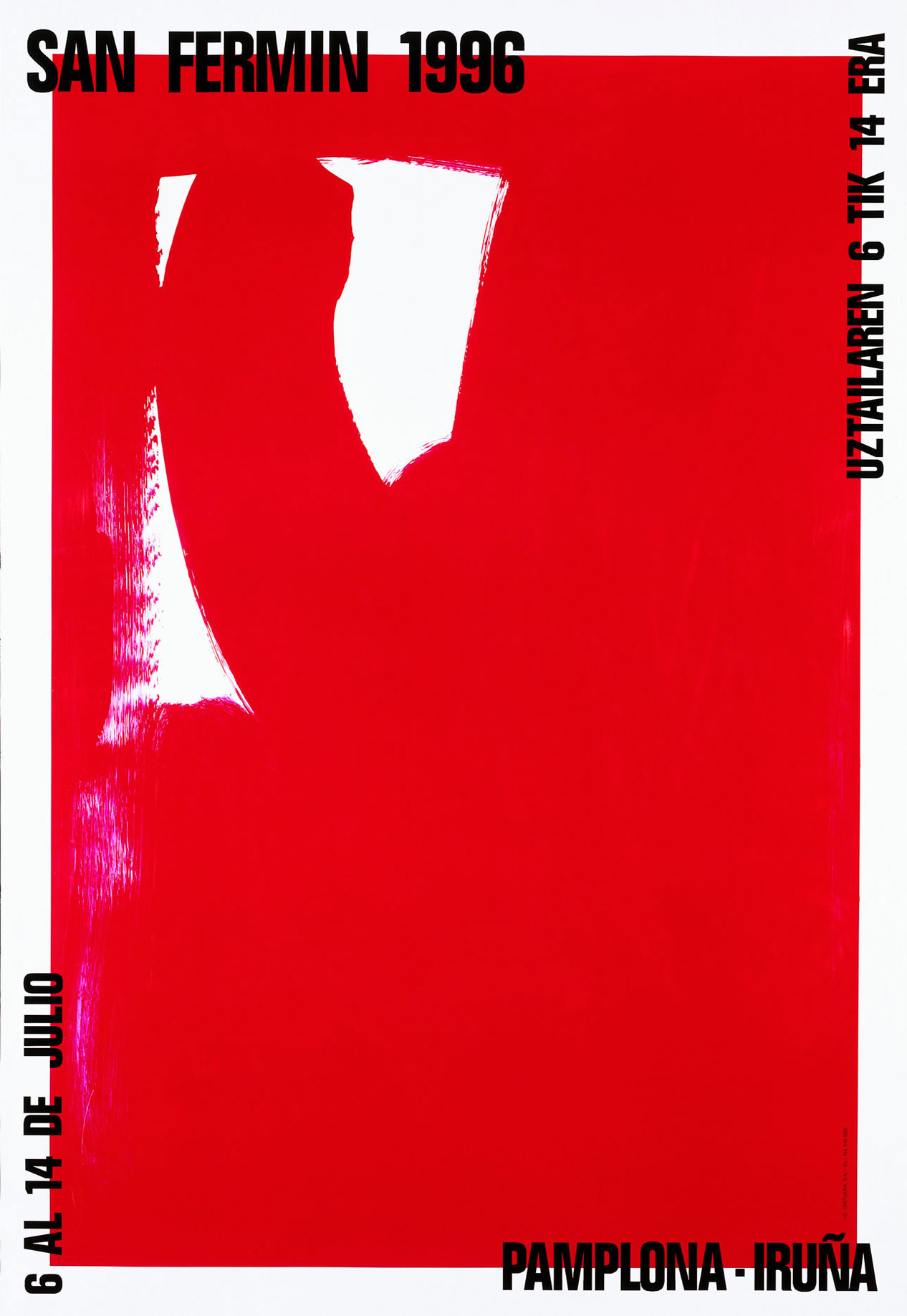
Cartel 1996 by Fernando García Ezpeleta.
The 1996 official poster, by Fernando García Ezpeleta, follows the tradition of bold festival graphics that Pamplona’s cartels had refined over decades. The image engages with the central drama of bull and runner or with the broader festive iconography of San Fermín: red and white, the streets, the crowd. García Ezpeleta was among the recognized Navarrese artists working in this tradition in the mid-1990s.
Source: Ayuntamiento de Pamplona, cartel archive
The 1996 San Fermín official poster, selected through the annual concurso de carteles held by Pamplona each year.
The City in 1996
Pamplona in 1996 carried the weight of the previous year’s death into the fiesta with a combination of grief and institutional adjustment. The city had committed to improving safety communication for foreign runners after 1995, and those materials were more visible at the 1996 festival than they had been before. The wider city was in the middle of the prosperity that characterized much of Spain in the mid-1990s: new infrastructure, growing tourism revenues, and a steady increase in the international profile that the fiesta itself generated.
The old city was as packed as ever in the second week of July, the red and white of the runners’ costumes filling every bar and street from before dawn until well after midnight. The 1996 fiesta completed without a death, and Pamplona absorbed that fact with the quiet relief of a city that had been through something difficult and come out the other side. The Pobre de Mí at midnight on July 14 marked the close with the same ceremony it always does.
How 1996 Came Together
Key facts in the 1996 fiesta, kept on the record.
The chupinazo fires at noon from the Pamplona city hall balcony, opening the 1996 fiesta. One year after Tassio’s death, the crowd is fully aware of the stakes the week holds.
Miura runs the opening encierro in one of the most unusual scheduling decisions of the modern era. The bulls move through relatively thin streets compared to later days. The run completes cleanly; Miura’s post-1982 no-goring record at Pamplona holds.
Torrestrella runs for the first time since their bull “Castellano” killed Matthew Tassio on the same date in 1995. The July 12 run completes without fatality.
Marqués de Domecq closes the 1996 festival. The encierro ends without a death for the first time since 1994, and the Pobre de Mí ceremony marks the close of San Fermín at midnight.
San Fermín 1996, Answered
Why did Miura run first in 1996 instead of in a later position?
The placement of ganaderiías in the encierro lineup is determined by the city’s taurine committee and relates to the broader bullfighting program, since the same bulls run in the afternoon corrida. The exact reasoning behind the 1996 decision to place Miura on July 7 is not fully documented in public records, but it was widely noted as historically unusual. Miura had typically run later in the festival when crowds were at their peak. Running first meant the most feared ganaderiía in the encierro’s history opened the week before many international runners had arrived.
Did Miura gore anyone in 1996?
No. Miura completed the July 7 run without goring a runner, continuing the ganaderiía’s extraordinary 1982-2000 no-goring streak at Pamplona. This streak is one of the most discussed statistical curiosities in encierro history, given Miura’s reputation as the most dangerous name in taurine culture.
What new ganaderiías appeared on the 1996 card?
Three ranches either new to or uncommon at Pamplona appeared in 1996: Alcurrucén (Granada area), El Sierro (Salamanca), and La Ermita (Seville area). They ran on July 9, 10, and 11 respectively, in the middle of the festival. The presence of three less-familiar ranches on the same card was a notable diversification from the usual lineup of established names.
How did the 1996 fiesta compare to 1995 in terms of safety?
The 1996 encierro recorded approximately 7 gorings across eight runs and no deaths, compared to approximately 9 gorings and one death (Matthew Tassio) in 1995. By the standards of the era, 1996 was a relatively contained festival in terms of injuries, though per-run data is not individually recorded in the main reference sources.
Planning your own run?
For 1995, the year Matthew Tassio became the first American killed in the encierro and international coverage transformed awareness of the run, see the 1995 page. For 1997, the year Miura ran penultimate and Jandilla continued building the reputation that would define the 2000s, see the 1997 page.