
San Fermín 1997: Jandilla locked in its annual place, Miura ran penultimate, and a woman-owned ranch brought its bulls to the July 9 morning.
July 6 to 14, 1997. Eight encierros, no deaths, and a lineup that placed two of the encierro’s most significant names in the second half of the week.
Looking Back at 1997
Looking back at 1997, several things are worth noting separately. First, the lineup itself: Jandilla ran fifth, Miura ran seventh, and El Pilar closed. That ordering placed two of the encierro’s most freighted names in the second half of the week, which created the kind of escalating tension that veteran runners plan their entire trip around. Second, the presence of María Luisa Domínguez on July 9 was notable in a world where female ranch ownership remained uncommon enough to draw comment. And third, the year produced approximately 6 gorings with no deaths, the kind of outcome that the taurine world calls, with understated precision, a normal festival.
Looking back further, 1997 fits into a mid-decade pattern of consolidation in the encierro’s international profile. The Tassio coverage of 1995 had not faded entirely; it had settled into something more durable: a baseline international awareness that kept the encierro in travel journalism and in the conversations of backpackers planning European summers. The internet was beginning to accelerate this. By 1997, running in Pamplona had become something that a certain kind of North American or Australian traveler put on a shortlist alongside Oktoberfest and the Camino de Santiago.
Dennis Clancey, Founder, Encierro
Jandilla, Miura Penultimate, and a Changing Roster
Spain in 1997 was deepening the economic expansion that had characterized the decade. The Aznar government was pushing toward meeting the criteria for European Monetary Union, and Spain’s growth rates were among the strongest in Western Europe. Pamplona, already a prosperous provincial capital in an autonomous community that had long outperformed the Spanish national average, shared in this prosperity. The fiesta infrastructure was well-funded, the city’s accommodation had expanded considerably since the 1980s, and international tourism was running at record levels.
The encierro itself was navigating a specific post-1995 moment. Safety communication had improved; the city was more deliberately reaching foreign runners with information about the risks. Experienced Navarrese runners expressed concern about crowds that didn’t know the course. Foreign runners pushed back that the encierro had always drawn outsiders and that Hemingway himself was not from Pamplona. The 1997 festival entered this conversation with a solid lineup, approximately 6 gorings, and eight mornings that passed without killing anyone.
“Jandilla every year now. The Tarifa bulls are getting a reputation. Fast, compact, lower to the ground than Miura. A different kind of fast.” Source: Encierro habitué, press notes, July 1997
Every 1997 Encierro, Day by Day
Each run with its ganaderiía, approximate time, and horn injuries. The route runs approximately 849 meters from Santo Domingo to the ring. Per-run goring counts for 1997 are not individually recorded in the main reference sources.

Conde de la Corte
Gored: see year total
Conde de la Corte, a well-regarded ranch from Badajoz, opened the 1997 festival. The Extremadura ranch had long maintained a solid reputation in taurine culture, and the July 7 morning set a measured tone for the week ahead.
Guardiola Fantoni
Gored: see year total
Guardiola Fantoni ran the second morning, as they did most years in this era. The Huelva ranch’s aggressive and unpredictable bulls meant the second day was rarely quiet. By July 8 the international crowd had filled in and the course was at near-full density.
María Luisa Domínguez
Gored: see year total
A female-owned ranch appearing on the Pamplona card was genuinely uncommon in 1997. María Luisa Domínguez brought her bulls from the Salamanca area to the third morning, and the run added a note of discussion to a taurine world that was still predominantly male in ownership and culture.

Torrestrella
Gored: see year total
Torrestrella ran the fourth morning of 1997, two years after “Castellano” killed Matthew Tassio. The Jerez ranch is generally consistent in producing well-built bulls; the July 10 morning passed without fatality, adding another data point to the ranch’s long record at Pamplona.

Jandilla
Gored: see year total
Jandilla ran the fifth morning, continuing what was becoming an annual Pamplona presence for the Tarifa ranch. Fast, compact bulls from the southern tip of the Iberian Peninsula, built differently from the tall Miura animals or the Salamanca type. By 1997 the encierro world was beginning to talk about Jandilla with a level of respect usually reserved for the old names.

Hermanos Astolfi
Gored: see year total
Hermanos Astolfi from Seville ran the sixth morning, a less common name in the Pamplona rotation. With Miura scheduled for the following day, the sixth morning had a particular quality: experienced runners were already calculating their approach for July 13.
Miura
Gored: see year total
Miura in the penultimate position, as the festival built toward its close, drew the crowds and attention the ganaderiía always commanded. The July 13 run extended the 1982-2000 no-goring streak once more. The bulls moved through streets at maximum density with the accumulated experience of runners who had been on the course all week.

El Pilar
Gored: see year total
El Pilar closed the 1997 festival on the feast day of San Fermín. A less common closer by the standards of the era, the Seville area ranch brought the eight mornings to an end without fatality. The “Pobre de Mí” ceremony followed at midnight.
What the Record Remembers
The Official San Fermín 1997 Poster
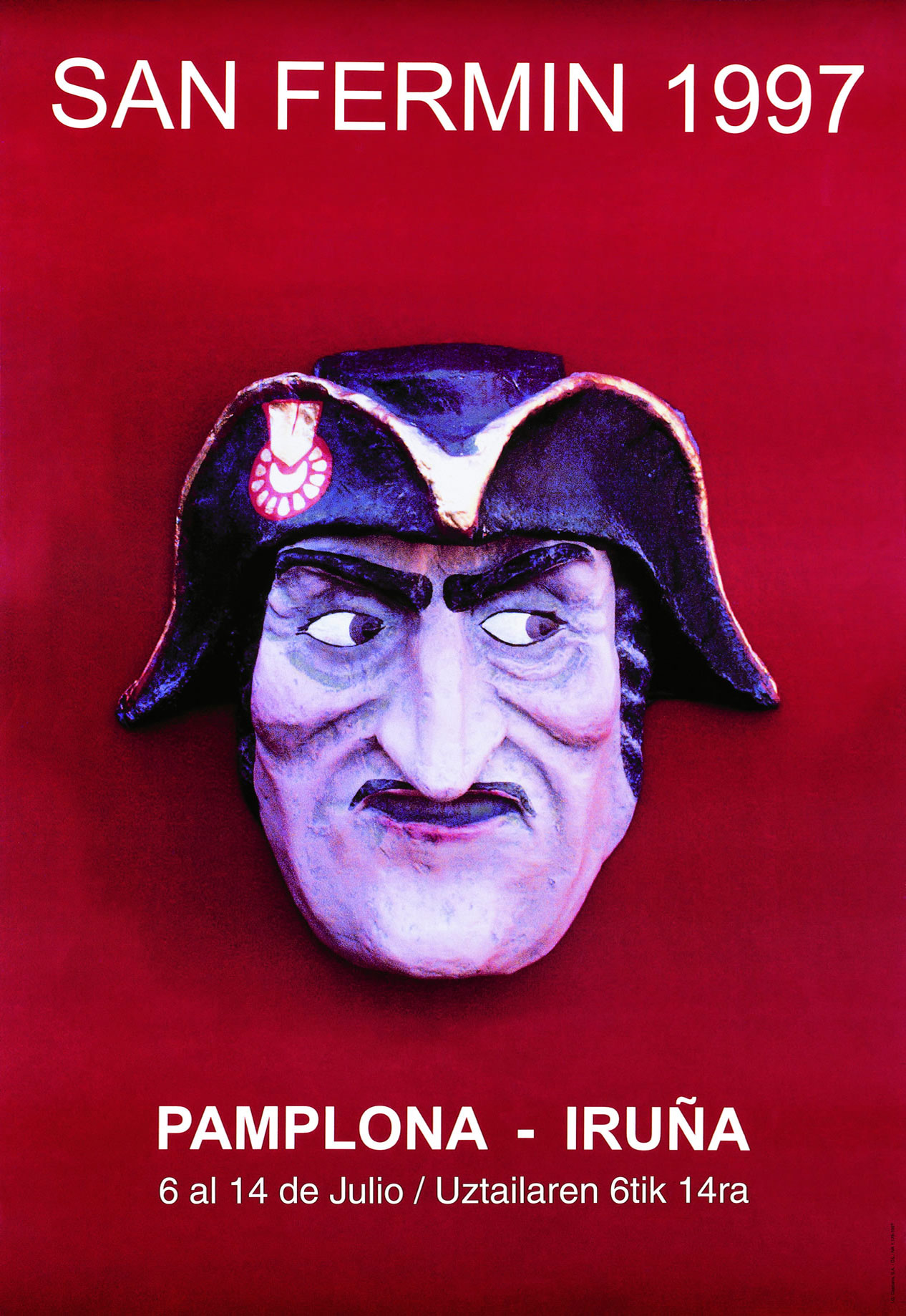
Cartel 1997 by Javier y Mitxelo Gurutxaga Leache.
The 1997 official poster was the work of two artists, the Gurutxaga Leache brothers, a relatively unusual collaborative credit in the history of the Pamplona cartel. The image works within the festival’s established visual language: the red pañuelo, the white clothing, the bull, the narrow street. Whether the brothers brought a distinct visual approach compared to single-artist years is a question the image itself answers better than any description.
Source: Ayuntamiento de Pamplona, cartel archive
Winner of the annual cartel contest and the official San Fermín 1997 poster for Sanfermines.
The City in 1997
Pamplona in 1997 was a city that had internalized the international attention without being overwhelmed by it. The old city, the casco antiguo within the sixteenth-century walls, remained the festival’s center: the bars of the Calle Estafeta and the surrounding streets, the Plaza del Castillo, the narrow corridors that become the encierro course. Outside the walls, the modern city had grown considerably, but the fiesta compressed everything into the historic core.
The July sun hit the limestone facades at a particular angle in the early morning that runners remember longer than the specific details of any single run, and the crowds of 1997 were no different: international, young, sleep-deprived, and completely absorbed in the experience of eight mornings that happened to be among the safest of the decade. The Pobre de Mí at midnight on July 14 closed the festival as it had done for generations before.
How 1997 Came Together
Key facts in the 1997 fiesta, kept on the record.
The chupinazo opens the 1997 fiesta at noon. The Plaza del Castillo fills as it does every year, the crowd already anticipating the following morning’s Conde de la Corte opening run.
María Luisa Domínguez’s bulls run the third encierro of the festival, one of the relatively uncommon appearances of a female-owned ranch on the Pamplona card in this era.
Jandilla runs the fifth morning, continuing the Tarifa ranch’s annual presence at Pamplona and adding another chapter to what was becoming one of the encierro’s most watched ganaderiía trajectories.
Miura runs the penultimate morning. The 1982-2000 no-goring streak at Pamplona continues. The streets are at maximum density with experienced runners who have been on the course all week.
San Fermín 1997, Answered
Which ganaderiías ran in 1997 and in what order?
The eight ganaderiías of 1997, in order: Conde de la Corte (Jul 7), Guardiola Fantoni (Jul 8), María Luisa Domínguez (Jul 9), Torrestrella (Jul 10), Jandilla (Jul 11), Hermanos Astolfi (Jul 12), Miura (Jul 13), El Pilar (Jul 14).
Why was Jandilla considered significant in 1997?
Jandilla, from Tarifa in Cádiz, was in the process of establishing itself as an annual Pamplona presence by 1997. The ranch’s fast, compact bulls from the southernmost tip of Spain had a different character from the more familiar Salamanca or Sevilla types. Through the late 1990s and into the 2000s, Jandilla would become one of the most discussed and respected ganaderiías in the encierro, and the 1997 run was part of that trajectory.
What was unusual about the July 9 run in 1997?
The July 9 run featured bulls from María Luisa Domínguez, a female-owned Salamanca area ranch. Woman-owned ganaderiías at Pamplona were uncommon in this era (Dolores Aguirre had run in 1995 as another example), and the appearance was noted in taurine press as a distinction from the predominantly male-owned ranch landscape.
How did Miura’s 1997 run fit into their broader Pamplona record?
Miura ran seventh in 1997, on July 13, and completed the morning without goring a runner. This continued the ganaderiía’s extraordinary 1982-2000 no-goring streak at Pamplona, a record that stood in striking contrast to their reputation as the deadliest ganaderiía in the history of the bullring. The streak would not end until 2000.
Planning your own run?
For 1996, the year Miura ran the opening morning in one of the most unusual scheduling decisions of the modern era, see the 1996 page. For 1998, the year Jandilla opened the festival for the first time and the encierro produced the lowest goring count of the decade, see the 1998 page.