
San Fermín 1998: Jandilla opened the festival for the first time and the encierro produced the lowest goring count of the decade.
July 6 to 14, 1998. Eight encierros, no deaths, and approximately 5 gorings across the full week: the mildest year of the 1990s by the numbers.
Looking Back at 1998
Looking back at 1998, two things defined the year. First: Jandilla on July 7. The Tarifa ranch, which had been building its reputation through annual appearances in the mid-1990s, was given the opening slot for the first time. That positioning put one of the encierro’s fastest and most compact ganaderiías on the first morning, before the week had built, before veteran runners had a full night in Pamplona. It was a statement of confidence in the ranch’s standing. Second: the goring count. Approximately 5 across eight runs, the lowest of the decade by most accounts. Commentators who covered the encierro regularly described 1998 as the mildest year of the era.
Looking back at what produces a mild year, the honest answer is that no one fully knows. Animal behavior varies. Crowd density changes. The specific geometry of each morning, how the bulls move through the curves, whether a runner falls in the wrong place at the wrong moment, involves variables that resist systematic explanation. The 1998 encierro was safe by the standards of the era. Approximately 5 gorings, no deaths, eight mornings that produced no single disaster. The taurine world moved on to 1999 and the question of what the last fiesta of the century would look like.
Dennis Clancey, Founder, Encierro
The Mildest Year of the Decade, and Jandilla’s Opening Debut
Spain in 1998 was at the crest of the economic expansion that had defined the decade. The country had met the Maastricht criteria and was on track to join the European single currency from its launch in 1999. Unemployment was falling from the high levels of the early 1990s; consumer confidence was strong; investment in infrastructure, including tourism infrastructure, was high. Pamplona’s international profile had continued to grow through the mid-1990s, and by 1998 the combination of post-Tassio international coverage, growing internet presence, and sustained travel journalism meant that San Fermín was better documented and more globally known than at any previous point in its history.
The internet’s role in spreading encierro footage and planning information was accelerating in 1998. Early video platforms and fan sites were carrying footage of recent runs; travel forums were accumulating first-hand accounts from runners of all nationalities. This was changing who arrived in Pamplona: more runners with more prior research, more context, more awareness of which ganaderiías had which reputations. The festival accommodated both those who came to run and those who came to watch, as it always has.
“Five gorings in eight runs. You can have a week like that and not be able to explain it. The bulls were as fast as any other year. The crowd was as dense. Sometimes the numbers just come out low.” Source: Encierro observer, cited in taurine press, July 1998
Every 1998 Encierro, Day by Day
Each run with its ganaderiía, approximate time, and horn injuries. The route runs approximately 849 meters from Santo Domingo to the ring. All eight 1998 encierros have available video footage.

Jandilla
Gored: see year total
Jandilla’s first opening-morning run at Pamplona. The Tarifa ranch’s fast, compact bulls moved through streets that were thinner than they would be on any subsequent morning, but the quality of the run was not diminished by the thinner crowd. A significant moment in the ranch’s trajectory.

Conde de la Corte
Gored: see year total
Conde de la Corte ran the second morning, the well-regarded Extremadura ranch following Jandilla’s opening. By July 8 the international crowd was building toward its peak, and the second morning drew a dense field of runners to the Estafeta.

Guardiola Fantoni
Gored: see year total
Guardiola Fantoni ran the third morning as part of their consistent annual presence in the 1990s Pamplona lineup. The aggressive Huelva ranch brought its characteristic unpredictability to a course that was now at full international density.

Cebada Gago
Gored: see year total
Cebada Gago, by 1998 firmly established as the encierro’s most dangerous ganaderiía by reputation, ran the fourth morning. The Bornos ranch’s fast, compact, aggressive bulls brought the kind of intensity that veteran runners specifically target and unprepared runners specifically do not anticipate.

Peñajara
Gored: see year total
Peñajara, a less common name in the Pamplona rotation, ran the fifth morning. The mid-festival position and the relative unfamiliarity of the ranch made for a morning where runners had less pre-existing knowledge of what to expect from the animals.

Miura
Gored: see year total
Miura in the sixth position, two days before the close of the festival. The 1982-2000 no-goring streak at Pamplona continued, with Miura’s tall, long-horned bulls moving through the Estafeta in front of a crowd that knew exactly what it was watching and gave the animals more room than they would give most other ganaderiías.

Marqués de Domecq
Gored: see year total
Marqués de Domecq ran the penultimate morning, the Jerez ranch bringing its characteristically ordered bulls to a course that was dense with runners at their most experienced point of the week. The July 13 morning passed without major incident.

Torrealta
Gored: see year total
Torrealta, from the Seville area, closed the 1998 encierro on the feast day of San Fermín. A less common closer, the ranch brought the eight mornings of the mildest year of the decade to an end without fatality or major drama.
What the Record Remembers
Official Sanfermines Poster, 1998
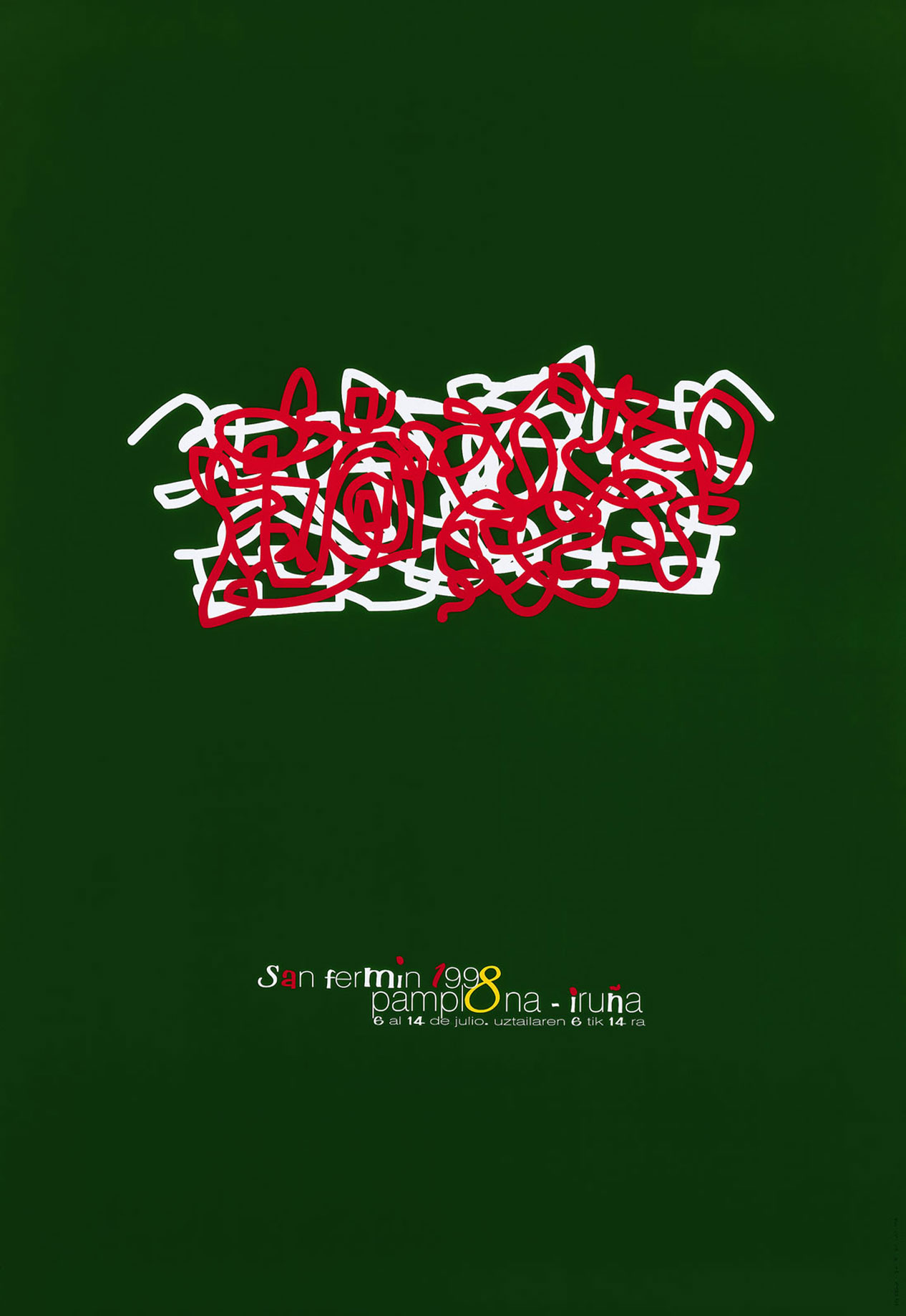
Cartel 1998 by Xabier Idoate Irigoyen.
The 1998 official poster, by Xabier Idoate Irigoyen, reflects the Navarrese and Basque artistic tradition that has long fed into the San Fermín cartel. Idoate Irigoyen worked within a visual landscape where the festival’s central imagery, the red and white of the runners, the bull, the narrow streets of the old city, had been refined over decades into a recognizable graphic language.
Source: Ayuntamiento de Pamplona, cartel archive
Selected as the official poster of Sanfermines 1998 through Pamplona’s annual concurso de carteles.
The City in 1998
Pamplona in 1998 was a city in full prosperity, the Navarrese capital benefiting from both the broader Spanish economic expansion and its own well-managed regional economy. The fiesta that July drew its usual million-visitor crowd into the old city, compressing the bars of the Estafeta and the plazas into a sustained week of density and noise.
The relative mildness of the encierros, approximately 5 gorings and no deaths, was not felt as mildness during the runs themselves; no runner standing in the street at 8:00 AM watching Cebada Gago or Jandilla approach experiences the morning as statistically uneventful. But in the aggregate, across the full week, 1998 produced the numbers of a year that the taurine world would later characterize as one of the safest in a dangerous decade. The Pobre de Mí at midnight on July 14 marked the close of a fiesta that had given Pamplona a week to be quietly grateful for.
How 1998 Came Together
Key facts in the 1998 fiesta, kept on the record.
The chupinazo fires at noon, opening the 1998 fiesta. The crowd in the Plaza del Castillo is aware that Jandilla will run the following morning for the first time in the opening position.
Jandilla runs the opening encierro for the first time in the ranch’s history at Pamplona. The Tarifa bulls move through streets that are thinner than they will be for the rest of the week. The run completes without fatality.
Miura runs the sixth encierro, extending the 1982-2000 no-goring streak at Pamplona to another year. The crowd gives the tall Sevilla bulls more room than they give most other ganaderiías.
Torrealta closes the 1998 festival, the Seville area ranch bringing the mildest year of the decade to an end. The Pobre de Mí ceremony marks the close of San Fermín at midnight.
San Fermín 1998, Answered
Why was 1998 considered the mildest year of the 1990s encierro decade?
Approximately 5 gorings across eight runs, with no deaths, made 1998 the lowest-injury year of the decade by most accounts. The specific combination of ganaderiías, crowd conditions, and the inherent randomness of each run produced a week that was, statistically, safer than the years immediately before or after. The taurine press noted it at the time; it remains a reference point in discussions of encierro variability.
Was 1998 the first time Jandilla opened the festival?
Yes. The July 7 position for Jandilla in 1998 was the first time the Tarifa ranch had been scheduled for the opening morning of the Pamplona encierro. The ranch had been appearing on the Pamplona card through the mid-1990s, building the reputation that would make it one of the most respected and feared ganaderiías of the 2000s. The opening slot confirmed its standing in the eyes of the selection committee.
How did Miura’s 1998 position compare to recent years?
Miura ran sixth in 1998, on July 12, compared to second in 1995, first in 1996, and seventh in 1997. The variation in positioning reflects scheduling decisions that relate to the broader corrida program as much as to any specific encierro strategy. Miura’s 1982-2000 no-goring streak at Pamplona continued through the July 12 run.
What is Peñajara and why did they appear on the 1998 card?
Peñajara was a ganaderiía that appeared on the 1998 card as a less common Pamplona presence. The ranch had standing in the broader taurine circuit to earn the selection, but it was not among the regularly rotating names familiar to veteran encierro followers. Running July 11, the fifth morning, Peñajara added an element of unfamiliarity for runners who typically prepare by studying specific ganaderiías’ behavioral tendencies.
Planning your own run?
For 1997, the year Jandilla ran fifth and Miura held its penultimate position in a lineup that produced approximately 6 gorings and no deaths, see the 1997 page. For 1999, the last encierros of the twentieth century, with Gutiérrez Lorenzo closing out a century of running, see the 1999 page.