
San Fermín 1999: Eight runs closed a century, Gutiérrez Lorenzo finished what Hemingway’s generation started watching, and no one who was there forgot it.
July 6 to 14, 1999. Eight encierros, no deaths, and the last San Fermín of the twentieth century.
Looking Back at 1999
Looking back at 1999, the millennium framing was inescapable. San Fermín had been run, with interruptions for war and plague across the centuries, as far back as the sixteenth century in its current form. The twentieth century had included two world wars, a Spanish Civil War, decades of dictatorship under Franco, the transition to democracy, and the integration into Europe. It had also included dozens of deaths on the encierro course, hundreds of gorings, and the gradual globalization of what had once been a purely local festival. The last July of that century came in 1999, and the eight encierros it contained were the last of their kind.
Looking back at the specific lineup, what stands out is the unusual closer. Gutiérrez Lorenzo, finishing out the century on July 14, was neither Miura nor any of the most recognizable heavy-hitters. The closing run is the feast day of San Fermín, the day with the most accumulated emotion, and a less familiar name in that slot gave 1999 a particular texture. The rockets fired eight times that July, and when they were done, the calendar turned toward a new millennium and a new set of questions about what the encierro would become.
Dennis Clancey, Founder, Encierro
The Last Encierros of the Twentieth Century
Spain in 1999 was at the peak of what economic historians would later call the “Spanish miracle” of the 1990s: growth rates consistently above the EU average, unemployment falling dramatically from the peaks of the early decade, infrastructure investment at record levels, and a cultural self-confidence rooted in two decades of successful democratic governance. The peseta was being phased out in favor of the euro; January 1, 1999, marked the euro’s launch as an accounting currency. For a country that had spent most of the twentieth century behind the rest of Western Europe, the millennial moment felt like an arrival.
The encierro was fully global by 1999 in ways that would have been unrecognizable to the runners of thirty years earlier. The internet was now a functioning mass medium; encierro websites, fan forums, and video archives had existed for several years. Footage of the 1995 death, the Miura opening of 1996, and dozens of other recent mornings was circulating online. Runners from North America, Australia, Japan, and across Europe were arriving in Pamplona with more prior knowledge than any previous generation, having watched footage, read first-hand accounts, and planned their strategy months in advance. The 1999 fiesta was both the last of the twentieth century and the first fully internet-mediated San Fermín.
“They knew this was the last one of the century. You could feel it. Not in the running, exactly, the bulls don’t know what century it is. But in everything around it.” Source: Encierro veteran, cited in millennium coverage, July 1999
Every 1999 Encierro, Day by Day
Each run with its ganaderiía, approximate time, and horn injuries. The route runs approximately 849 meters from Santo Domingo to the ring. Per-run goring counts for 1999 are not individually recorded in the main reference sources.
Marqués de Domecq
Gored: see year total
The final century’s last encierros opened with Marqués de Domecq, the Jerez ranch known for orderly bulls. The July 7 morning drew the usual opening-day crowd: thinner than the peak days, but carrying the particular charge of the first rocket of the last San Fermín of the twentieth century.

Guardiola Fantoni
Gored: see year total
Guardiola Fantoni ran the second morning of 1999, as the aggressive Huelva ranch had done through most of the decade. By July 8 the international crowd was filling in and the festival was running at full capacity across the old city.

Cebada Gago
Gored: see year total
Cebada Gago ran the third morning, placed early in the week despite its reputation as the most dangerous ganaderiía in the encierro by this point. The Bornos ranch’s fast, compact, aggressive bulls brought the first major test of the millennium-close week on July 9.

Adolfo Martín
Gored: see year total
Adolfo Martín from Salamanca ran the fourth morning. The ranch would go on to become a well-known Pamplona name through the 2000s; in 1999 it was building that reputation. Salamanca-type bulls bring a different character to the course than the Andalusian ranches.

Miura
Gored: see year total
Miura’s penultimate-decade appearance at Pamplona, running fifth in 1999. The 1982-2000 no-goring streak continued for one more year. The tall, long-horned Sevilla bulls moved through the Estafeta in front of a crowd that gave them the space that experience teaches. One more year of the paradox: the most feared name, a clean record.
Jandilla
Gored: see year total
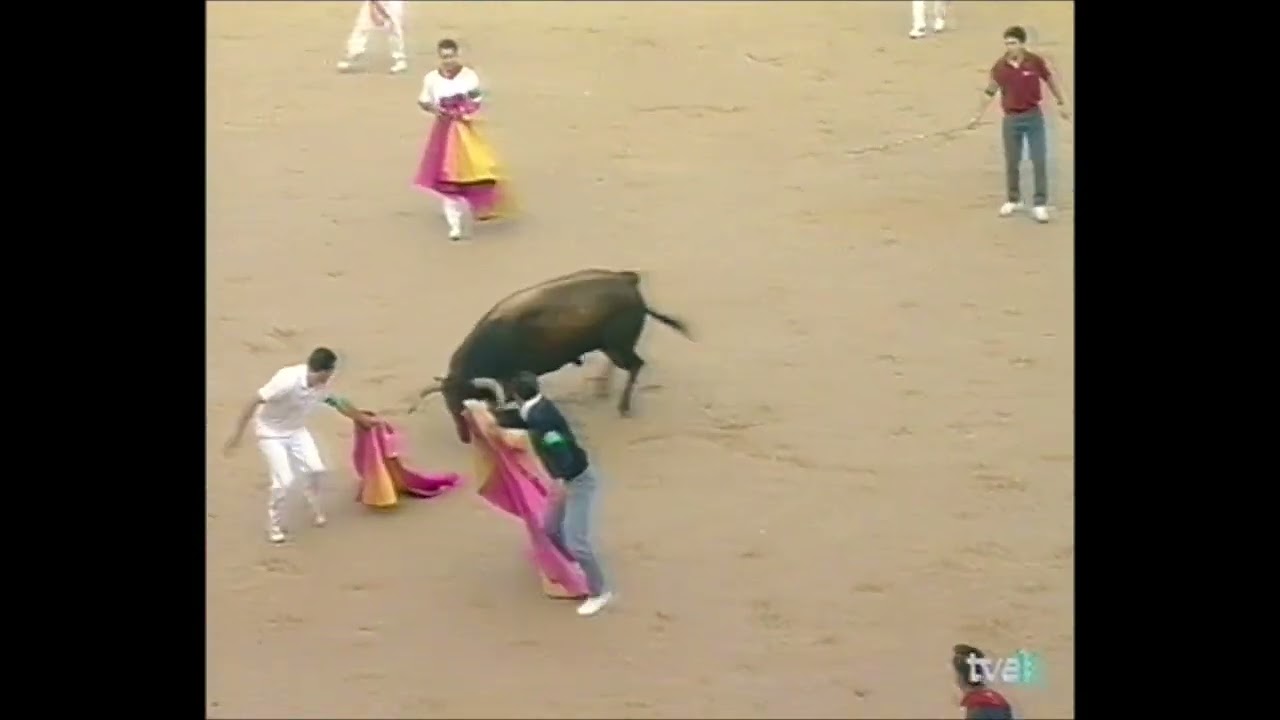
Jandilla ran sixth, continuing the annual Pamplona presence that had made the Tarifa ranch one of the most discussed ganaderiías of the era. Fast, compact, built for the specific geometry of the cobblestone course. The sixth morning of the last fiesta of the century brought the usual Jandilla intensity.

Guadalest
Gored: see year total
Guadalest, from the Valencia area, was an unusual presence at Pamplona. The roster had long been dominated by Andalusian and Salamanca ranches; a Valencian ganaderiía in the penultimate slot was genuinely uncommon. The July 13 morning added a geographical note to a lineup that was otherwise unusual in other ways.

Gutiérrez Lorenzo
Gored: see year total
The final encierro of the twentieth century. Gutiérrez Lorenzo, neither the most famous nor the most feared name in the encierro’s history, closed eight mornings and a hundred years. The rocket fired. The bulls ran. The century ended.
What the Record Remembers
Official Poster: San Fermín 1999
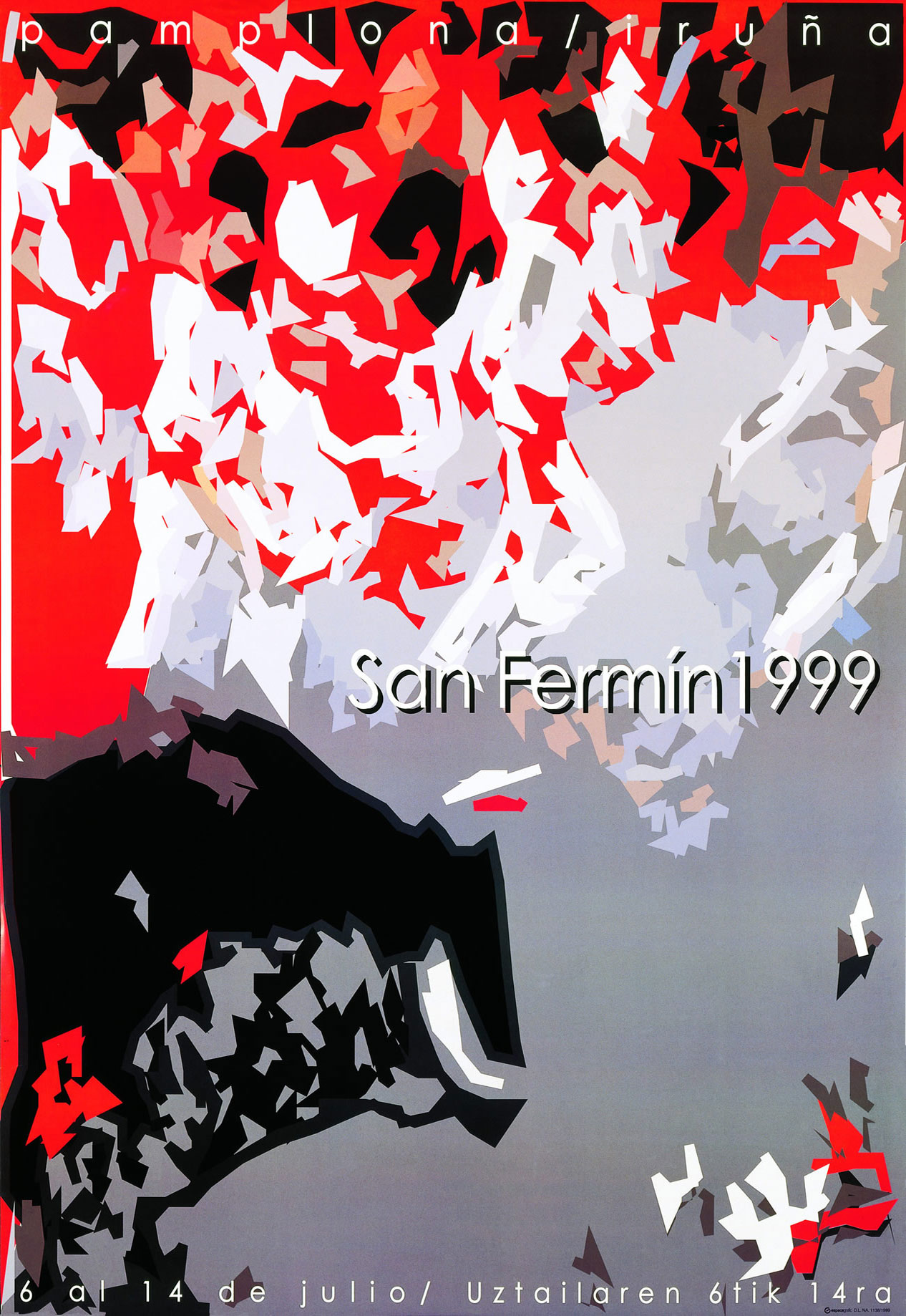
Cartel 1999 by Juan Jesús Viscarret Garro.
The 1999 official poster, by Juan Jesús Viscarret Garro, carried the weight of a closing-century commission. The image engages with the festival’s central visual language, the red and white, the bull, the streets of the old city, while perhaps carrying some note of the millennial significance that the year held. Viscarret Garro was working within a long tradition of Navarrese cartel artists who had defined the visual identity of the festival through the twentieth century.
Source: Ayuntamiento de Pamplona, cartel archive
The official San Fermín 1999 cartel was chosen via the city’s annual poster contest, the concurso de carteles.
The City in 1999
Pamplona in July 1999 carried the weight and the lightness of a city that knew it was closing something. The economic prosperity of the late 1990s was visible in the infrastructure, the restaurants, the accommodation that had expanded considerably since the lean years of the early 1980s. The international crowd that packed the old city was better informed than any previous generation, many of them having researched the encierro online, having watched footage of earlier runs, having read first-hand accounts from runners of every nationality.
The streets of the casco antiguo were as narrow as they had always been; the course had not changed; the distances from Calle Santo Domingo to the Plaza de Toros were the same as they had been when the first modern encierro ran in the form recognizable today. Eight rockets in July 1999 covered those same distances one last time in the twentieth century, and then Pamplona began preparing for the next thousand years. The Pobre de Mí at midnight on July 14 brought the last San Fermín of the century to its traditional close.
How 1999 Came Together
Key facts in the 1999 fiesta, kept on the record.
The chupinazo fires at noon, opening the final San Fermín of the twentieth century. The Plaza del Castillo crowd carries an awareness, spoken and unspoken, that this is the last time the festival will open in this century.
Cebada Gago runs the third encierro, the Bornos ranch’s fast bulls bringing one of the week’s most anticipated mornings. The YouTube footage from SanFerminEncierroTV captures the run.
Miura runs the fifth encierro, extending the 1982-2000 no-goring streak at Pamplona for what will prove to be its penultimate year. The most feared ganaderiía in the encierro’s history runs cleanly for the second-to-last time in this particular record.
Gutiérrez Lorenzo closes the final encierro of the twentieth century. The Pobre de Mí ceremony at midnight marks the end of San Fermín 1999 and the end of the encierro’s century.
San Fermín 1999, Answered
What made the 1999 encierro historically significant beyond the millennium framing?
The 1999 fiesta was the last of the twentieth century, a fact that carried genuine emotional weight for a festival with centuries of continuous history. Beyond the calendar significance, the year featured an unusual closing ganaderiía (Gutiérrez Lorenzo), a rare Valencian ranch in the lineup (Guadalest on July 13), and Miura’s penultimate clean run before the 1982-2000 no-goring streak ended in 2000. The approximately 7 gorings and no deaths made it a mid-range year by the standards of the decade.
Which ganaderiías ran in 1999 and in what order?
The eight ganaderiías of 1999, in order: Marqués de Domecq (Jul 7), Guardiola Fantoni (Jul 8), Cebada Gago (Jul 9), Adolfo Martín (Jul 10), Miura (Jul 11), Jandilla (Jul 12), Guadalest (Jul 13), Gutiérrez Lorenzo (Jul 14).
Why was Guadalest unusual at Pamplona?
Guadalest is from the Valencia area, making it geographically atypical for the Pamplona encierro, whose ganaderiía roster has historically drawn from Andalusia (Cádiz, Sevilla, Huelva) and the Castilian meseta (Salamanca, Extremadura). Valencian taurine culture is real and substantial, but Valencian ranches had rarely appeared on the Pamplona card. Guadalest’s July 13 slot in 1999 was genuinely uncommon.
Did Miura maintain its no-goring streak in 1999?
Yes. Miura ran fifth on July 11 and completed the morning without goring a runner, extending the 1982-2000 no-goring streak at Pamplona for one more year. The streak would end in 2000, making 1999 the final year of what had become one of the more discussed statistical records in the encierro’s modern history.
Planning your own run?
For 1998, the mildest year of the decade with approximately 5 gorings across eight runs and Jandilla opening for the first time, see the 1998 page. For 2000, the first encierros of a new millennium and the year Miura’s eighteen-year no-goring streak at Pamplona finally ended, see the 2000 page.