
Most first-time runners plan their day around one time: 8:00, when the rocket goes up and the bulls leave the corral. Everything before that feels like free time. Wake up, find a coffee, flag down a taxi around 7:20, walk on. Almost every step of that plan is wrong, and in Pamplona a running of the bulls morning is settled well before the rocket.
It matters because nothing in the old town bends for a runner who is late. There is no ride-share app to rescue a missed taxi, most bars are still shut, a full bladder cannot be dealt with once you are between the barriers, and the city closes the route to new runners at 7:30. A first-timer who gets any one of those wrong can travel all the way to Spain and end up watching the run from behind a fence.
Encierro founder Dennis Clancey has run the encierro every encierro year since 2007 and walks first-time clients through this exact morning every fiesta. What follows is that morning in his own words, from the taxi to the chant to San Fermín, with the city’s rules and the taxi phone numbers checked against Ayuntamiento de Pamplona and Mancomunidad de la Comarca de Pamplona pages. First, the line that frames everything Encierro writes about the run:
“We never encourage anyone to get on that run route in the morning. We simply exist to help people make the most informed decision about getting there.”
Dennis Clancey, Founder of Encierro
There Is No Uber in Pamplona, So Book Your Taxi the Night Before
The first surprise for many visitors is the ride there. Runners staying outside the old town, or in a hotel across the city, often assume they can open an app at 6:30 and be at the route ten minutes later. Dennis starts with the fact that ends that plan:
“It’s important that people understand that Pamplona does not have Uber or other ride-sharing apps. There’s just official city cabs that you can call. Your hotel will know the number.”
Dennis Clancey, Founder of Encierro
Taxis in Pamplona and the surrounding towns are regulated by the Mancomunidad de la Comarca de Pamplona, the regional body that runs public transport here. Its page on how to request a taxi lists, as of October 2026:
- Tele Taxi San Fermín: 948 23 23 00 or 948 35 13 35 (from a foreign phone, add +34). The Ayuntamiento’s airport taxi page gives the same two numbers for booking a taxi in advance.
- Taxi Licencia 044: 609 45 21 91.
- Pidetaxi: a taxi-booking app for Android and iPhone, also listed by the Mancomunidad.
Dennis has seen stretches when the app did not work, so treat it as a backup to a phone booking rather than the plan. The plan is to book ahead:
“People need to be cautious of waiting to the last minute to get one in Pamplona. Sometimes it’s better to arrange it the night before to make sure you have it waiting for you to get to the run route, depending on how far out you are.”
Dennis Clancey, Founder of Encierro
His point about the hotel is practical. The front desk knows the number and can place the call for you the evening before, which removes the language barrier from the one booking that matters most that week.
The second thing to know is where the taxi will leave you. The route is closed off by barriers, and no taxi can take you onto it. Dennis names the drop-off he sees most:
“You’re going to need the taxi to drop you somewhere close, but they can’t drop you directly to the run route. One of the common places to get dropped off is Paseo Sarasate, which is right outside Plaza del Castillo. And from there, I’d say about 200 meters to the run route, maximum.”
Dennis Clancey, Founder of Encierro
Ask the driver for Paseo de Sarasate by name. From there you walk, and you want to reach the entrance in the Plaza Consistorial with time to spare, which is the subject of the next section.
The City Closes the Route at 7:30. Dennis Tells First-Timers 7:00.
The city’s rules for 2026 set three times. From 7:15, only people who intend to run may stay on the route. Between 7:15 and 7:30, runners can enter only through the Plaza Consistorial, in front of the town hall. After 7:30, nobody who wants to run may enter at all. Those times come from the Ayuntamiento’s notice of 19 June 2026, which described the access times as a change for that year. They have moved before, so check them again before the 2027 fiesta.
Dennis does not build a first-timer’s morning around the deadline. He builds it around a buffer:
“They’ve gone back and forth over the years about 7:15, 7:30. But typically I’ll just tell people, look, if you want to just make sure that you’re not going to miss the run, get on the run route by seven o’clock. It’s a good rule of thumb.”
Dennis Clancey, Founder of Encierro
The buffer exists because of what he has watched go wrong. First-timers rarely miss the run because they overslept. They miss it because the last stretch took longer than they expected:
“I tell people never wait till the last moment to get on the run route. If you’re there about 6:30, if you’re further afield, if you show up fairly early, it’s okay. You’ve come all the way to Spain, and at least you’re not going to miss things. But typically, first-time runners, I tell them just to be on the run route by seven o’clock. That allows a little bit of a buffer in the event that they get a bit confused on where they’re going. Maybe they don’t know the city as well as they thought they did, and get confused about the placement of the police and the barriers.”
Dennis Clancey, Founder of Encierro
Arriving early costs a first-timer some standing around. Arriving late can cost the run. Where you have to be before 7:30, and how the police line at the end of Town Hall works, is covered step by step in Where You Stand at 7:30 Decides Whether You Run at All. Read it before run morning.
One situation pushes the morning earlier still: a runner walking over with a friend or partner who is watching from a balcony.
“Those non-runners often have a balcony that they intend to watch the run from, and usually those balcony companies want people to show up by 6:50, seven o’clock latest, down to the street-level door for whatever building has the balcony. So sometimes you have to go a bit early. If a non-runner needs to get to their balcony and they’re walking with a runner, it likely means you need to show up a little bit earlier, sometimes as early as 6:45, so the person gets to their balcony and the runner makes their way onto the route.”
Dennis Clancey, Founder of Encierro
If you are leaving together, plan around the balcony guest’s door time, not the runner’s entry time.
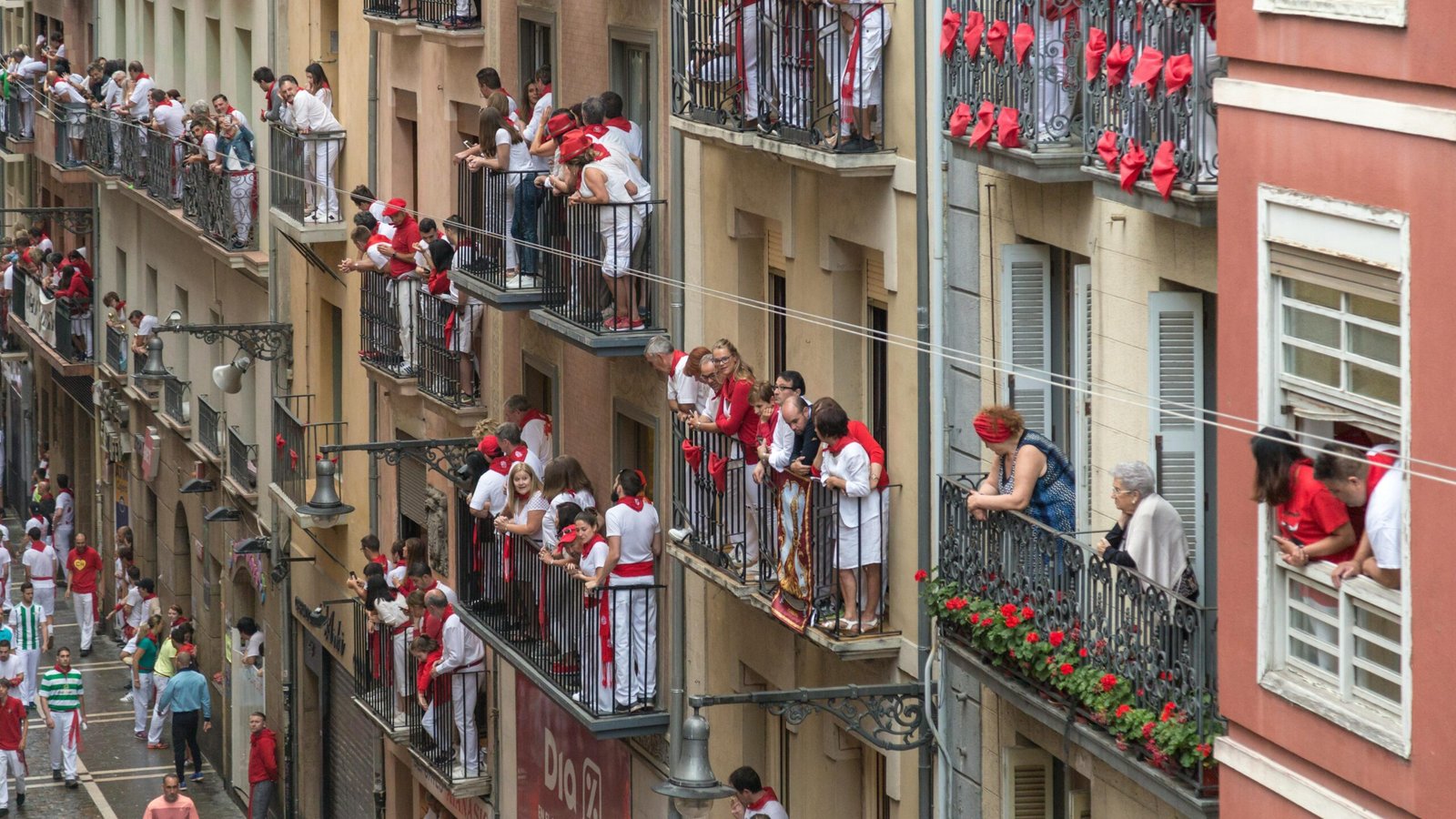
July 7, 2026: The Morning the Entrance Filled Up Before 7:30
The case for the buffer is not theoretical. On July 7, 2026, the first encierro of that fiesta, the entrance to the route jammed in the final minutes before the cutoff. Dennis described what happened at the entrance:
“On July 7th, 2026, there were so many runners trying to get on the run route right before 7:30 that runners struggled to get on the run route, and some were not able to enter. To clarify, the police will never cut off the number of runners getting on the run route.”
Dennis Clancey, Founder of Encierro
The police did not cap the number of runners that morning. The problem was the clock. Between 7:15 and 7:30 the city allows entry only through the Plaza Consistorial, so everyone who leaves it late arrives at the same entrance in the same few minutes. When 7:30 came, the people still outside the barriers were out for the day, whatever the reason they were late.
Dennis has seen packed entrances before, and his advice keeps coming back to the same instruction:
“There have been previous days where it was fairly packed trying to get onto the run route, and they need to make sure they’re on the run route in time. So don’t leave it to the last second.”
Dennis Clancey, Founder of Encierro
The lesson is arithmetic. The deadline is 7:30 and the plan should be 7:00. A runner who is on the route at 7:00 has half an hour of margin for a late taxi, a wrong turn or a crowd at the entrance. A runner who aims for 7:25 has none.
Before You Step Between the Barriers: Toilet First, Eat Light, Carry Nothing
Run morning starts early enough that most of the old town has not opened. Dennis does point first-timers to one place:
“One of the common places to go to the bathroom before the run is at El Redín. It’s on Calle Mercado. It’s a small little coffee shop, also a place where it’s common for people to go get coffee. Most places won’t be open before the run.”
Dennis Clancey, Founder of Encierro
El Redín is at Calle Mercado 5, which Dennis describes as “down behind Town Hall.” He has also noted why so many runners end up there: “Sometimes getting a coffee makes you want to go to the restroom, sometimes just the nervousness of the run makes you need to go.” Calle Mercado is a different street from Calle Mercaderes, the stretch of the route just past the town hall. The names are close and visitors mix them up.
His stronger advice is not to rely on any bar at all:
“I think the best thing is, before you leave your hotel or your accommodation, try to use the restroom then, because you never know. You get caught on the run route and you have to pee, you might not have an option to get off.”
Dennis Clancey, Founder of Encierro
The city does set up toilets for the fiesta. For 2026 the Ayuntamiento listed 68 toilet locations, 37 of them in the Casco Antiguo, with portable units at places including Cuesta del Redín, Plaza del Castillo and the Plaza de Toros, and said its conventional public toilets would stay open 24 hours (Ayuntamiento notice, San Fermín 2026). The notice does not place any of them on the route itself, which is Dennis’s point: once you are in, you are in.
The same logic covers breakfast:
“I wouldn’t eat much. You want to be light, and you don’t want to have to use the bathroom in an emergency right before the run starts, because you won’t have an option. You’d have to get off the run route and just miss the run.”
Dennis Clancey, Founder of Encierro
Whatever you eat or drink, finish it before you walk on. Dennis tells first-timers to carry nothing onto the route:
“Don’t bring anything on the run route. You’re gonna end up with trash. You might just get kicked off the run route. If the police see you drinking something or eating something, they’re gonna take it that you’re not serious. You don’t wanna cause attention to yourself.”
Dennis Clancey, Founder of Encierro
For a visitor who does not speak Spanish, that attention is worse than it sounds:
“It could be additionally confusing for people if they don’t speak Spanish. They might not understand what the police are saying to them. So the fewer things that draw the attention of the police for a first-time runner, the better.”
Dennis Clancey, Founder of Encierro
The police on the route are checking who is there and in what state, which is part of why entry closes at 7:30. A runner holding a drink or a sandwich stands out for the wrong reason, and a runner who cannot follow an instruction in Spanish has the most to lose from standing out.
On the Route: The Mayor’s Walk, the Police Line and the Chant to San Fermín
Once you are on, the time before the rocket is not empty. Several things happen in a set order, and a first-timer who does not know them can misread every one. The first is a sweep down the middle of the street:
“The police will come through, and they’ll create space in the center of the route for the mayor and other city officials to walk through the route ahead of the run.”
Dennis Clancey, Founder of Encierro
Experienced runners know a use for that sweep:
“Some runners will use that gap, as the mayor walks through, to walk behind the city officials, because it allows you a quick ability to move further up the route.”
Dennis Clancey, Founder of Encierro
A first-timer does not need to try it. The change that frees everyone comes a little later:
“It’s really 10 to 15 minutes before the run that the police line finally opens up, and the police allow runners to move to any part of the run route that they’d like to be. That’s when the route opens up a little bit.”
Dennis Clancey, Founder of Encierro
Until then, runners are held in the two sections where they had to be by 7:30, Town Hall and the hill of Santo Domingo. Once the line opens, they can move to where they plan to start. Where a first-timer should stand, and the five-lane way of thinking about the street, are covered in What to Do If You Fall in the Running of the Bulls, and the sections themselves are laid out on the Pamplona bull run map.
Between those moments there is a lot of waiting, and Dennis does not want first-timers spending it standing still:
“We recommend people stay limber. Don’t stand in one place necessarily. Make sure you’re constantly stretching, you’re moving, you’re walking. You don’t want your legs to get stiff. The more time you can spend stretching, preparing to be limber, I think the better mentally prepared you’ll remain, rather than kind of sitting there and being left to one’s own thoughts.”
Dennis Clancey, Founder of Encierro
Keep moving, but not into doorways or blind spots: the city’s rules for runners say not to wait for the bulls there, and not to cross or stop in front of other runners.
If you are starting on the first part of the route, there is one more thing to find while you wait, and it is above your head:
“If you’re on the first part of the run route, there are cables that run over the run route, and there are cameras on those. Runners will use those to sight where the bulls are, because those cameras will track over the lead animal during the run. It’s the best indication of figuring out where exactly the bulls are during the run.”
Dennis Clancey, Founder of Encierro
The moment that unsettles first-timers most comes last. Near the bottom of the Cuesta de Santo Domingo, close to the corrals, an image of San Fermín sits in the wall:
“There’s a small statue of the saint that is placed in a small cove in the wall down on Santo Domingo.”
Dennis Clancey, Founder of Encierro
During the fiesta the figure in that niche is an image from 1978 owned by the peñas; the city’s own image of the saint takes its place for the rest of the year. Runners sing to it three times before each encierro, at 7:55, 7:57 and 7:59, in Spanish and in Basque (Ayuntamiento, 15 July 2026). Dennis explains why that matters to anyone standing elsewhere on the route:
“It’s only done at the bottom of Santo Domingo. Runners from all over the route will go down to the bottom of Santo Domingo to sing that chant. But those runners who are not going to start in that area of Santo Domingo will only do the first chant. That way they have enough time to run up the route to wherever their start point is before the bulls get released. So it’s only the runners that are running in Santo Domingo that remain in place for the three-minute and one-minute sing to the saint.”
Dennis Clancey, Founder of Encierro
Which produces the sight that rattles people who have never seen it:
“The other thing to be cautious of, that I think can create a bit of nervousness for runners, is you’ll see a wave of runners jogging, running up the route about two to three minutes before the run. And the reason you’re seeing that is it’s all those individuals that were just singing to the saint who are making their way up the route to their starting points.”
Dennis Clancey, Founder of Encierro
So when a crowd of runners comes jogging up the street two or three minutes before 8:00, the bulls have not been released and nothing has gone wrong. Those are runners heading back to their spots after the first song. The rocket that announces the corral gate is about to open goes up at 8:00.
Frequently Asked Questions
Is there Uber in Pamplona during San Fermín?
No, according to Dennis Clancey: Pamplona has no Uber or other ride-share apps, only licensed city taxis. The Mancomunidad de la Comarca de Pamplona lists Tele Taxi San Fermín at 948 23 23 00 or 948 35 13 35, Taxi Licencia 044 at 609 45 21 91, and the Pidetaxi app for Android and iPhone. For a run morning, book the taxi the night before and ask to be dropped on Paseo de Sarasate, by the Plaza del Castillo. From there it is a short walk to the route.
What time should I get to the running of the bulls in Pamplona?
Be on the route by 7:00 if it is your first run. The city’s 2026 rules allowed only runners on the route from 7:15, allowed entry only through the Plaza Consistorial between 7:15 and 7:30, and closed the route to new runners at 7:30. Dennis tells first-timers 7:00 because it leaves time for a late taxi, a wrong turn or a packed entrance like the one on July 7, 2026. The bulls are released at 8:00.
Can you bring food or water on the running of the bulls route?
Dennis’s advice is to bring nothing. Food or drink on the route creates trash and draws police attention, and police who see a runner eating or drinking may take it that the runner is not serious and remove them. That is harder still for a runner who cannot follow instructions in Spanish. Have your coffee before you walk on, eat lightly, and enter the route with empty hands.
Where can you go to the bathroom before the running of the bulls?
Use the toilet before you leave your hotel or apartment, because once you are on the route you may not be able to get off. Dennis points first-timers to El Redín, a small coffee shop at Calle Mercado 5 that is a common stop for coffee and the bathroom, since most places are still closed. The Ayuntamiento also sets up fiesta toilets; for 2026 it listed 68 locations, including portable units at Cuesta del Redín and Plaza del Castillo. None of them is listed on the route itself.
Encierro founder Dennis Clancey has run the encierro every encierro year since 2007. Every article on the Encierro blog is authored or reviewed by active bull runners with direct experience in Pamplona. Taxi numbers and city rules were checked against Ayuntamiento de Pamplona and Mancomunidad de la Comarca de Pamplona pages in October 2026; check them again before you travel.