
Most people who have never been to Pamplona picture one thing when they hear that a runner was gored by a bull: a horn driven into the body, an open wound, blood on the cobblestones. Some of the time that picture is right. Much of the time it is not, and a runner who believes a horn injury always looks like that can walk away from a serious one thinking it was only a bruise.
This matters because the injuries a runner underestimates are the ones that go untreated. Spanish surgeons who treat horn injuries every summer sort them into several kinds, from a glancing blow to a wound with no broken skin at all and torn muscle underneath. English has one word for all of them. Spanish has a whole vocabulary, and knowing it changes what you do in the minutes after a horn touches you.
Encierro founder Dennis Clancey has run the encierro every encierro year since 2007. What follows is the Spanish classification of horn injuries as the medical literature defines it, with Dennis’s own answers, in his own words, on what a runner should do when it happens.
What “Gored” Means in English, and Why That Picture Is Too Narrow
In English, “gored” carries one image: penetration. The horn goes in. Newcomers to the run reach for an even stronger word.
“In English, we’re typically thinking about goring as puncturing of skin and going into the body. I find people unfamiliar with the bull run often using the word impaled or impaling, and I think that’s accurate for what we usually think of when we hear the term. Gore implies a sense of the opening of one’s body, and the fluids in one’s body becoming exposed.”
Dennis Clancey, Founder of Encierro
Spanish works differently. To be corneado is to be struck by a horn, and the Spanish medical literature splits horn injuries into types by how deep the horn went and what it did on the way. A doctor in Pamplona or Castellón will tell you not just that a runner was hit, but whether it was a varetazo, a puntazo or a cornada, and if it was a cornada, what kind.
“It was in recently talking to a Spaniard that I realized the various ways that the Spanish categorize corneados. There are tons of different terms that are used for a bull goring injury.”
Dennis Clancey, Founder of Encierro
The practical point is simple. In English, “I wasn’t gored” usually means “the skin isn’t broken, so I’m fine.” In Spanish medicine, an unbroken skin rules out nothing.
The Spanish Vocabulary of Horn Injuries, From Varetazo to Cornada Envainada
The definitions below follow Spanish clinical sources: a 2003 clinical note in the emergency medicine journal Emergencias (Navarro Valle and colleagues), a 2025 classification presented at Spain’s national surgery meeting and published as an abstract in Cirugía Española (Casanova and colleagues), and a 2025 review of how to treat patients injured by bulls in the Revista Española de Cirugía Ortopédica y Traumatología (Martínez-Hernández and colleagues). The sources agree on the terms. They group a few of them differently, which is noted where it matters.
- Varetazo. A blow from the side of the horn, which strikes the body at a glancing angle. It bruises or scrapes but does not penetrate. The 2025 surgeons’ classification describes it as a closed injury made by the flat of the horn.
- Puntazo. A shallow wound from the tip of the horn that opens the skin and the fatty tissue just under it, and goes no deeper. A puntazo simple barely enters. A puntazo corrido is dragged: the tip tears a long track along the skin instead of a single hole.
- Cornada. The horn passes through the fascia, the tough layer that wraps the muscles, and reaches muscle, organs or a body cavity. This is what English speakers mean by “gored”, and it is the injury that needs a surgeon.
- Cornada envainada, or sheathed goring, also called a closed cornada. The skin is not broken, but the muscle and connective tissue underneath are torn. From the outside it can look like a bruise. The 2003 note says it can cause traumatic hernias, where the abdominal wall gives way under intact skin. One 2024 report in Cirugía Española found it accounts for under 2% of abdominal horn wounds and “requires a high degree of suspicion.”
- Cornada de varias trayectorias, a goring with several tracks. One entry hole, several paths inside. The entry wound can be small while the damage underneath is extensive.
- Herida despistante, a misleading wound. The worst damage sits a long way from the entry hole, so the wound you can see says little about the injury you cannot.
- Gloved goring. The 2025 review describes a horn that passes through the fascia while the victim’s clothing stays intact. Untorn whites are no proof that the horn stayed out.
Where the sources differ: the 2025 surgeons’ classification puts the cornada envainada with the non-penetrating injuries, because the skin stays whole, and counts the puntazo as penetrating, because the skin is opened. The 2003 note and the 2025 review group the puntazo with the shallow injuries and the cornada envainada with the cornadas, because the deep damage is what counts. Both schemes describe the same injuries. For a runner, the lesson from either is that the skin is a poor guide to what happened underneath.
Where the Horn Lands: What 387 Patients in Castellón Showed
The best-known Spanish study of horn wounds comes from the General Hospital of Castellón, in a province where, according to the 2025 review, more than 7,000 street events with bulls are held every year. Martínez-Ramos and colleagues, writing in Cirugía Española in 2006, reviewed 387 admissions for horn wounds between January 1978 and October 2005.
- Legs: 244 wounds, 63%.
- Abdomen: 44, 11.3%.
- Perineum, the area between the legs: 41, 10.5%.
- Chest: 21, 5.4%.
- Arms: 19, 4.9%.
- Head and neck: 12, 3.1%.
- Back and lower back: 6, 1.5%.
Thirty-one patients needed abdominal surgery, and 23 of them had an injured organ. Three of the 387 died, of hypovolemic shock, septic shock and gas gangrene. The authors call these wounds severe but with a generally good prognosis when treated. These are patients from Castellón’s street festivals, not from Pamplona, but the pattern is the same one the 2025 review describes across Spain: about 60% of horn injuries are to the legs.
Pamplona publishes its own count. Encierro’s review of every public injury record from 2013 to 2026 found about six horn wounds a fiesta, with single years ranging from two to twelve. It also found that no published source defines what counts as a “horn wound”: in one year a graze from a steer was counted, and in another a graze whose victim refused care was not. The Spanish categories above are exactly what that count leaves out.
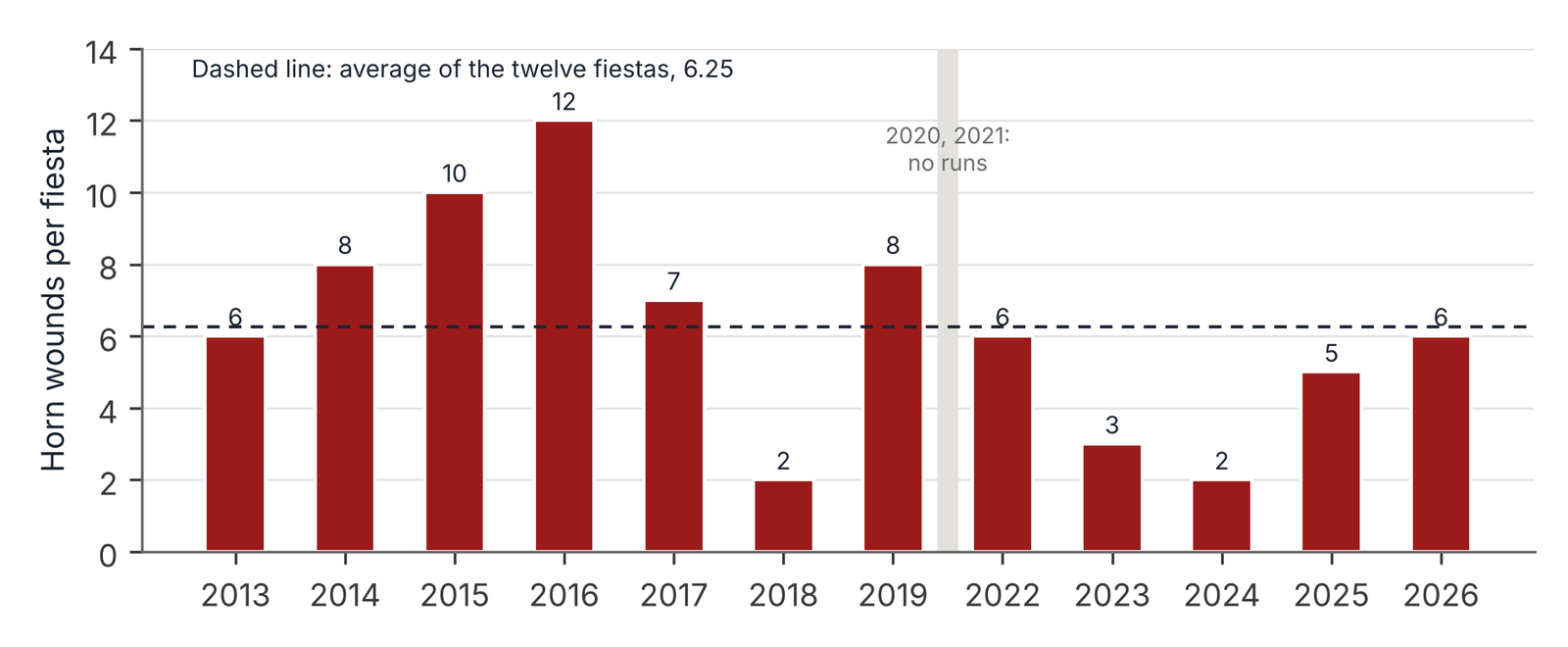
Why a Horn Injury That Looks Small Can Be Serious
A cornada envainada and a misleading wound share one trait: the outside understates the inside. Add the state a runner is in seconds after a bull has passed, and the risk of walking away from a real injury is obvious.
“For a runner, regardless of how severe you think an injury is, it’s always good to have it reviewed by the medics and doctors on scene. You have a lot of adrenaline going through your body, and it’s helpful to make sure that a trained medical professional has the opportunity to assess any damage. After the run, you might underestimate the degree of damage you’ve suffered.”
Dennis Clancey, Founder of Encierro
The mechanics explain why. A bull’s horn is a blunt cone at the base and a point at the tip. Which part strikes, and at what angle, decides whether the result is a varetazo, a puntazo or a cornada. When the horn strikes without cutting the skin, the damage can still reach the muscle underneath. Adrenaline blunts pain for the first minutes, which is exactly when a runner decides whether to get checked or walk to breakfast. A runner who has been hit by a horn, anywhere, by any part of it, has a question only a doctor can answer.
14 July 2014 at La Curva: One Bull, Three Runners, Seven Gorings
The last run of San Fermín 2014 was run by Miura bulls. According to Diario de Navarra’s account of the run, a bull named Olivito fell at La Curva, where Calle Mercaderes turns into Estafeta, and was left behind the herd. A bull on its own, a suelto, no longer has the steers to follow and can turn on whoever is near it. Olivito gored three runners seven times between them, and the run lasted 4 minutes 57 seconds, the longest of that year.
The three injuries show the range in one morning. A young Australian runner and a man from Burlada were each gored three times and needed surgery; both were reported stable afterwards. A third runner was gored in the right thigh and was discharged a few hours later. Dennis remembers the young Australian’s wound.
“The horn had opened the man’s [thigh] muscle, which was flapping about on one of his legs.”
Dennis Clancey, Founder of Encierro
The lesson is the one the Spanish vocabulary is built for. Three men were gored by the same bull in the same stretch of street, and the injuries ran from a wound treated in a few hours to repeated cornadas that needed an operating theatre. Nobody on the street could have told which was which by looking, and a separated bull is the situation in which most of them happen.
The First Minutes After a Horn Hit: Get Distance, Then Get Seen
What a runner does in the seconds after a horn strike depends on one thing: where the bull is.
“The hope is that if you get hit by a horn, it glances off of you and doesn’t go through you. The fortunate thing with getting a horn going into your body is that medics are fairly close. It’s important to get someone’s attention. Be vocal.”
Dennis Clancey, Founder of Encierro
If the herd has gone by together, the street empties of danger in seconds. A separated bull is different. It can stay in one stretch, turn back, and go after the same runner twice.
“This is where one’s own instincts take over, and I think it’s important to follow your instincts. If the bull is still in your vicinity and you have an ability to get away from it, I think that’s number one: getting distance between you and the bull. If a bull has been separated and has already gone after you, has already hit you, the thing to think about is how to get as much distance between you and that bull. There are bound to be runners around you that will help to get the medics’ attention if they see someone’s not moving. But people need to use their best judgment in the event they’ve already been hit by a bull.”
Dennis Clancey, Founder of Encierro
First-timers often do the opposite when a bull is loose. They stop to look.
“There’s a tendency the first time you run, when there is a separated bull, to stick around and try to watch what’s happening. But I recommend that first-time runners take off running and get as far as they can away from a lone bull. First, the bull can accelerate faster than you can, so it can very quickly close the distance between you and it, if it so chooses. Secondly, it’s important that you get distance between you and the bull because you can’t guarantee the actions of the crowd around you, and other people can limit your ability to get away in the split seconds it may take for a bull to get to your position.”
Dennis Clancey, Founder of Encierro
This is also why the common advice to fall and stay down applies only in one situation, when the herd is passing over you, and not when a single bull is circling. Encierro’s article on what to do if you fall explains the difference, and the article on the suelto, the separated bull, explains how a lone bull behaves.
Before You Believe “I’m Fine”
After a horn strike, the injured runner is usually the worst judge of the injury. Friends and other runners are better placed, up to a point.
“I’ll just quickly check the person to make sure there isn’t any blood. I’ll stick with them typically for a little bit to try to assess: did they hit their head, are there other things? But not being a medical professional, I think it’s important for runners to recognize that they’re not medical professionals, and it’s best, if there are ever any concerns, to seek the medical attention of those individuals that are right on the route. Everywhere that there is a vallado, a fence along the route, there’ll be medics there, and those medics are trained to get an injured runner to higher levels of care as efficiently as possible.”
Dennis Clancey, Founder of Encierro
Put the vocabulary and the advice together and the rule is short. No blood does not mean no cornada. A runner who has been hit by a horn goes to the medics at the fence, says so, and lets them decide. For what happens after that, including hospital transfer and insurance, see Encierro’s article on what actually happens if you get hurt in Pamplona, and for who gets hurt and how, the answers in Is Running with the Bulls Safe for Beginners?
Frequently Asked Questions
What does it mean to be gored by a bull?
In English, being gored by a bull means the horn has pierced the body. Spanish medicine is more precise: a cornada is a wound in which the horn passes through the fascia into muscle, organs or a body cavity, while shallower injuries are called a varetazo (a glancing blow) or a puntazo (a shallow wound from the tip). A cornada envainada is a goring with no broken skin, where the damage is underneath. Any of them can follow a single contact with a horn.
What is a cornada envainada?
A cornada envainada, or sheathed goring, is a horn injury in which the skin stays intact but the muscle and connective tissue underneath are torn. It can look like an ordinary bruise and can cause a traumatic hernia. One Spanish surgical report puts it at under 2% of abdominal horn wounds and says it requires a high degree of suspicion. It is the main reason any horn strike should be checked by a doctor.
What should you do if a bull’s horn hits you at the running of the bulls?
If the bull is still near you, especially a bull separated from the herd, get as much distance from it as you can first. Then get the medics’ attention and be vocal; other runners will usually help. Have the injury checked by the medics posted at the fences along the route even if it looks minor, because adrenaline hides pain and some horn injuries leave the skin unbroken.
Where do most horn injuries happen on the body?
Mostly in the legs. A Castellón hospital study of 387 horn wounds found 63% in the legs, 11.3% in the abdomen and 10.5% in the perineum, and a 2025 Spanish review puts leg injuries at about 60% of all horn injuries. Abdominal wounds are less common but account for a large share of deaths. These figures come from Spanish bull festivals generally, not the Pamplona run alone.
Encierro founder Dennis Clancey has run the encierro every encierro year since 2007. Every article on the Encierro blog is authored or reviewed by active bull runners with direct experience in Pamplona. This article describes medical terms for readers’ understanding and is not medical advice.