Almost every first-timer who comes to Pamplona asks the same question before anything else: is running with the bulls safe for someone who has never done it? Many hope the answer depends on finding the right section, the right morning or the right trick. It does not. The honest answer is short, and it comes first in this article.
The question matters because a beginner who believes some part of the route is safe will stand in the wrong place, trust the wrong crowd and make the decision to run more lightly than it deserves. A beginner who understands where the real danger comes from can make a far better decision, including the decision not to run.
Dennis Clancey, founder of Encierro, has run in Pamplona since 2007 and briefs first-time runners on the route every fiesta. He also directed Encierro’s review of every public injury record we could find for the San Fermín encierros from 2013 to 2026, published as Encierro Research Report No. 1. What follows is mostly his answers, in his own words.
Is Running with the Bulls Safe for Beginners?
“A beginner who asks whether the running of the bulls is safe: the easiest and clearest answer is no. In fact, my first piece of advice about running with bulls is: don’t do it. If you don’t do it, you can’t get hurt.”
Dennis Clancey, Founder of Encierro
“That said, at Encierro we recognize that people will resolve to accept the risk anyway, and we believe that those individuals deserve to have someone they can discuss the run with, so they can make as informed a decision about their run as possible: both in whether they run, and in the plan, tactics and strategy they employ while running.”
Dennis Clancey, Founder of Encierro
Do Beginners Get Hurt More Often Than Experienced Runners?
Nobody can answer this from the records, because nobody records it. Encierro’s research report found no public source, from the regional Health Department, the city, the first-aid organisations or the medical literature, that says whether an injured runner was running for the first time. What the city did record, in its runner surveys from 2013 to 2019, is how many runners were first-timers: between 43 and 65 percent of the runners interviewed each year.
“That’s a percentage of people interviewed, not necessarily a percentage of people actually running, but this is the best data that we have. The city didn’t publish how it chose who to interview, so those figures cannot be treated as exact. There is a claim out there that two in three runners are first-time runners, but that’s only close if you assume 2014 was accurate, and even then the data is very outdated. If the data is accurate, most runs skew towards about 50-50.”
Dennis Clancey, Founder of Encierro
“There’s no public source of information that indicates that first-time runners are any more susceptible to injury than experienced runners. In my experience, injuries are spread across both groups, both those experienced and beginners. I can’t speak to the reasons and statistics behind this, as no study actually exists, but I can say my belief, from having watched runs and often attended the daily briefings after the encierros, discussing the injuries and events of the encierro. I think there are various reasons why people can get injured.”
Dennis Clancey, Founder of Encierro
“Experienced runners can be susceptible because they are sometimes accepting more risk by running in the center of the street, attempting to run on the horns of a bull. What we call coger toro, or pillar toro: running directly in front of the horns while attempting to not impede the animal in any way. This brings risk from other runners surrounding the individual, plus the bull itself. Inexperienced runners, beginner runners who are not running so aggressively, can often be hurt by the crowd, or because of the stark difference in the pace of the bull to that individual.”
Dennis Clancey, Founder of Encierro
“Are People Like Me the Ones Who Get Hurt?”
“I do have people ask me sometimes, ‘Is it people like me that tend to get hurt?’ And people asking it can be asking across different dimensions of identity: their fitness, their age, their experience, the part of the route they intend to run in. And again, there’s no real data to suggest that someone who’s running for the first time, or across some dimension of identity, is any more likely to get injured.”
Dennis Clancey, Founder of Encierro
What the label “first-timer” hides matters more than the label itself.
“Lumping everyone in the first-timer category fails to capture the fact that there is a difference between a runner who is sober, fit, rested, well positioned and briefed, versus one that is uneducated, drunk and tired.”
Dennis Clancey, Founder of Encierro
“If the city was to record one extra thing about every injured runner, it’d be interesting to know. They’ll typically ask you for your name, age and country of origin, but it’d be interesting to know if you’re running for the first time, or how much experience you had, so we had better data on this.”
Dennis Clancey, Founder of Encierro
How Do First-Time Runners Actually Get Hurt?
“Among first-timers getting hurt, I see very similar injuries to what I see from experienced runners as well. It’s mostly a mix of scrapes and fractures from falls, and wounds and bruises from the animal itself.”
Dennis Clancey, Founder of Encierro
A runner does not have to touch a bull to be hurt by one. The crowd does much of the damage.
“The challenge is that you have people running with great force, and you can have one runner that falls. I’ve personally been in circumstances where someone’s tripped, but because they’re continuing to tumble, they might kick out a leg, and that might trip me, outside of my peripheral vision, and send me down. From that you can get a knee contusion and other injuries. But now that you’re tumbling because of another runner, you could have other runners attempting to jump over you, stepping on you; various things can happen.”
Dennis Clancey, Founder of Encierro
Research backs up how falls happen. A peer-reviewed study that filmed two runs on Calle Estafeta in 2019 recorded 20 falls, all of them as the bulls passed, and 14 of the 20 involved more than one person. Runners have a word for what that becomes.
“One of the big challenges that I see on the run route, particularly in the Bajada del Callejón and at La Curva de Estafeta, is that people start to fall and other people fall on them. You get what we call a montón, a heap of people, which makes it difficult for the bull to avoid. A bull can easily hurdle over one or two people, but once you have a pile of people it becomes much more difficult and riskier for those individuals. It’s for that reason we always advise our clients, as best they can, to avoid crowds. You should never assume your safety in a crowd.”
Dennis Clancey, Founder of Encierro
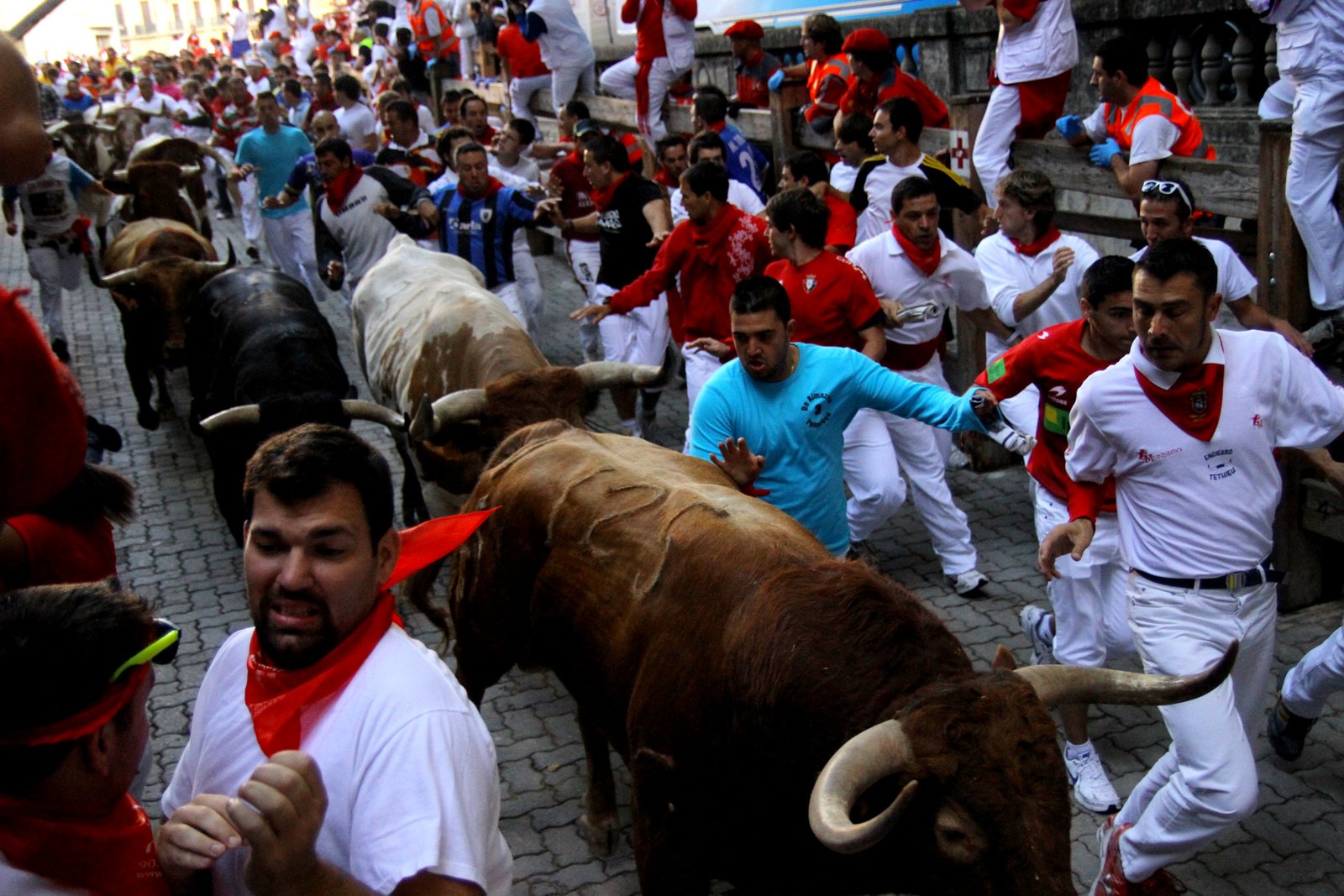
Why Is a Crowd More Dangerous Than It Looks?
“What I mean by crowds is places along the run route where there are tight groups of people. This is often places where people assume the run is more safe. A good example in recent years has been individuals standing on the inside of La Curva, just at the start of Estafeta Street. Those individuals assume that the bulls will take a wide turn at La Curva, and so they will be safe on the inside. The problem is that there are so many people compacted in a small area that many of those people have no freedom of maneuver to get out of a bad situation if the bull takes the turn tight. To their credit, the police have been diligent in recent years in kicking runners out of this area just before the bulls arrive.”
Dennis Clancey, Founder of Encierro
Where Should a First-Time Runner Not Run?
Dennis advises first-timers against three sections of the route. You can see each one on the Pamplona bull run route map.
The lower stretch of Santo Domingo
“Santo Domingo is tricky just because of the speed of the bulls. We recommend our runners get some experience before they start to run the lower stretch of Santo Domingo, when the bulls are at their fastest. The bulls are disproportionately faster than humans while running uphill, and this is nowhere more obvious than at the beginning of Calle Santo Domingo.”
Dennis Clancey, Founder of Encierro
La Curva, where Mercaderes turns into Estafeta
“La Curva de Mercaderes, going into Estafeta, is problematic because you have a lot of runners doing various things, running in different directions. I have a very good friend, a great runner of La Curva, who was injured in 2026 because there was an individual obstructing his way as he entered the curve. And the times that I’ve gotten injured in Pamplona, I’ve just bruised knees from going down, or times that I’ve been tripped by individuals, right in the vicinity of La Curva. It’s just tricky given the turn, and there’s a lot of unexpected elements; when you’re running for the first time, it adds a level of complexity that is best to avoid.”
Dennis Clancey, Founder of Encierro
The Bajada del Callejón, into the bullring
“In that section, part of the challenge is that the route goes from its widest to its thinnest in a very short distance. Add to that the fact that you have runners who are running too early and moving too far up the run route, so the end of the run tends to be the most crowded. This creates more probability of people tripping each other and ending up in a montón.”
Dennis Clancey, Founder of Encierro
Timing on the route matters as much as place. Encierro’s guide to the 7:30 entry time and the police line explains where first-timers wait before the run, and why standing on the route can be more dangerous than running.
Condition, Not Just Experience: 14 July 2014 at La Curva
In 2008, researchers at the Universidad Pública de Navarra asked 55 experts to rate what most affects a runner’s risk. They put a runner’s present condition, meaning sleep, alcohol and drugs, at the top, ahead of experience, knowledge of the rules and fitness. That is expert opinion, not injury data, but Dennis has seen what it looks like on the street.
“I’m aware of a study from 2008 where 55 experts rated a runner’s present condition as more influential than their experience, which would lend to proper preparation for the run.”
Dennis Clancey, Founder of Encierro
On 14 July 2014, the last run of that fiesta, a Miura bull named Olivito fell at the Mercaderes curve and was left behind the herd. Separated from the other animals, it turned back on the runners again and again, and gored three of them seven times between them, according to Diario de Navarra’s account of the run. A young Australian runner was gored three times; the run lasted almost five minutes, the longest of that year. Dennis remembers what the Australian looked like before the bull reached him.
“This is a very well-known incident where a runner who appeared to have been out all night, had wine-soaked clothes and appeared drunk, was chased by a bull at La Curva, and the horn had opened the man’s [thigh] muscle, which was flapping about on one of his legs. It was an example of how a dazed runner kind of attracted the attention of the bull. A well-known British runner, Alexander Fiske-Harrison, remarked that the bull likely singled him out because he smelled like rotten fruit from the wine-soaked clothes he wore. How he got on the run route, and how he wasn’t identified as being drunk, is still unknown. Whether he was drunk is also unknown, but he was still in the clothing of the day before.”
Dennis Clancey, Founder of Encierro
The runner survived; Diario de Navarra reported him stable after surgery. The lesson Dennis draws is not about experience. It is about the state a runner arrives in. Alexander Fiske-Harrison is a British writer and long-time runner in Pamplona; his remark is quoted here as Dennis remembers it.
What Do First-Timers Misunderstand About the Danger?
“I think a lot of first-time runners assume the biggest risk is from trampling, and the most interesting lesson they learn is when we discuss ‘fall down, stay down’ as a general rule. But ‘fall down, stay down’ is important only in context, and we spend a lot of time talking about that. We’ve even written a whole blog post on the fact that ‘fall down, stay down’ is for a very specific circumstance.”
Dennis Clancey, Founder of Encierro
That post is What to Do If You Fall in the Running of the Bulls Depends on One Thing: How Close the Bulls Are. The rule’s best-known lesson comes from the 1995 fiesta, when a 22-year-old runner from Illinois, reported to be running for the first time, fell in the Town Hall square, got up, and was gored.
“The 1995 death of Matthew Tassio is often given as an example of what not to do, a violation of the ‘fall down, stay down’ rule. It’s one that we discuss on every one of our tours, because I think it’s relevant for the people that are running for the first time: not only because they can maybe relate to someone who’s running for the first time, but there’s also a very clear lesson about ‘fall down, stay down’.”
Dennis Clancey, Founder of Encierro
One case cannot show that first-timers are more at risk of dying. The city’s list records 16 deaths in the encierro since 1910, the most recent in 2009, and they include a local man who had run for nearly fifty years. The full record is in our analysis of running of the bulls deaths and injuries.
Why Talk to an Active Runner Before Your First Run?
“At Encierro, we want to ensure that people are as educated as possible about the run. Because of that, our guides are only active, respected runners that are selected to do this, people that are passionate. We spend our days at Fiesta shadowing each other during the tours, discussing what has changed from day to day, so we can be as informed as possible. We believe that our clients, typically beginners, first-time runners, deserve to have the very best information, and part of that preparation is being able to talk to an active bull runner on the running of the bulls route: the recorrido, as we call it.”
Dennis Clancey, Founder of Encierro
“For those that want to travel in a way that’s respectful to the places they visit, it’s best to be as educated as possible about a hundreds-of-years-old tradition before just jumping into it. Anyone can get in those streets, regardless of the degree to which they study, but I think it’s important to show respect to the places we visit, and to be as educated on the traditions that those people embrace.”
Dennis Clancey, Founder of Encierro
Is It Okay Not to Run?
“I want a nervous beginner to understand that it’s okay not to run if, at the balance of all considerations, they don’t think it’s the best idea. I want people to remember that the decisions they make affect not only themselves, but everyone who cares about and relies on them, so not to take the decision to run lightly. We never encourage anyone to get on the run route in the morning. We simply exist to help people make the most informed decision about whether to run.”
Dennis Clancey, Founder of Encierro
Frequently Asked Questions
Is running with the bulls safe for first-timers?
No. No part of the route is safe, for first-timers or for experienced runners, and the only way to be sure of not being hurt is not to run. Encierro never encourages anyone to run; it exists to help people decide with the best information, including whether to run at all. Injuries range from scrapes and bruises from falls to horn wounds, and a run of years without a death does not mean the risk of death is gone.
Do beginners get hurt more at the running of the bulls?
No record shows it either way. None of the injury records we found notes whether the injured runner was running for the first time, so no injury rate for beginners exists. In Dennis Clancey’s experience, injuries are spread across beginners and experienced runners, for different reasons: experienced runners take more risk near the horns, while beginners are more often caught by the crowd or by the bulls’ speed.
Where should a first-time runner not run in Pamplona?
Encierro advises first-timers against three sections: the lower stretch of Santo Domingo, where the bulls run fastest uphill; La Curva, where Mercaderes turns into Estafeta and runners move in every direction; and the Bajada del Callejón, where the route narrows sharply into the bullring and crowds build up. Packed groups anywhere on the route, including the inside of La Curva, are dangerous because nobody in them can move out of the way.
Can anyone run with the bulls?
There is no registration, but the city’s ordinance sets rules: runners must be 18 or older, may not run drunk or under the influence of drugs, may not use cameras or phones to record without authorisation, must wear suitable shoes, and may not enter the route after 7:30. Police can remove people who break them. Being allowed to run is not the same as being ready to, which is why preparation and condition matter as much as experience.
Dennis Clancey is the founder of Encierro and has run the encierro every year since 2007. Every article on the Encierro blog is authored or reviewed by active bull runners with direct experience in Pamplona.