
San Fermín 2027: July 6 to 14. Tours filling fast. Book your spot  | 
ToursRunning with Bulls About Fiesta About UsShop Book Now
The Encierro archive · 1919

Running of the Bulls 1919: San Fermín in Pamplona

San Fermín 1919 ran from July 6 to 18, with a bull run (encierro) every morning at seven from Monday, July 7, to Friday, July 11. On the first morning a horn wounded one young man in the neck, half a centimetre from the jugular, and the photographer Pepe Roldán caught a dangerous moment on camera; on the fourth day so many people came that many were left outside the ring.11, 2, 3, 9, 7

By Encierro · Last reviewed

5runs, July 7 to 11
7:00start, a.m.
100sprints sold of one photograph

How the fiesta ran in 1919

The poster announced the Ferias y Fiestas “del 6 al 18 de Julio”.11 On July 7 the dianas were played by dulzainas, bands and cavalry trumpets, and “A las siete se verificará el encierro de los toros”: the encierro was at seven.2 There was a run every morning from July 7 to 11.3, 4, 6, 7, 8

Soldiers were again forbidden to enter the ring “á la hora del encierro por la puerta por donde entra el ganado”, at encierro time through the gate the herd used, or to run ahead of it.1

Every known encierro of 1919, by day and ranch

The encierros of San Fermín 1919, from the Diario de Navarra programmes and reports.
DateRunRanch (ganadería)What the paper reported
July 71(first encierro)A young man wounded in the neck; a straggler penned
July 82Cándido DíazUnder two minutes; ring full again
July 93Villar HermanosOne bull turned at the toril gate
July 104Viuda de Concha y SierraMany left outside the ring
July 115, lastMarqués de AlbaserradaOne bull chased runners the length of Estafeta

The 1919 encierros, day by day

Run 1 of 5

· The first encierro

Start7:00 a.m.
DeadNone

One young man was wounded in the neck: half a centimetre lower and the horn would have reached the jugular, proof once more, the paper said, that the bulls of San Fermín carry the hand of Providence on their horns.3 The photographer Pepe Roldán caught a dangerous moment that morning, a bull hooking a boy who had just been knocked down; hundreds of prints were sold.9 The Díaz mayoral, Agustín, drew the bull away, but it ran out again after other reckless runners; in the end “se consiguió traer á mandamiento al toro rezagado” with two steers and penned it. Rumour spoke of dead, but all were alive.3 Three weeks later the paper recalled that another young man had been gored and tossed again and again that morning, “á quien todo el público dió por muerto”, whom the whole crowd had taken for dead.5
Run 2 of 5

· Cándido Díaz

Start7:00 a.m.
TimeUnder 2 minutes

The programme: “A las siete encierro de los toros de don Cándido Díaz”, the Navarre bulls of Funes.3 The ring was as full as on the first day, and many early risers were left in the street for lack of room, though fewer ran ahead of the bulls. The six fine Navarre bulls, under cover of the steers, ran the course in under two minutes.4

Run 3 of 5

· Villar Hermanos

IncidentsNone

The Villar Hermanos bulls ran without incident and went straight to the corral. One, “desde la misma puerta del toril volvió la cara haciendo un peligroso retroceso”, turned round at the very gate of the pen in a dangerous retreat, until the stick of the great Agustín on its hind legs sent it through the door the others had used.6

Run 4 of 5

· Viuda de Concha y Sierra

CrowdMany left outside

“Era el de ayer el cuarto encierro y aún se quedó bastante gente sin poder entrar”: even on the fourth day many people could not get into the ring. Only the three big groups running ahead of the bulls got in, and with nowhere safe to go they stayed in the ring or between the barriers.7

Run 5 of 5, the last

· Marqués de Albaserrada

StreetsWet

The streets were wet and the ring full. The six Andalusian bulls of the Marqués de Albaserrada ran, and one, well ahead of the herd, “llevó de cabeza por toda la calle de la Estafeta” the runners at the back of the crowd, chasing them the length of Estafeta. Entering the ring, a young man fell and a bull hooked him and turned him over.8

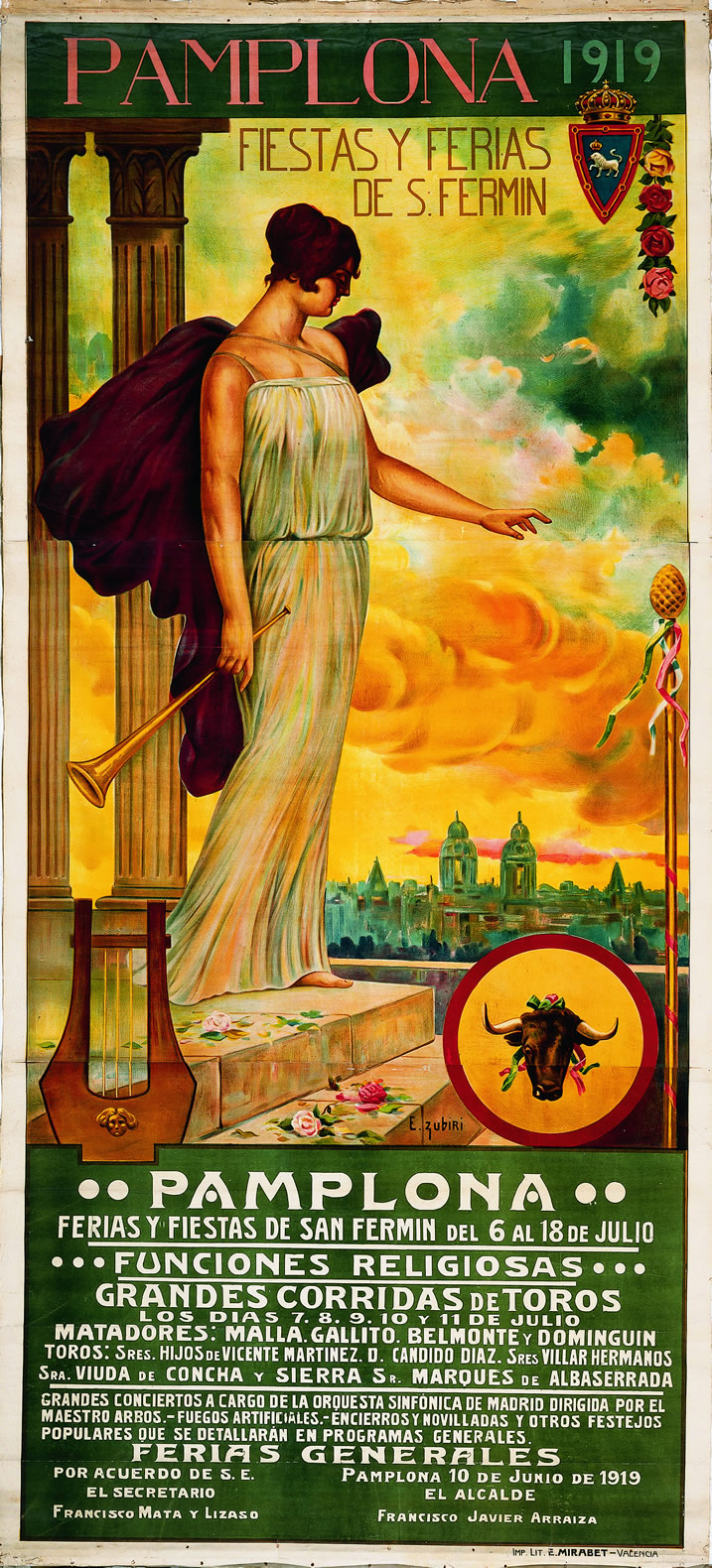
San Fermín 1919 poster (cartel)

San Fermín 1919 poster (cartel) by E. Zubiri: a tall woman in a long pale classical robe stands on stone steps between columns, a trumpet in her hand, with a lyre and a medallion with a bull’s head at her feet and the towers of Pamplona behind
Cartel de San Fermín 1919. Poster of the Ferias y Fiestas de San Fermín 1919, signed E. Zubiri. Tap the poster to see it full size. See every San Fermín poster.11, 10
San Fermín 1919 poster (cartel) by E. Zubiri: a tall woman in a long pale classical robe stands on stone steps between columns, a trumpet in her hand, with a lyre and a medallion with a bull’s head at her feet and the towers of Pamplona behind
Artist
E. Zubiri (signature)
Fiesta on the poster
Del 6 al 18 de julio
Dated
Pamplona, June 10, 1919

Ollaquindía found the 1919 poster cold, a theme “de los que te llevan lejos”: on the stone steps of a basilica, between Doric columns, a matron in a vestal’s tunic holds a trumpet; at her bare feet lie a three-stringed lyre and a medallion with a bull’s head, and in the distance, under heavy clouds, stand the towers of the cathedral. Inside, he notes, the programme offered the usual fiestas, among them the encierros and the classic walks in calle Estafeta.10

The poster names the ranches whose bulls came that year, among them the sons of Vicente Martínez, Cándido Díaz, Villar Hermanos, the Viuda de Concha y Sierra and the Marqués de Albaserrada, and announces concerts by the Madrid Symphony Orchestra.11

Pamplona in 1919

The photograph

Roldán’s picture

Pepe Roldán’s photograph of a bull hooking a boy who had just been knocked down, on July 7, 1919, sold in the hundreds of prints, the paper reported.9

Words of 1919

Traer á mandamiento

To bring a straggler under control was “traer á mandamiento”; a bull that turned round “volvió la cara”. The steers were cabestros and the herdsmen’s chief, Agustín, the mayoral.3, 6

Photographs

Where to see old photographs

The city’s photo archive, the Fototeca de Pamplona, holds historic photographs of the encierro, free to view online.12

San Fermín 1919: questions and answers

When were the bull runs of San Fermín 1919?

San Fermín 1919 had a bull run every morning at seven from Monday, July 7, to Friday, July 11, 1919. The fiesta ran from July 6 to 18.11, 2, 3, 4, 6, 7, 8

What happened in the first encierro of 1919?

A horn wounded a young man in the neck, half a centimetre from the jugular, in the first encierro of 1919, on July 7, and another was gored and tossed again and again, and the whole crowd took him for dead. Rumour spoke of dead, but all were alive.3, 5

What was Pepe Roldán’s photograph of 1919?

Pepe Roldán photographed a bull hooking a boy who had just been knocked down in the encierro of July 7, 1919, and the Diario de Navarra reported that hundreds of prints were sold.9

Which ranches’ bulls ran in 1919?

The bulls of San Fermín 1919 came from Cándido Díaz on July 8, Villar Hermanos on July 9, the Viuda de Concha y Sierra on July 10 and the Marqués de Albaserrada on July 11.3, 6, 7, 8

Who made the San Fermín 1919 poster?

E. Zubiri made the San Fermín 1919 poster, signed on the poster itself: a woman in a classical robe with a trumpet, a lyre and a medallion with a bull’s head, which Ollaquindía found cold.11, 10

Sources

Numbers on the page refer to this list. Diario de Navarra pages are cited from its archive (hemeroteca); quotations in Spanish are given as printed, in the spelling of the day.

Full source list
  1. Diario de Navarra, July 6, 1919, page 1: garrison order, soldiers forbidden to enter the ring “á la hora del encierro por la puerta por donde entra el ganado”. Diario de Navarra archive
  2. Diario de Navarra, July 7, 1919, page 2: programme for July 7, “A las siete se verificará el encierro de los toros”. Diario de Navarra archive
  3. Diario de Navarra, July 8, 1919, page 1: the first encierro, July 7, “se consiguió traer á mandamiento al toro rezagado”; programme for July 8, the Cándido Díaz bulls. Diario de Navarra archive
  4. Diario de Navarra, July 9, 1919, page 1: the Cándido Díaz encierro of July 8: the ring as full as on the first day, the six Navarre bulls under cover of the steers in under two minutes. Diario de Navarra archive
  5. Diario de Navarra, July 30, 1919, page 1: a young man “acorneado y volteado repetidas veces” by a bull in the encierro of the morning of July 7, “á quien todo el público dió por muerto”. Diario de Navarra archive
  6. Diario de Navarra, July 10, 1919, page 1: the Villar Hermanos encierro of July 9, “desde la misma puerta del toril volvió la cara”. Diario de Navarra archive
  7. Diario de Navarra, July 11, 1919, page 1: “Era el de ayer el cuarto encierro y aún se quedó bastante gente sin poder entrar”. Diario de Navarra archive
  8. Diario de Navarra, July 12, 1919, page 1: the Albaserrada encierro of July 11, “llevó de cabeza por toda la calle de la Estafeta”. Diario de Navarra archive
  9. Diario de Navarra, July 16, 1919, page 1: the photograph by Pepe Roldán of the bull and the fallen boy on July 7, hundreds of prints sold. Diario de Navarra archive
  10. Ricardo Ollaquindía, 100 años de carteles de las fiestas y ferias de San Fermín (1882 to 1981), Pamplona, 1981, chapter “1919”. Free copy in the Biblioteca Navarra Digital (BiNaDi). binadi.navarra.es
  11. The poster of the Fiestas y Ferias de San Fermín 1919 itself, “del 6 al 18 de Julio”, dated Pamplona, June 10, 1919; signed E. Zubiri.
  12. Fototeca de Pamplona, Archivo Municipal de Pamplona (photographs of the encierro, free to view online; publication needs the archive’s permission). archivo.pamplona.es
How to cite this page

Encierro. “Running of the Bulls 1919: San Fermín in Pamplona.” Encierro.com, November 9, 2026. https://encierro.com/san-fermin-1919/

Corrections and updates
  • : questions and answers rewritten around what people search, each answer with its sources; the poster labelled with its Spanish name, cartel.
  • : page published.

Walk the route with people who run it

Book your walk