
San Fermín 2027: July 6 to 14. Tours filling fast. Book your spot  | 
ToursRunning with Bulls About Fiesta About UsShop Book Now
The Encierro archive · 1934

Running of the Bulls 1934: San Fermín in Pamplona

San Fermín 1934 had bull runs (encierros) on July 7, 8, 9 and 10 and on Sunday, July 15, at seven in the morning on the days the paper gives a time. On the first, the Villamarta bulls ran in under three minutes, running over runners who had thrown themselves to the ground; on the last, “por las calles pasaron dos toros sueltos entre centenares de corredores, como no se ha conocido”, and some two dozen boys were treated for trampling.2, 4, 7, 8, 9

By Encierro · Last reviewed

5runs, July 7 to 10 and 15
7:00start, a.m.
About 24boys treated, July 15

How the fiesta ran in 1934

The bulls ran on the first four days, July 7 to 10, and once more on Sunday, July 15. A bus company advertised early coaches on the two Sundays, leaving Areso at five in the morning to arrive in time for the encierro.1 From six in the morning “queda prohibido el tránsito de toda clase de vehículos y caballerías por las calles” of the course, until the bulls were penned.3

After the fiesta a former mozo wrote to the paper that the many outsiders who ran could not be stopped, and that the remedy for those who thought anything goes lay not with the authorities but with the true Pamplona mozos: “debéis de velar por los encierros lo mismo que lo hacemos los ex-mozos”, you must watch over the encierros as we former mozos do.10

Every known encierro of 1934, by day and ranch

The encierros of San Fermín 1934, from the Diario de Navarra programmes and reports.
DateRunRanch (ganadería)What the paper reported
July 71VillamartaUnder three minutes; runners run over
July 82Sánchez Cobaleda (programmed)Programme: encierro at seven; a minister watching
July 93Blanco (programmed)Dianas on the fiesta programme
July 104Concha y SierraSome bulls loose; a minister watching
July 155, lastGarcía NateraTwo bulls loose among hundreds of runners

The 1934 encierros, day by day

Run 1 of 5

· Villamarta

Start7:00 a.m.
TimeUnder 3 minutes

“A las siete en punto se verificará el encierro de los toros de Villamarta”, the programme said.2 At seven sharp the Villamarta bulls left the little corral at the Rochapea gate and ran the course in under three minutes, “pasando en algunos sitios del recorrido por encima de muchos corredores”: in places they passed right over runners who, with no room, had thrown themselves to the ground. In the ring one bull, egged on by people trying to keep it in the arena, turned confused, and the guards had to step in.4
Run 2 of 5, programmed

· Sánchez Cobaleda

Start7:00 a.m.

The programme set the encierro at seven.4 The bulls of the day were those of Sánchez Cobaleda, formerly Villar.12 The Minister of Communications, Sr. Cid, in Pamplona for two days of the fiesta, went to an encierro, a show that he liked very much.5

Run 3 of 5, programmed

· Blanco

Dianas6:00 a.m.

The fiesta programme set dianas at six on July 7, 8, 9, 10 and 15. The bulls of July 9 were those of Blanco, formerly Parladé.12

Run 4 of 5

· Concha y Sierra

IncidentsNone

The Concha y Sierra encierro passed without incident. “Aunque por la calle pasaron algunos toros sueltos, dando derrotes a derecha e izquierda”, some bulls went loose down the street hooking left and right, but they entered the ring bunched and went straight to the corrals, ignoring the runners around them. The crowd was enormous from the early hours.7 The Minister of Communications, Sr. Cid, came from San Sebastián at dawn to watch the encierro with the governor, then had the classic breakfast of churros.6

Run 5 of 5, the last

· García Natera

Start7:00 a.m.
TreatedAbout two dozen boys

“A las siete en punto se verificará el encierro de los toros”, the programme said; the bulls of the day were eight of García Natera.8 There were fewer people than on any of the three working days of the fiesta, but too much drink among the locals after the night’s dance, many unable to stand, and “por las calles pasaron dos toros sueltos entre centenares de corredores, como no se ha conocido”: two bulls ran loose through the streets among hundreds of runners, as never seen before. There was no catastrophe, the paper said, because the bulls were more frightened of the people than the people of the bulls; still, about two dozen boys were treated at the ring’s infirmary for trampling and hoof blows. It was a double encierro: the rest of the herd came in far behind the two loose bulls.9

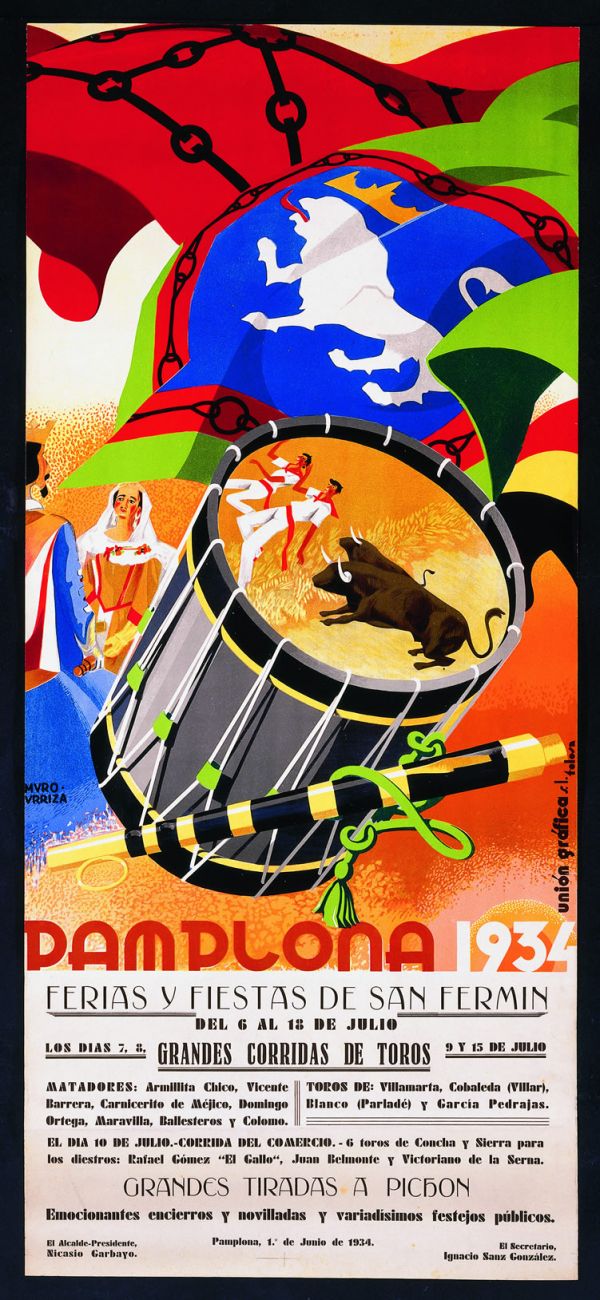
San Fermín 1934 poster (cartel)

San Fermín 1934 poster (cartel) by Muro Urriza: a txistu pipe and a drum under waving banners with the shields of Navarre and Pamplona; on the drumskin two runners in white with red sashes flee from two bulls
Cartel de San Fermín 1934. Poster of the Ferias y Fiestas de San Fermín 1934, signed Muro Urriza. Tap the poster to see it full size. See every San Fermín poster.11, 12
San Fermín 1934 poster (cartel) by Muro Urriza: a txistu pipe and a drum under waving banners with the shields of Navarre and Pamplona; on the drumskin two runners in white with red sashes flee from two bulls
Artist
Muro Urriza (signature)
Fiesta on the poster
Del 6 al 18 de julio
Dated
Pamplona, June 1, 1934
Printed by
Unión Gráfica, Tolosa

Ollaquindía notes that the 1934 poster was the first to show symbolic objects instead of human figures: under waving banners with the shields of Navarre and Pamplona lie a txistu and a drum, and on its skin, as in a ring, two bulls chase two mozos.12 The poster also promises “Emocionantes encierros”.11

He adds, quoting José Joaquín Arazuri, that in the Republican years 1934 to 1936 the general peal of church bells in the city’s parishes was dropped, except at San Lorenzo and a few convents.12

Pamplona in 1934

Words of 1934

Toros sueltos

Loose bulls, out ahead of the herd and the steers, were “toros sueltos”. A former runner wrote as one of the “ex-mozos”.9, 10

Photographs

Where to see old photographs

The Diario de Navarra printed a photograph of the crowd and the loose bulls entering the passage from Santo Domingo to the Plaza Consistorial on July 15, 1934. The city’s photo archive, the Fototeca de Pamplona, holds historic photographs of the encierro, free to view online.9, 13

San Fermín 1934: questions and answers

When were the bull runs of San Fermín 1934?

The bull runs of San Fermín 1934 took place on July 7, 8, 9 and 10, 1934, and on Sunday, July 15, the last; the paper gives seven in the morning for July 7, 8 and 15.2, 4, 7, 8, 9

What happened in the last encierro of 1934?

Two bulls ran loose through Pamplona’s streets among hundreds of runners on July 15, 1934, “como no se ha conocido”, as never seen before. There was no catastrophe, the Diario de Navarra said, but about two dozen boys were treated at the ring’s infirmary for trampling and hoof blows.9

How fast was the first run of 1934?

The Villamarta bulls ran the course in under three minutes on July 7, 1934, passing in places over runners who had thrown themselves to the ground, the Diario de Navarra reported.4

Did a minister watch the running of the bulls in 1934?

The Minister of Communications, Sr. Cid, watched the running of the bulls in 1934: he came from San Sebastián at dawn on July 10 to see the encierro with the governor, then had the classic breakfast of churros.5, 6

Who made the San Fermín 1934 poster?

Muro Urriza made the San Fermín 1934 poster, the first, Ollaquindía notes, to show symbolic objects instead of human figures: a txistu and a drum under the banners of Navarre and Pamplona, with two bulls chasing two runners on the drumskin.11, 12

Sources

Numbers on the page refer to this list. Diario de Navarra pages are cited from its archive (hemeroteca); quotations in Spanish are given as printed, in the spelling of the day.

Full source list
  1. Diario de Navarra, July 6, 1934, page 9: a bus company’s notice, on July 8 and 15 leaving Areso at five in the morning to arrive for the encierro. Diario de Navarra archive
  2. Diario de Navarra, July 6, 1934, page 4: programme for July 7, “A las siete en punto se verificará el encierro de los toros de Villamarta”. Diario de Navarra archive
  3. Diario de Navarra, July 7, 1934, page 10: traffic rules: from six in the morning, “queda prohibido el tránsito de toda clase de vehículos y caballerías por las calles” of the encierro course until the bulls are penned. Diario de Navarra archive
  4. Diario de Navarra, July 8, 1934, page 4: the Villamarta encierro of July 7, under three minutes, “pasando en algunos sitios del recorrido por encima de muchos corredores”; programme for July 8, the encierro at seven. Diario de Navarra archive
  5. Diario de Navarra, July 10, 1934, page 6: the minister, Sr. Cid, in Pamplona for two days of the fiesta, “Además de concurrir al encierro de los toros, espectáculo que le gustó muchísimo”. Diario de Navarra archive
  6. Diario de Navarra, July 11, 1934, page 2: the Minister of Communications, Sr. Cid, came from San Sebastián at dawn “para presenciar el encierro”, then breakfast with churros. Diario de Navarra archive
  7. Diario de Navarra, July 11, 1934, page 4: the Concha y Sierra encierro of July 10, “Aunque por la calle pasaron algunos toros sueltos, dando derrotes a derecha e izquierda”. Diario de Navarra archive
  8. Diario de Navarra, July 15, 1934, page 6: programme for July 15, “A las siete en punto se verificará el encierro de los toros”. Diario de Navarra archive
  9. Diario de Navarra, July 17, 1934, page 3: the encierro of Sunday, July 15, “por las calles pasaron dos toros sueltos entre centenares de corredores, como no se ha conocido”. Diario de Navarra archive
  10. Diario de Navarra, July 21, 1934, page 1: letter from a former mozo, “debéis de velar por los encierros lo mismo que lo hacemos los ex-mozos”. Diario de Navarra archive
  11. The poster of the Ferias y Fiestas de San Fermín 1934 itself, “del 6 al 18 de julio”, dated Pamplona, June 1, 1934; signed Muro Urriza; printed by Unión Gráfica, Tolosa.
  12. Ricardo Ollaquindía, 100 años de carteles de las fiestas y ferias de San Fermín (1882 to 1981), Pamplona, 1981, chapter “1934”. Free copy in the Biblioteca Navarra Digital (BiNaDi). binadi.navarra.es
  13. Fototeca de Pamplona, Archivo Municipal de Pamplona (photographs of the encierro, free to view online; publication needs the archive’s permission). archivo.pamplona.es
How to cite this page

Encierro. “Running of the Bulls 1934: San Fermín in Pamplona.” Encierro.com, November 9, 2026. https://encierro.com/san-fermin-1934/

Corrections and updates
  • : questions and answers rewritten around what people search, each answer with its sources; the poster labelled with its Spanish name, cartel.
  • : page published.

Walk the route with people who run it

Book your walk