San Fermín 2027: July 6 to 14. Tours filling fast. Book your spot  | 
ToursRunning with Bulls About Fiesta About UsShop Book Now
The Encierro archive · 1935

Running of the Bulls 1935: San Fermín in Pamplona

San Fermín 1935 had bull runs (encierros) on July 7, 8, 9 and 10 and on Sunday, July 14, set for seven in the morning. On July 10, at the corral gate, a bull of doña Carmen de Federico gored Gonzalo Bustinduy, a 29-year-old chemical engineer living in San Sebastián, who died of his wounds. The paper feared that everything seemed to conspire towards the early disappearance of the encierros.1, 3, 5, 6, 9, 15, 11, 12

By Encierro · Last reviewed

1death: gored July 10
7:00start, a.m.
3 a.m.special train from San Sebastián, July 14

How the fiesta ran in 1935

The bulls ran on July 7, 8, 9 and 10, then once more on Sunday, July 14.3, 5, 6, 12 Visitors came early: a bus service arrived in time for the Sunday encierros, and for the last run a special train left San Sebastián at three in the morning.2, 7

On the morning of July 8 the bulls tumbled through the streets: one rolled head over heels in the little square of the Plaza Consistorial, another, at the start of Estafeta, crashed into the door of the Guerendiain house and broke it.3 General Fanjul, whom the paper called a son of Pamplona, came to the Sunday encierro of July 7, which he had not seen for many years.4

After the goring of July 10 the paper wrote that circumstances “parecen confabularse para que se llegue pronto a la desaparición de nuestros típicos y tradicionales «encierros»”, seemed to conspire towards the early disappearance of the typical and traditional encierros.6

Every known encierro of 1935, by day and ranch

The encierros of San Fermín 1935, from the Diario de Navarra programmes and reports.
DateRunRanch (ganadería)What the paper reported
July 71ClairacImmense crowd; perfect order
July 82Fernández Durán (programme)Bulls tumbling in the streets
July 93TerronesBulls entered the ring very loose
July 104Carmen de FedericoGonzalo Bustinduy gored; died
July 145, lastAntonio Pérez de San FernandoNo incident; a bull fell and lagged

The 1935 encierros, day by day

Run 1 of 5

· Clairac

Start7:00 a.m.
DaySunday

“a las siete, se verificará el encierro”, the programme said.1 An immense crowd packed into the ring for the Sunday encierro, and all passed in perfect order; the bulls were those of Clairac, and the paper printed three photographs of the first encierro.3, 4

Run 2 of 5

· Fernández Durán (programme)

IncidentsNone

The paper reported that the first encierros had been watched by many thousands without the least incident, though on this morning the bulls went “dando vueltas de campana por las calles”, somersaulting through the streets.3 The bulls of the day were those of Fernández Durán.14

Run 3 of 5

· Terrones

Start7:00 a.m.

“A las siete en punto, encierro de los toros”.3 “Los toros de Terrones entraron muy sueltos en la plaza”: the Terrones bulls came into the ring well apart; one tried to stay behind but was soon brought into line and went into the corral. Afterwards came the very lively padded-horn cows of Alaiza.5

Run 4 of 5

· Carmen de Federico

Dead1

The six bulls of doña Carmen de Federico, the old Murube line, were already filing into the corral gate when some reckless people cut the biggest one off from the herd, and it turned on them. A young man went at the bull with his jacket in his hand and called it from two metres away; the paper said he was in no state to know what he was doing. The bull charged, he fell trying to get away, and it gored him.6 He was Gonzalo Bustinduy, a chemical engineer of 29, born in San Luis Potosí, Mexico, and living in San Sebastián. He was treated in Pamplona, taken to San Sebastián on the evening of July 11, and died there of his wounds.8, 9, 15 His funeral in San Sebastián was a great show of mourning.10

Run 5 of 5, the last

· Antonio Pérez de San Fernando

Start7:00 a.m.
IncidentsNone

“A las siete en punto, encierro de los toros”.11 The crowd was on the thin side and the encierro passed without incident, although one bull that lagged in the street after a great tumble nearly gave a few scares in the ring, alone and surrounded by people, until a helper known as el Chico de Olite and the Alaiza herdsmen brought it in.12 The bulls were those of Antonio Pérez de San Fernando, unloaded at the Gas corrals during the week.5

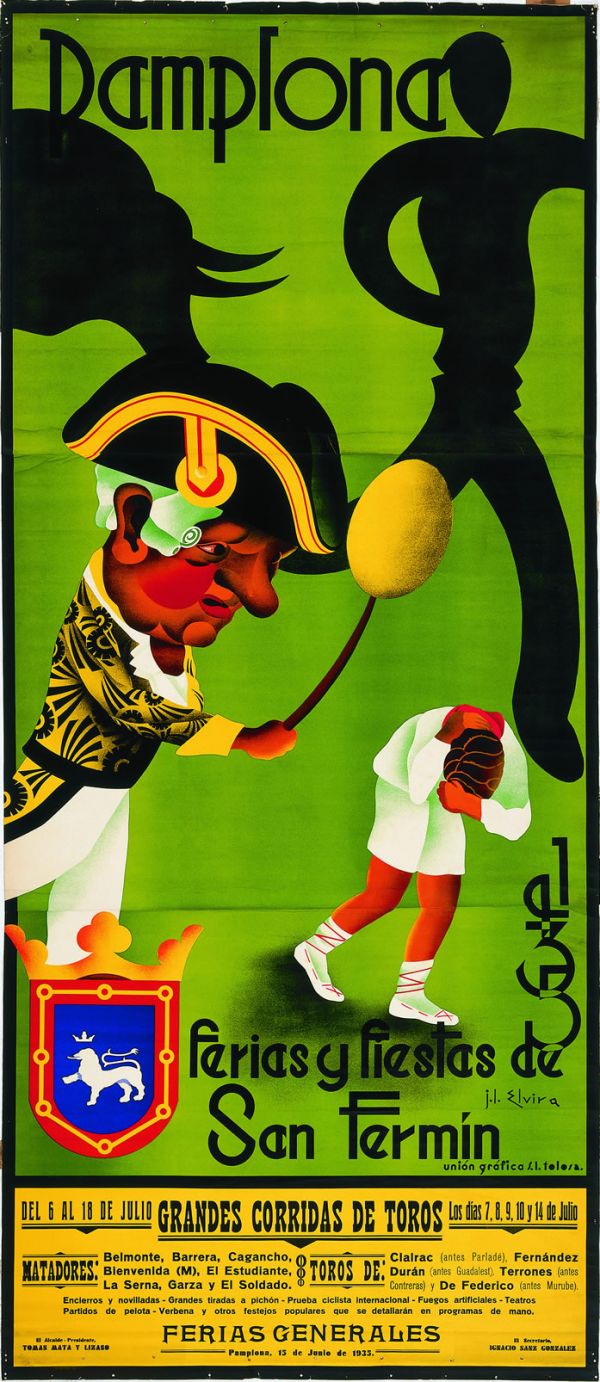
San Fermín 1935 poster (cartel)

San Fermín 1935 poster (cartel) by J. L. Elvira: a kiliki, a big-headed figure in a black bicorne hat, swings a bladder on a stick at a small boy in white who covers his head, with dark shadows of figures behind them on a green ground
Cartel de San Fermín 1935. Poster of the Ferias y Fiestas de San Fermín 1935, signed J. L. Elvira. Tap the poster to see it full size. See every San Fermín poster.13, 14
San Fermín 1935 poster (cartel) by J. L. Elvira: a kiliki, a big-headed figure in a black bicorne hat, swings a bladder on a stick at a small boy in white who covers his head, with dark shadows of figures behind them on a green ground
Artist
J. L. Elvira (signature)
Fiesta on the poster
Del 6 al 18 de julio
Dated
Pamplona, June 15, 1935
Printed by
Unión Gráfica, Tolosa

Ollaquindía calls the 1935 poster one more variation on an eternal San Fermín theme: in full light, a kiliki landing bladder blows on a boy who covers his head; behind, in the half-light of dawn, a mozo running on the horns of a bull.14 On the poster the kiliki wears a black bicorne hat with gold trim, and the shadows behind fall dark across a green ground.13

He tells a story, perhaps true, perhaps invented by Ignacio Baleztena, from that Republican year: a new Japanese big-head arrived that looked just like the bishop of Pamplona. The councillor who had ordered it tried to paint the likeness away and failed; the bishop saw it in the street, took it as a joke and blessed it.14

Pamplona in 1935

The list of the dead

Pamplona’s list

Gonzalo Bustinduy, gored on July 10, 1935, is on Pamplona’s list of encierro deaths.15

Words of 1935

Vueltas de campana

Bulls that somersaulted went “dando vueltas de campana”. Bulls running apart from the herd were “muy sueltos”.3, 5

Photographs

Where to see old photographs

The Diario de Navarra printed photographs of the first encierros of 1935 (Fotos Galle). The city’s photo archive, the Fototeca de Pamplona, holds historic photographs of the encierro, free to view online.4, 16

San Fermín 1935: questions and answers

Who died in the running of the bulls in 1935?

Gonzalo Bustinduy, a 29-year-old chemical engineer living in San Sebastián, died in the running of the bulls of San Fermín 1935. A bull of doña Carmen de Federico gored him at the corral gate on July 10, 1935, after the bull was cut off from the herd, and he is on Pamplona’s list of encierro deaths.6, 9, 15

Why did the paper fear for the encierro in 1935?

After Gonzalo Bustinduy was gored on July 10, 1935, the Diario de Navarra wrote that circumstances seemed to conspire towards the early disappearance of Pamplona’s typical and traditional encierros.6

How did visitors get to the running of the bulls in 1935?

Visitors reached the San Fermín 1935 encierros by bus and by train: a bus service arrived in time for the Sunday encierros, and a special train left San Sebastián at three in the morning for the last run, on July 14, 1935.2, 7

What happened in the encierro of July 8, 1935?

The bulls tumbled through Pamplona’s streets on July 8, 1935. One rolled head over heels in the little square of the Plaza Consistorial, and another crashed into the door of the Guerendiain house at the start of Estafeta and broke it.3

When were the bull runs of San Fermín 1935?

The running of the bulls of San Fermín 1935 took place on July 7, 8, 9 and 10 and on Sunday, July 14, 1935, set for seven in the morning.1, 3, 5, 6, 11, 12

Who made the San Fermín 1935 poster?

J. L. Elvira made the San Fermín 1935 poster, signed on the poster itself: a kiliki in a black bicorne hat lands bladder blows on a boy who covers his head, while behind, in the half-light of dawn, a runner runs on the horns of a bull.13, 14

Sources

Numbers on the page refer to this list. Diario de Navarra pages are cited from its archive (hemeroteca); quotations in Spanish are given as printed, in the spelling of the day.

Full source list
  1. Diario de Navarra, July 7, 1935, page 3: programme for July 7, “a las siete, se verificará el encierro”. Diario de Navarra archive
  2. Diario de Navarra, July 5, 1935, page 9: a bus notice, on July 7 and 14 a morning service arriving in time for the encierro. Diario de Navarra archive
  3. Diario de Navarra, July 9, 1935, page 3: the first two days, July 7 and 8: perfect order despite the crowds, “los de Clairac” on July 7; on the morning of July 8 the bulls went “dando vueltas de campana por las calles”, one rolling in the plazuela Consistorial, another breaking the door of the Guerendiain house at the start of Estafeta; photographs (Galle); programme for July 9, “A las siete en punto, encierro de los toros”. Diario de Navarra archive
  4. Diario de Navarra, July 9, 1935, page 4: General Fanjul, a native of Pamplona, at the Sunday encierro, which he had not seen for many years; “Tres detalles del primer encierro” (Fotos Galle). Diario de Navarra archive
  5. Diario de Navarra, July 10, 1935, page 3: “Los toros de Terrones entraron muy sueltos en la plaza”, July 9. Diario de Navarra archive
  6. Diario de Navarra, July 11, 1935, page 3: the encierro of July 10, the bulls of doña Carmen de Federico, a young man gored at the corral gate; editorial, circumstances “parecen confabularse para que se llegue pronto a la desaparición de nuestros típicos y tradicionales «encierros»”. Diario de Navarra archive
  7. Diario de Navarra, July 11, 1935, page 6: a special train from San Sebastián at 3 a.m. for the encierro of July 14. Diario de Navarra archive
  8. Diario de Navarra, July 12, 1935, page 2: the “joven donostiarra” taken to San Sebastián on the evening of July 11. Diario de Navarra archive
  9. Diario de Navarra, July 13, 1935, page 8: wire from San Sebastián: “falleció en la Clínica el ingeniero químico don Gonzalo Bustinduy”, gored in the Pamplona encierro. Diario de Navarra archive
  10. Diario de Navarra, July 14, 1935, page 4: “El entierro de Bustinduy”, a great show of mourning in San Sebastián. Diario de Navarra archive
  11. Diario de Navarra, July 14, 1935, page 1: programme for July 14, “A las siete en punto, encierro de los toros”. Diario de Navarra archive
  12. Diario de Navarra, July 16, 1935, page 5: the encierro of July 14, thin in people, “se verificó sin novedad”; a bull left behind after a great tumble. Diario de Navarra archive
  13. The poster of the Ferias y Fiestas de San Fermín 1935 itself, “del 6 al 18 de julio”, dated Pamplona, June 15, 1935; signed J. L. Elvira; printed by Unión Gráfica, Tolosa.
  14. Ricardo Ollaquindía, 100 años de carteles de las fiestas y ferias de San Fermín (1882 to 1981), Pamplona, 1981, chapter “1935”. Free copy in the Biblioteca Navarra Digital (BiNaDi). binadi.navarra.es
  15. Ayuntamiento de Pamplona, “Pamplona recordará a los 16 fallecidos en la historia del encierro con adoquines”, December 27, 2023. pamplona.es
  16. Fototeca de Pamplona, Archivo Municipal de Pamplona (photographs of the encierro, free to view online; publication needs the archive’s permission). archivo.pamplona.es
How to cite this page

Encierro. “Running of the Bulls 1935: San Fermín in Pamplona.” Encierro.com, November 9, 2026. https://encierro.com/san-fermin-1935/

Corrections and updates
  • : questions and answers rewritten around what people search, each answer with its sources; the poster labelled with its Spanish name, cartel.
  • : page published.

Walk the route with people who run it

Book your walk