San Fermín 2027: July 6 to 14. Tours filling fast. Book your spot  | 
ToursRunning with Bulls About Fiesta About UsShop Book Now
The Encierro archive · 1936

Running of the Bulls 1936: San Fermín in Pamplona

San Fermín 1936 had six bull runs (encierros), every day from Tuesday, July 7, to Sunday, July 12, one of them added at the last moment; the programmes set them at seven. On the last, the Alaiza mayoral Moncayola drew a bull left in the ring into the corral with his smock held a palm from its horns. Writing years later, Ollaquindía noted that as the programme went out, other programmes were being prepared that would begin on the fiesta’s last day.2, 4, 5, 7, 9, 10, 11, 15

By Encierro · Last reviewed

6runs, July 7 to 12
7:00start, a.m.
Under 2 minTassara, July 8

How the fiesta ran in 1936

The runs were every day from July 7 to 12: five programmed, and one “extraordinario y fuera de programa organizado a última hora”, extraordinary and out of programme, arranged at the last moment on July 10.2, 7 A bus company, La Aresoarra, ran special early services for the encierro, leaving Areso at half past four on July 7, 8 and 9, and on Sunday the 12th from Santesteban at four.1, 6

The herdsmen and steers of the Navarre ranch of Alaiza led the runs again; the paper printed verses to the Alaiza lead steer.4, 5 After the fiesta it was agreed to reward the herdsman Moncayola for his work in the ring during the encierros.12

Every known encierro of 1936, by day and ranch

The encierros of San Fermín 1936, from the Diario de Navarra programmes and reports.
DateRunRanch (ganadería)What the paper reported
July 71Marqués de AlbaidaFirst run at seven sharp
July 82Clemente TassaraUnder two minutes
July 93Antonio EscuderoTwo encierros: a young bull lost in Estafeta
July 104Antonio Pérez de San FernandoExtra run; a runner’s smock split in two
July 115Pérez T. SanchónAlmost among family
July 126, lastAntonio Pérez de San FernandoMoncayola and the bull left in the ring

The 1936 encierros, day by day

Run 1 of 6

· Marqués de Albaida

Start7:00 a.m.

With few outsiders but many locals and people from the neighbouring provinces filling the ring, “se verificó a las 7 en punto de la mañana el primer encierro”, the first encierro of the fiesta, at seven sharp, with the bulls of the Marqués de Albaida.2

Run 2 of 6

· Clemente Tassara

Start7:00 a.m.
TimeUnder 2 minutes

The programme set the encierro at seven.3 At seven sharp, without incident, the cattle of Clemente Tassara, formerly Parladé, “hizo el recorrido en menos de dos minutos”, ran the course in under two minutes, faster than any runner’s legs. The only ones ahead of the bulls were the Alaiza steers, which as the day before went in front knocking people over, with nothing worse than falls and frights. The bulls entered the ring bunched.4

Run 3 of 6

· Antonio Escudero

Encierros2
WeatherShowers

The young bulls were those of Antonio Escudero, formerly Argimiro Pérez Tabernero.13 In showery weather a big crowd came, and “en vez de uno se encontraron con dos encierros”: instead of one encierro they got two. A light chestnut young bull lagged in the Plaza Consistorial, went up Estafeta on its own and even turned back from the top, as if to say, the paper joked, this is too long and I am going back to my mother. The others went straight into the corral with the steers.5

Run 4 of 6, the extra

· Antonio Pérez de San Fernando

Bulls4 of 8 for Sunday

An encierro “extraordinario y fuera de programa organizado a última hora” was added at the last moment. Hardly anyone came from outside, and the ring at encierro time was the thinnest the paper had seen in many years. Four of the eight bulls for Sunday ran, half on each day, like mixing sherry and muscatel, the paper said; nothing happened in the ring and two small incidents on the course, one of them a runner run down in the Plaza Consistorial whose smock was split in two.7 The paper’s photograph of that moment called the bull an Albaida.8

Run 5 of 6

· Pérez T. Sanchón

Start7:00 a.m.

“A las 7 se verificará el encierro de los toros”, the programme said, with the bulls of Alipio Pérez T. Sanchón, of Salamanca.9 Storms on the Cantabrian coast kept many from Gipuzkoa and Bizkaia away, and “El encierro de los toros puede decirse que lo presenciamos en familia”: there were gaps in the stands and room to stand, and the runners went in ahead of the bulls without a crush; with so much room, more of them fell.10

Run 6 of 6, the last

· Antonio Pérez de San Fernando

Ring full by6:30 a.m.

By half past six the ring was full and the paid seats sold out, and from five minutes before the bulls were penned hundreds more came in through the encierro gate. The other four of the eight Salamanca bulls ran mixed in with packs of people, jumping over those who fell and butting their way through. One lagging bull stood in the ring; it could have swept away everyone around it, but Moncayola, the Alaiza mayoral, drew it into the corral, the bull following, fixed on, the smock he held a palm from its horns. Then came all the Alaiza padded-horn cows.11

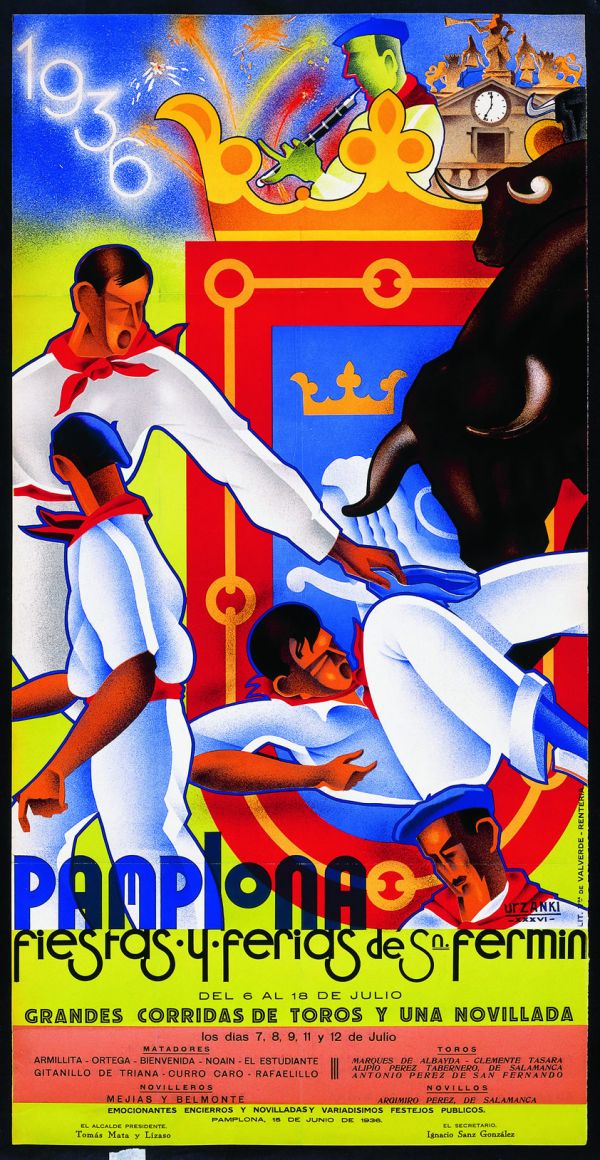
San Fermín 1936 poster (cartel)

San Fermín 1936 poster (cartel) by Urzanki: runners in white with red neckerchiefs, one falling backwards, flee a black bull in front of a crowned red shield, with the town hall clock, a piper and fireworks above
Cartel de San Fermín 1936. Poster of the Ferias y Fiestas de San Fermín 1936, signed Urzanki. Tap the poster to see it full size. See every San Fermín poster.14, 15
San Fermín 1936 poster (cartel) by Urzanki: runners in white with red neckerchiefs, one falling backwards, flee a black bull in front of a crowned red shield, with the town hall clock, a piper and fireworks above
Artist
Urzanki (signature)
Fiesta on the poster
Del 6 al 18 de julio
Dated
Pamplona, June 15, 1936
Printed by
Lit. Vda. de Valverde, Rentería

Ollaquindía describes the 1936 poster: a bull about to catch a fallen mozo while another young man tries to draw it off, and above, the town hall clock showing the hour, seven in the morning.15 The runners wear white with red neckerchiefs and berets, in front of a crowned red shield, with a piper and fireworks at the top. The poster also promises “Emocionantes encierros”.14

He adds, in brackets, that 1936 is hard to put aside, and that when this programme went out others were being prepared that would begin precisely on the last day of the fiesta, which ended, as in other years, on July 18.15

Pamplona in 1936

Words of 1936

Fuera de programa

An extra run was “fuera de programa”, out of programme. A run watched by few was “en familia”, among family.7, 10

Photographs

Where to see old photographs

The Diario de Navarra printed a photograph from the encierro of July 10, 1936, of a bull running down a runner at the entrance to the Plaza Consistorial, splitting his smock in two, with no harm done. The city’s photo archive, the Fototeca de Pamplona, holds historic photographs of the encierro, free to view online.8, 16

San Fermín 1936: questions and answers

When were the bull runs of San Fermín 1936?

San Fermín 1936 had a bull run every morning from Tuesday, July 7, to Sunday, July 12, 1936: six runs, set for seven, including an extra encierro arranged at the last moment on July 10.2, 4, 5, 7, 9, 10, 11

What was the extra encierro of July 10, 1936?

The extra encierro of July 10, 1936 was “extraordinario y fuera de programa organizado a última hora”, out of programme and arranged at the last moment: four of the eight bulls meant for Sunday ran that day, and the other four on Sunday, July 12.7, 11

What did Moncayola do in the running of the bulls of 1936?

Moncayola was the mayoral, or head herdsman, of the Navarre ranch of Alaiza, whose herdsmen and steers led the runs of 1936. On July 12, 1936 he drew a bull left in the ring into the corral with his smock held a palm from its horns, and it was agreed to reward him for his work in the ring during the encierros.4, 5, 11, 12

How fast was the running of the bulls in 1936?

The Clemente Tassara bulls ran the course in under two minutes on July 8, 1936, faster than any runner’s legs, with only the Alaiza steers ahead of them, the Diario de Navarra reported.4

Who made the San Fermín 1936 poster?

Urzanki made the San Fermín 1936 poster, signed on the poster itself: a bull about to catch a fallen runner while another young man tries to draw it off, below the town hall clock showing seven in the morning.14, 15

Sources

Numbers on the page refer to this list. Diario de Navarra pages are cited from its archive (hemeroteca); quotations in Spanish are given as printed, in the spelling of the day.

Full source list
  1. Diario de Navarra, July 5, 1936, page 10: a bus notice, “los días 7, 8 y 9 se hará servicio especial para el encierro”, leaving Areso at 4:30 a.m. Diario de Navarra archive
  2. Diario de Navarra, July 8, 1936, page 3: “se verificó a las 7 en punto de la mañana el primer encierro”, July 7, the bulls of the Marqués de Albaida. Diario de Navarra archive
  3. Diario de Navarra, July 8, 1936, page 5: programme for July 8, the encierro at seven, the bulls of Clemente Tassara. Diario de Navarra archive
  4. Diario de Navarra, July 9, 1936, page 3: the Tassara encierro of July 8, the herd “hizo el recorrido en menos de dos minutos”. Diario de Navarra archive
  5. Diario de Navarra, July 10, 1936, page 3: the encierro of July 9, “en vez de uno se encontraron con dos encierros”; verses to the Alaiza lead steer. Diario de Navarra archive
  6. Diario de Navarra, July 10, 1936, page 11: a bus for the encierro of Sunday, July 12, from Santesteban at four and Areso at five. Diario de Navarra archive
  7. Diario de Navarra, July 11, 1936, page 3: the encierro of July 10, “extraordinario y fuera de programa organizado a última hora”, four of the eight Pérez de San Fernando bulls for Sunday; a runner’s smock split in two in the plazuela Consistorial. Diario de Navarra archive
  8. Diario de Navarra, July 11, 1936, page 1: photograph, “Del encierro de ayer”: a bull “atropelló al desembocar en la plaza Consistorial a un carrerista”; the caption calls it an Albaida bull (Foto Galle). Diario de Navarra archive
  9. Diario de Navarra, July 11, 1936, page 5: programme for July 11, “A las 7 se verificará el encierro de los toros”, the bulls of Alipio Pérez T. Sanchón. Diario de Navarra archive
  10. Diario de Navarra, July 12, 1936, page 3: the encierro of July 11, “El encierro de los toros puede decirse que lo presenciamos en familia”. Diario de Navarra archive
  11. Diario de Navarra, July 14, 1936, page 3: the last encierro, Sunday, July 12, the ring full by 6:30; Moncayola and the bull left in the ring. Diario de Navarra archive
  12. Diario de Navarra, July 15, 1936, page 3: “Se acordó gratificar al pastor Moncayola” for his work in the ring during the encierros. Diario de Navarra archive
  13. Diario de Navarra, July 9, 1936, page 4: programme for July 9, the young bulls of don Antonio Escudero, formerly Argimiro Pérez Tabernero. Diario de Navarra archive
  14. The poster of the Ferias y Fiestas de San Fermín 1936 itself, “del 6 al 18 de julio”, dated Pamplona, June 15, 1936; signed Urzanki XXXVI; printed by Lit. Vda. de Valverde, Rentería.
  15. Ricardo Ollaquindía, 100 años de carteles de las fiestas y ferias de San Fermín (1882 to 1981), Pamplona, 1981, chapter “1936”. Free copy in the Biblioteca Navarra Digital (BiNaDi). binadi.navarra.es
  16. Fototeca de Pamplona, Archivo Municipal de Pamplona (photographs of the encierro, free to view online; publication needs the archive’s permission). archivo.pamplona.es
How to cite this page

Encierro. “Running of the Bulls 1936: San Fermín in Pamplona.” Encierro.com, November 9, 2026. https://encierro.com/san-fermin-1936/

Corrections and updates
  • : questions and answers rewritten around what people search, each answer with its sources; the poster labelled with its Spanish name, cartel.
  • : page published.

Walk the route with people who run it

Book your walk