Ask how dangerous the running of the bulls is and you will usually be handed one number: a death toll, an “injured every year” figure, or odds of being gored. Many of those numbers come with no source, some are years out of date, and none of them can tell you what will happen on a future morning in Pamplona. The honest version of the question is narrower and harder: how dangerous has the run been, according to the records that exist? That is the question this article and the report behind it answer, including the running of the bulls deaths and injuries recorded in the public record.
It matters because a number without its basis misleads in both directions. “71 injured” in 2026 and “35 taken to hospital” in 2019 sound like a trend; they are two different counts, made by different bodies in different ways. A rate that sounds like your personal odds is not your personal odds. Getting this wrong is how frightening myths and false reassurance both spread.
Encierro founder Dennis Clancey, who has run in Pamplona since 2007, directed a review of every public injury record we could find for the San Fermín encierros from 2013 to 2026. The result is Encierro Research Report No. 1: 52 pages, 295 footnotes and more than 70 published sources, with every figure traced to the body that counted it. This article gives the key findings. The full report is free to download.
These are counts of what happened in past years. They describe the event as a whole, not the chance of anything happening to any one person, and they do not predict a future run.
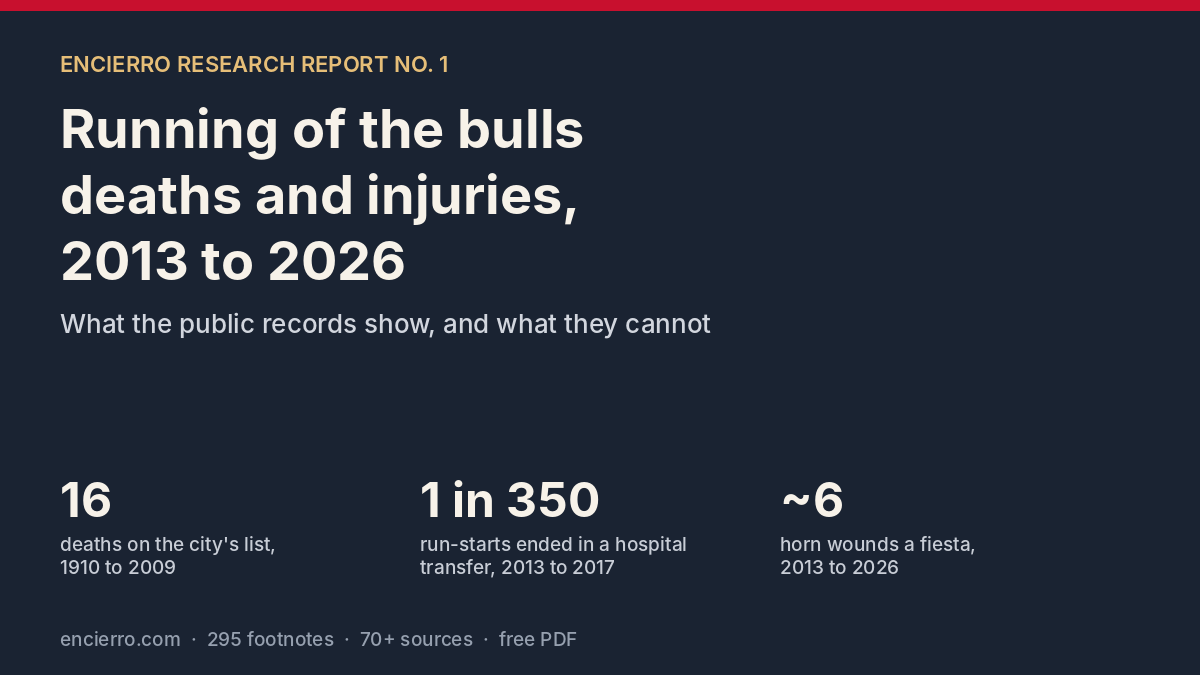
Key findings at a glance
- From 2013 to 2017, about 2.9 of every 1,000 run-starts (one person on the route for one morning’s run), or about 1 in 350, ended with the runner taken to the hospital complex. In 2018 and 2019, under a revised runner count, the figure was about 2.8 per 1,000, or about 1 in 360.
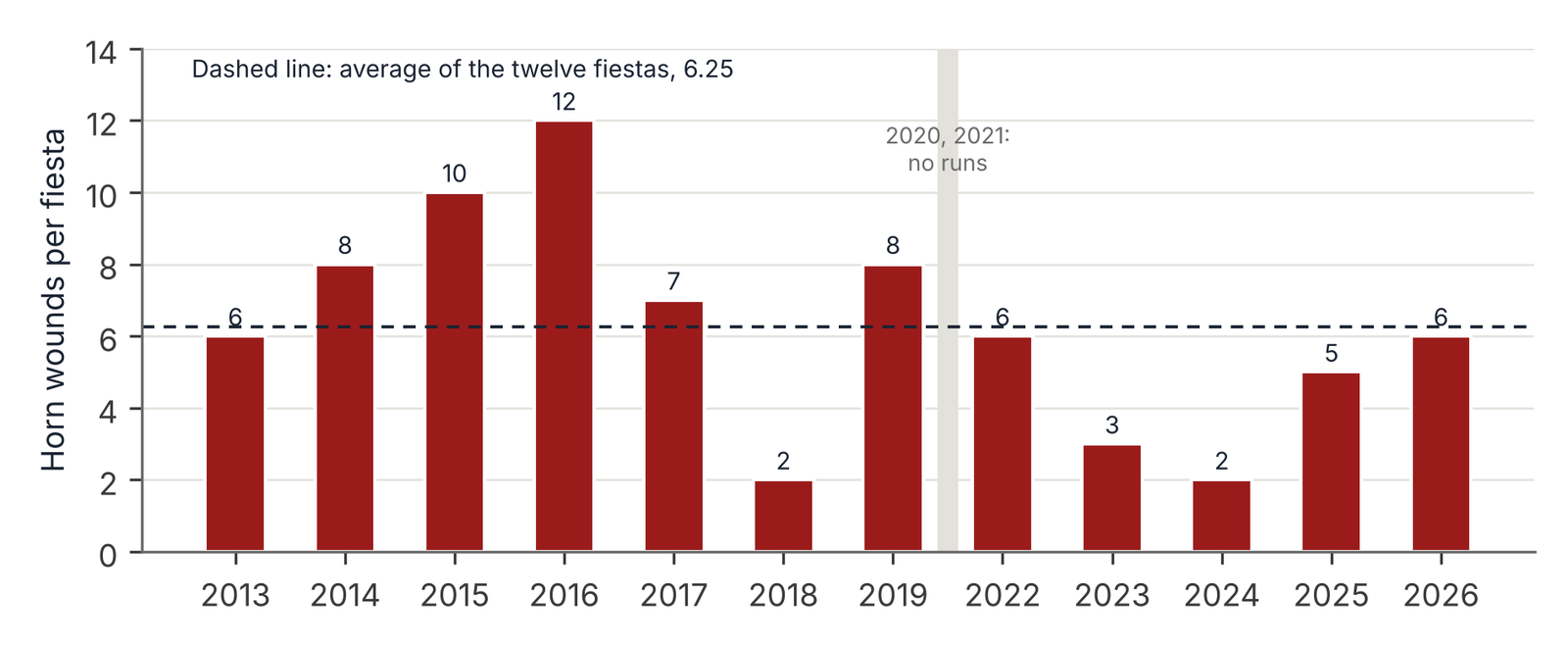
- Horn wounds averaged about six a fiesta from 2013 to 2026, with single years ranging from two to twelve: about 1 for every 2,000 run-starts from 2013 to 2017, and about 1 in 3,000 from 2018 to 2023.
- Running of the bulls deaths: the city of Pamplona’s list records 16 deaths in the encierro from 1910 to 2009. No death in the encierro was recorded in any source we read from 2010 to 2026.
- On the regional Health Department’s count, the number of injured people differed between years far more than chance explains, so no single year stands for a typical one.
- Between 43 and 65 percent of runners interviewed by the city each year from 2013 to 2019 were running for the first time. No public source we found shows whether first-timers are hurt more often.
- We did not find a city runner count for 2024 to 2026, so no injury rate can be given for those years.
Running of the bulls deaths: 16 on the city’s list, the last in 2009
Figures for running of the bulls deaths repeated online disagree, and some are years out of date. The most complete record is the one the city itself keeps. In December 2023 the Ayuntamiento de Pamplona published a list of the 16 people who died in the encierro, from a runner gored at the old bullring in 1910 to a 27-year-old caught at the Telefónica stretch in 2009, and placed an engraved paving stone where each was caught. Read in full, the list shows eleven deaths before 1980 and five from 1980 onwards. Six of those who died were from Pamplona and six from elsewhere in Navarra; two were from elsewhere in Spain, one from Mexico and one from the United States. They were aged from 17 to 63.
The three most recent deaths show how different the circumstances can be. On 13 July 1995 a 22-year-old from Illinois, reported to be running for the first time, fell in the Plaza Consistorial, got up, and was gored by a bull from the Torrestrella ranch. On 8 July 2003 a 63-year-old Pamplona man who had run the encierro since the age of 14 suffered head injuries in the run; he died on 24 September after about two and a half months in hospital. On 10 July 2009 a 27-year-old from Alcalá de Henares was gored in the neck and lung at the Telefónica stretch by a bull from the Jandilla ranch that had separated from the herd, and died in hospital the same morning. We found no source describing his experience as a runner.
Three cases are far too few to show whether experience, age or origin changes the risk of death, and the report draws no conclusion from them. Nor does a run of fifteen fiestas without a recorded death show that the risk is zero. One more trap: deaths at bull events in other Spanish towns are a separate matter, and they are not part of the Pamplona count.
Running of the bulls injuries, year by year
The word “injured” in Pamplona covers at least five different counts: everyone the Red Cross attended on the street, the people the DYA ambulance service attended, the people the Health Department’s hospital and emergency service saw, the runners taken to the hospital complex, and the running tallies in the morning papers. In 2026, for example, Cruz Roja recorded 359 attentions in the encierros, while the Health Department counted 71 injured. Neither number is wrong. They measure different things, and they cannot be added together or compared as if they were the same.
The table keeps each count separate. “Taken to hospital” is the number of runners news agencies tallied as needing care at the hospital complex; it is the most consistent series we found. “Health Department injured” counts people seen at the hospital or by the out-of-hospital emergency service.
| Year | Runners counted by the city (run-starts) | Taken to the hospital complex | Horn wounds | Health Department injured |
|---|---|---|---|---|
| 2013 | 17,813 | 50 | 6 | not found |
| 2014 | 17,126 | 42 | 8 | not found |
| 2015 | 16,629 | 37 | 10 | not found |
| 2016 | 16,448 | 67 | 12 | not found |
| 2017 | 17,126 | 51 | 7 | not found |
| 2018 | 14,110 (revised method) | 42 | 2 | not found |
| 2019 | 13,800 | 35 | 8 | 78 (provisional) |
| 2020, 2021 | No encierros (fiesta cancelled because of COVID-19) | |||
| 2022 | 13,100 | 52 | 6 | 92 (provisional) |
| 2023 | 16,730 | not on this basis | 3 | 44 (provisional) |
| 2024 | not found | not found | 2 | 56 |
| 2025 | not found | not found | 5 | 45 (hospital only) |
| 2026 | not found | not found | 6 | 71 |
Hospital admissions are a better marker of serious injury than attendance, though they also depend on clinical decisions and bed availability, and they are published only in some years: 12 runners admitted in 2017, 17 in 2019, 6 in 2022 and 7 in 2023, about 1 in 1,400 run-starts across those four years. In 2026 the Health Department reported 9 admitted from the encierros, two of them in intensive care.
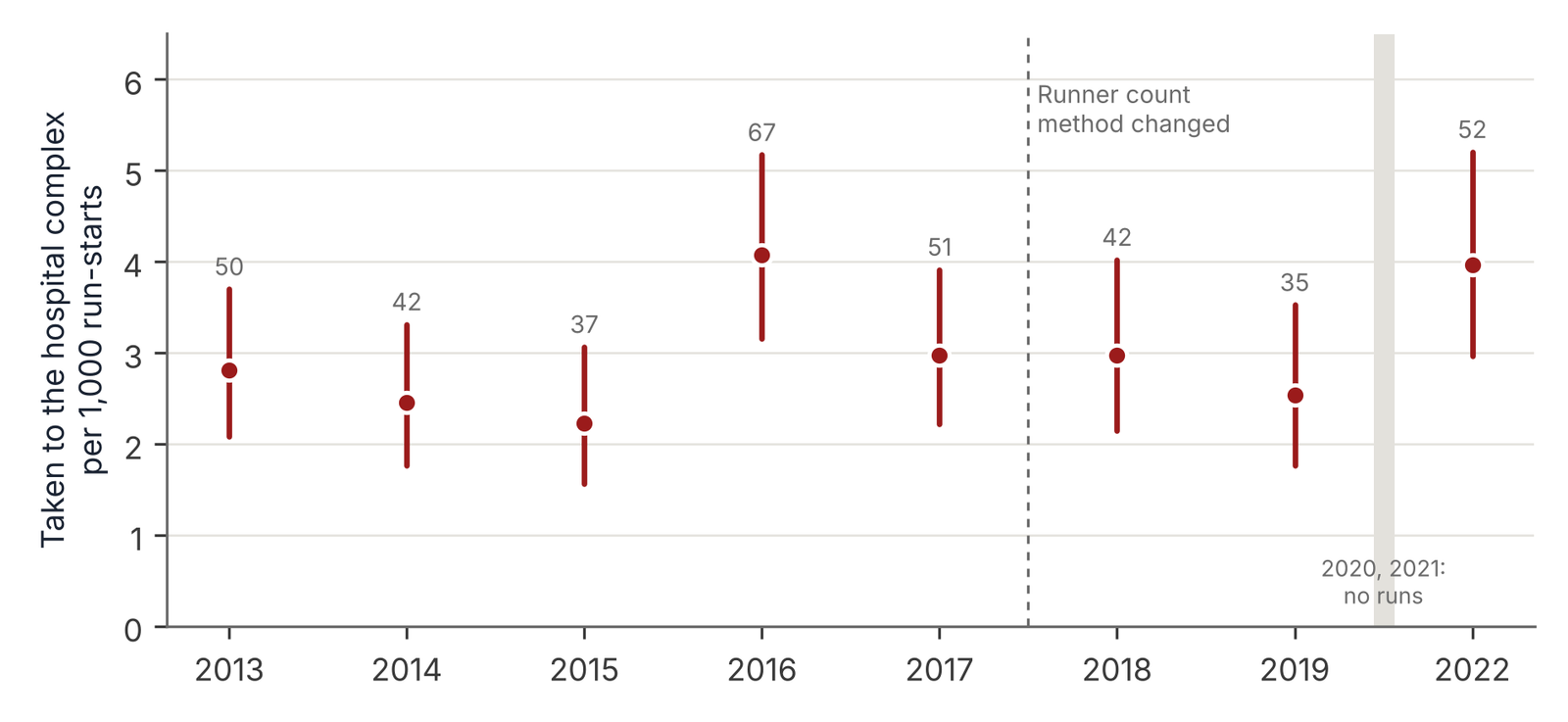
What “1 in 350” means, and what it does not
To compare years with different crowds, a count has to be divided by the number of people exposed. The only such number we found is the city’s count of people standing on the route minutes before each run, made from police camera images and added up over the eight mornings. One person on the route for one morning is one run-start. Someone who runs on four mornings is four run-starts.
So “about 1 in 350” means that, across 2013 to 2017, the hospital complex received roughly one runner for every 350 times someone stood on the route. It is a description of the event. It is not the chance that any particular person will be hurt, for three reasons: nobody knows how many different people ran; the people on the route differ enormously in where they run, how close they get to the bulls, how often they run, and how fit, rested and sober they are; and the records say nothing about any of that.
The city changed how it counted runners in 2018, drawing the counted zones more tightly. The report therefore gives figures for each side of that change separately rather than mixing them. On each side, the rate of runners taken to the hospital complex came out at about 2.9 and 2.8 per 1,000, though the tighter count makes the two hard to compare exactly.
That is why Encierro does not turn these figures into anyone’s odds.
“I never attempt to answer the question of danger without proper context. That’s a judgment an individual needs to make on their own, a calculus of the risk that they’re accepting. The best we can do is help to provide as much context as possible, and allow them to understand the elements involved that can contribute to that danger.”
Dennis Clancey, Founder of Encierro
“We never claim that we can make our clients safer. What we attempt to do is allow them to make more informed decisions during the encierro, and to hopefully take the correct, decisive action when needed.”
Dennis Clancey, Founder of Encierro
Horn wounds: about six a fiesta, and why one year says little about the next
Across the twelve fiestas from 2013 to 2026, the sources record 75 horn wounds, an average of about six a fiesta, from two in 2018 and 2024 to twelve in 2016. Sources disagree by one or two wounds in four of those years, and we found no published definition of a horn wound: a graze from a steer was counted in 2024, while a graze whose victim refused care was not counted in 2019.
With about six events a year, chance alone can produce anything from two to twelve in a single fiesta. The yearly figures are consistent with one unchanging rate, although counts this small can only detect large changes. A year with two horn wounds is not evidence that the run became less dangerous, and a year with twelve is not evidence that it became more so.
The broader injury counts tell the same story more strongly. On the Health Department’s basis, 2019, 2022 and 2023 differed almost threefold per run-start, far more than chance would produce. Crowds, bulls, weather, the number of weekend runs, provisional counting and the classification of cases all change from year to year, and none of them is recorded alongside the counts. The event itself has changed too: the runner count changed method in 2018, there were no runs in 2020 and 2021, we found no runner counts after 2023, and the rules on entering the route changed in 2026. A past year describes that year.
What the records cannot tell you
- Your own chance of being hurt. The records are counts for the event, not for people.
- What a future run will look like. Past counts are not a forecast.
- Whether beginners are hurt more often. No public source we found records whether an injured runner was running for the first time. Dennis Clancey answers the beginner’s question from his own experience in Is Running with the Bulls Safe for Beginners?
- Whether any safety measure worked. We found no evaluation of the anti-slip street treatment, the double fence or the 2014 rules for their effect on injuries.
- How many injuries never reached a clinic. Every count depends on someone being seen by a counted service.
- Whether the run is more or less dangerous than other activities. No comparison counts the same kind of harm in the same way.
Dennis Clancey’s own view of why such comparisons mislead:
“There’s a tendency sometimes to look at running of the bulls danger in the same way we look at the danger of running a marathon or jumping from an airplane. The challenge with that is that there’s a fundamentally different risk at the running of the bulls: despite one’s own cognizance, physical abilities and health, the bull can contribute to an outcome no runner fully controls. [In skydiving, outcomes] were often driven by equipment malfunctions or improper training.”
Dennis Clancey, Founder of Encierro
Absence of a figure in this report means we did not find it when the analysis was carried out, not that it does not exist. The regional government’s press room on navarra.es, which holds the Health Department’s own bulletins, could not be made to load at the time of reporting, on several devices; the site is presumed to have been down temporarily, and the figures will be checked against it in a later version.
How this analysis was done, and what makes it different
We found no comparable consolidated analysis of injury outcomes at the Pamplona encierro published elsewhere. Much of what is published about running of the bulls deaths and injuries gives a single total, often undated and unsourced. This report was built differently.
- Every figure is traced. Each one carries a footnote with the body that counted it, the publication, the web address, the date we read it, and how fully we read it. Where a news organisation relayed a public body’s figure we could not open ourselves, the note says so.
- Primary records first. The city’s list of deaths and its runner counts, the Health Department’s end-of-fiesta balances as reported, news-agency tallies of the daily medical bulletins, and two peer-reviewed studies: a 2021 video study of runners’ movement and falls and a 2008 expert-judgement risk study.
- The research literature was searched. PubMed, Europe PMC, Dialnet and SciELO were searched with dated queries. None returned an epidemiological series of encierro injuries.
- The uncertainty is measured, not hidden. Rates come with an exact range for chance, a second range that allows the runner count to be up to 15 percent wrong, and a test of whether the years really differ. The 2018 counting change is handled by reporting each period separately.
- Different counts are never mixed. Five kinds of “injured” are kept apart, and a count on one basis is never compared with a count on another.
- The gaps are set out as clearly as the findings. The report lists what is missing, who may hold it, and what would change the conclusions most.
Dennis Clancey on why Encierro did the work:
“A number of sites will often quote various numbers or give various rules of thumb without showing the math behind it. So we wanted to go and see what was publicly available, to arrive at more reliable numbers. We will update this as more data becomes available, but we wanted to set the standard, since we are the company focused on meticulous detail about the bull run itself.”
Dennis Clancey, Founder of Encierro
The report was directed and written by Dennis Clancey. Research on methods, the categorisation of sources and the general format were assisted by an AI system (Claude, developed by Anthropic), which also ran literature searches, retrieved sources and ran the calculations, all checked by the author; every source, figure and statement was reviewed by the author. It received no external funding and has not been externally reviewed; instead every source is given in full so that any reader can check any figure. Encierro exists to educate people about the encierro and offers walking tours of the route.
Read or download the full report
How dangerous is the running of the bulls in Pamplona? What the public records show and what they cannot (Encierro Research Report No. 1, version 1.0, 4 October 2026) covers running of the bulls deaths and injuries in depth: what was counted and by whom, how every number was made, the full year-by-year tables, what the records do and do not support, the gaps and who may close them, and how confident anyone can be in each figure.
How to cite: Clancey, D. (2026). How dangerous is the running of the bulls in Pamplona? What the public records show and what they cannot (Encierro Research Report No. 1, Version 1.0). Encierro. https://encierro.com/blog/the-encierro/running-of-the-bulls-injuries-and-deaths/
Corrections: if you find an error, write to aupa@encierro.com. Confirmed errors are corrected openly, with the date and the change shown. The next full update is planned after the 2027 fiesta.
Frequently Asked Questions
How many people have died running with the bulls in Pamplona?
On running of the bulls deaths, the city of Pamplona’s list records 16 people who died in the encierro from 1910 to 2009, the most recent on 10 July 2009 at the Telefónica stretch. Eleven of the deaths came before 1980 and five from 1980 onwards. No death in the encierro was recorded in any source we read from 2010 to 2026. Lower counts that circulate online are out of date or start at a different year.
How many people get injured at the running of the bulls each year?
It depends on what is counted. From 2013 to 2019, news agencies reported between 35 and 67 runners a fiesta taken to the hospital complex. The Health Department, which also counts people seen by its out-of-hospital emergency service, reported between 44 and 92 injured a year in the fiestas from 2019 to 2026 where it gave a full figure. The Red Cross attends several times as many people on the street, most for minor wounds; festival-wide medical figures are larger again. Horn wounds averaged about six a fiesta.
How dangerous is the running of the bulls?
The records can only say how dangerous it has been. From 2013 to 2017, about 1 in 350 run-starts ended with a runner taken to the hospital complex, and about 1 in 2,000 with a horn wound. Those are figures for the event as a whole in past years. They are not anyone’s personal chance of injury, and they do not predict a future run.
What are the odds of dying at the running of the bulls?
No reliable figure exists for any individual’s odds. The number of different people who run each year is unknown, we found no city runner counts after 2023, and deaths are too rare for a meaningful rate: the city’s list has five since 1980. Odds quoted online, such as “1 in 100,000”, come with no source or method, and we could not trace them to any record.
Every article on the Encierro blog is authored or reviewed by active bull runners with direct experience in Pamplona. This article summarises Encierro Research Report No. 1, directed and written by Dennis Clancey, founder of Encierro.